10 elements of basic kitchen knowledge

May 13th, 2008


Salt in oil. According to Pierre Gagnaire, this is Hervé This’ main discovery. It allows him to sprinkle salt on dishes without the salt dissolving in water from the dish. Thereby the “crunch” of the salt is retained.

Rob Mifsud, perhaps best know for his Hungry in Hogtown blog has interviewed Hervé This. At the end of the interview Hervé lists 10 elements of basic kitchen knowledge. Some may seem obvious, but they are not, according to Hervé. Here’s the list so you can judge by yourselves:

  1. Salt dissolves in water.
  2. Salt does not dissolve in oil.
  3. Oil does not dissolve in water.
  4. Water boils at 100 °C (212 °F).
  5. Generally foods contain mostly water (or another fluid).
  6. Foods without water or fluid are tough.
  7. Some proteins (in eggs, meat, fish) coagulate.
  8. Collagen dissolves in water at temperatures higher than 55 °C (131 °F).
  9. Dishes are dispersed systems (combinations of gas, liquid or solid ingredients transformed by cooking).
  10. Some chemical processes - such as the Maillard Reaction (browning or caramelizing) - generate new flavours.

Help needed with densities of hydrocolloids

April 30th, 2008


Photo by Mel B via flickr.com (CC).

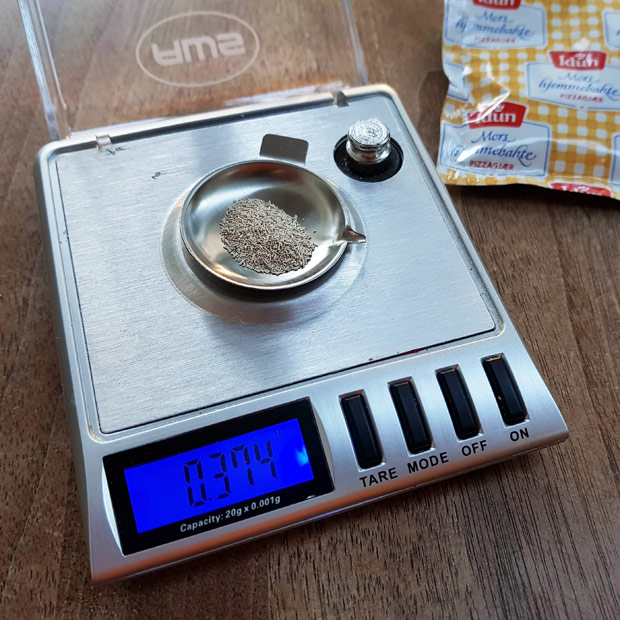
Measuring powders by volume has serious limitations (more on this later in an up-coming post), but one great advantage is that for small quantities going by volume can sometimes be more accurate than weighing them. At least when you work in a kitchen and don’t have access to professional lab scales. When a scale shows 0.1 g, the true weight could be anywere from 0.05-0.149 g due to rounding (that’s ± 50%!). Not to mention the fact that cheap balances aren’t always very accurate for such small amounts, even though they feature a 0.1 g resolution.

I’m currently working on a major revision of the collection of hydrocolloid recipes. One thing I would like to include is a table with densities of the hydrocolloids and chemicals used. When the densities are known, it’s possible to give some rough advice for what volume to use (this on-line conversion calculator has the densities of many common ingredients). This could ease small scale preparations. It will also make it easier to calculate the percentage of hydrocolloid used in recipes where the amount is given by volume. I’ve measured the hydrocolloids I have at hand, but I need your help to fill out the table and repeat the measurements I’ve done. With enough measurements I could also do some statistics and make a plot. I’m also interested to see if there is much variation between different brands.

How to determine the density:

  1. Find a suitable measuring spoon, cup, shot glass, container - whatever you have - with a volume of at least 10 mL (I used one of about 30 mL).
  2. Put the empty container on the balance and use the tara function.
  3. Fill completely with water and weigh again. The difference gives you the exact volume (for water 1 g = 1 mL).
  4. Dry the container, put it on the balance and use the tara function.
  5. Spoon the hydrocolloid into the container, tap the side gently once or twice with the spoon and level off.
  6. Weigh the container again and write down the mass of the hydrocolloid.
  7. To calculate the density of the hydrocolloid, divide the mass by the volume you obtained for your container. This gives you the density of the hydrocolloid with units g/mL.

Repeat steps 4-7 for each hydrocolloid you have at hand. I would very much appreciate if you email your results directly to me at webmaster (@) khymos (.) org. Please include the volume you measured (larger volume means more accurate measurement) and which brand you used. It will be interesting to see if the brands differ a lot.

I should add one coment about the products from texturePro: this picture indicates that all (?!!) the texturePro hydrocolloids are mixed with maltodextrin (please correct me if I’m wrong - it could be that this only applies to the cocktailPro kit). And I think the same is the case for several of the Sosa products. This increases the volume and eases the use of a measuring spoon (which comes with every texturePro kit), but unless the exact proportion of hydrocolloid to maltodextrin is known, following other recipes than the onces included with the kit is more or less impossible. Let me know if you have further details on the hydrocolloid/maltodextrin ratio in texturePro or Sosa products.

In advance: Thank you very much for your help!

Ice cubes and air bubbles

April 13th, 2008

Ice cubes are used both to cool drinks, but also to significantly impact the flavour of certain drinks. No matter your motivation, you should never use “old” ice cubes which have been sitting in your freezer for a while. Why? Melt some “old” ice cubes and taste the water. You’ll smell why! The reason is that volatile compounds in your freezer slowly find their way into the ice cubes which for some reason mostly are made in trays without a cover. But as I surfed around, researching this post I discovered that oxo and other producers now sell ice cube trays with lids. That’s a small step forward!

Another thing about ice cubes is that they look nice. I admit that air bubbles can sometimes be quite beautiful (and even artistic when pictured with a macro lens as above), but there are times when I whish I could make perfectly clear ice cubes. At room temperature a certain amount of air is dissolved in water. When you cool water, the solubility of air increases (!), but only until the water starts freezing. At this point the water can no longer keep the air dissolved and a bubble is formed. Vice versa - when you boil water the solubility of air decreases and the dissolved gases escape.

When making ice cubes, the bubbles that are formed can easily escape as long as there is no ice blocking their way. This is sort of a catch 22 situation since the air expulsion is directly related to the ice formation. When making ice cubes in a normal freezer, the ice cubes are cooled from the outside, causing the air to get trapped throughout the ice cube.

Many people have thought about smart ways to achieve this (as a quick patent search shows). There are two strategies to obtain clear ice cubes. Let the gas escape while the water freezes or degas and filter the water before freezing. Icicles are a good example that when running water freezes, it normally produces very clear ice. This is utilized in commercial ice cube makers. Here a “cold finger” is exposed to water that moves. This way bubbles are carried away before they can get trapped. These ice cubes typically are ring or cup shaped. The second method is suggested many places on the net. I’ve listed them here together with some thoughts and discussion.

Degassing
Degas the water (i.e. remove the dissolved air). This is easily done by boiling the water for a couple of minutes and letting it cool again. Some webpages suggest that the process should be repeated for best results.

Slow cooling
If the water is cooled too quickly, the ice will not be able to push the impurities ahead of the freezing interface. But if an ice cube freezes from all sides it doesn’t really help as the bubbles get trapped in the middle. A drawback with slow cooling is that the solubility of gas will increase when the water is cooled and so it will allow more gas to dissolve before the water freezes. So slow cooling should probably be combined with some kind of gas tight cover.

Directional cooling
I’ve been pondering about making trays with insulated sides and cover and a metal base, thereby utilizing the fact that metals are superb heat conductors compared to plastic, wood or glass. The metal would then serve to conduct away heat from the water. Bubbles would form on the ice front, but they would probably escape, rather than become encapsuled into the ice. I’ve tried to illustrate it here:

Turns out that someone has actually patented something similar where metal “fingers” are used to conduct away heat from the center, giving ring shaped ice cubes. Does anyone know if these were ever made for sale? Perhaps an ice cube tray in aluminum would work if one insulates the top so that the cubes freeze from the bottom and up, keeping the water on top free flowing so bubbles can escape.

Layer-by-layer method
There might be a simple (but time consuming) way of achieving directional cooling: By building up the ice cubes layer by layer. Once the first layer is frozen this will help freeze the next layer from the bottom up and so on. I guess layers of 1-5 mm would work, but this needs more testing. My experiments so far have not been very promising. Plenty of bubbles, even with a layer of only 2 mm.

Filtering
Particles can act as nucleation sites for air bubbles. To avoid this filter the water and make sure that all the equipment is clean. Also, don’t use a towel to try your equipment as this will probably leave small fibers behind.

Remove salts
Both tap water and bottled water contain trace amounts of salts. When water freezes these minerals are not incorporated into the ice structure. As a consequence the soluble salts will concentrate in the water that’s not yet frozen. In the end there is so little water left that the concentration of the salts becomes sufficiently high so that the freezing point of this remaining water is lower than the temperature in the freezer (meaning that this water won’t freeze). Other salts, especially calcium salts such as calcium carbonate will precipitate. And these particles can act as nucleation sites. If after boiling water there are particles present, these should be filtered away before freezing. The easiest way to get rid of salts is to use distilled water.

I’ve done a couple of experiments and it seems there is no quick fix. The water in the ice cubes pictured above was boiled for several minutes before freezing, but plenty of bubbles formed as you can see. I also tried the layer-by-layer method, but even in a thin layer of only 2-3 mm I could detect many bubbles. So clearly I need to do more experiments.

What are your experiences with making clear ice cubes?

The Big Fat Duck Cookbook

April 10th, 2008

I recently blogged about the Alinea cookbook, and then in a Q&A with both Grant Achatz and Heston Blumenthal I discovered that there is another great cook book coming up this fall: The Big Fat Duck Cookbook! It’s quite amazing that these two books will be released within weeks of each other this fall.

This is what the publisher promises us:

In the first section of The Big Fat Duck Cookbook, we learn the history of the restaurant, from its humble beginnings to its third Michelin star (the day Heston received the news of this he had been wondering how exactly he would be able to pay his staff that month). Next we meet 50 of his signature recipes – sardine on toast sorbet, salmon poached with liquorice, hot and iced tea, chocolate wine – which, while challenging for anyone not equipped with ice baths, dehydrators, vacuum pumps and nitrogen on tap, will inspire home cooks and chefs alike. Finally, we hear from the experts whose scientific know-how has contributed to Heston’s topsy-turvy world, on subjects as diverse as synaesthesia, creaminess and flavour expectation.

With an introduction by Harold McGee, incredible colour photographs throughout, illustrations by Dave McKean, multiple ribbons, real cloth binding and a gorgeous slip case, The Big Fat Duck Cookbook is not only the nearest thing to an autobiography from the world’s most fascinating chef, but also a stunning, colourful and joyous work of art.

Compared to the Alinea cookbook this one is one is more expensive and has fewer recipes. But hey - who buys cookbooks based on the price/recipe anyway?
;)

Osmosis in the kitchen

April 9th, 2008

Lettuce should be fresh and crisp but upon storage water will eventually evaporate. The pressure inside the cells drops and the leaves shrink and become less appetizing. The simple yet effective remedy is to immerse the lettuce leaves in plain, cold tap water. The water will then diffuse back into the cells again. The process is known as osmosis [wikipedia].

For the following experiment I purposly left some lettuce (Lactuca sativa var. crispa, sold in Norway under the name “Rapid”, it’s a Summer Crisp/Batavian cultivar) to really dry out as you can see from the picture.

After approximately 4 hours in water the leaf looks like this. Notice that along the rim the leaf was so dry that the cells were damaged “beyond repair”.

To illustrate this relatively slow process I set my camera to take a picture every minute and left it for almost 4 hours. I then stiched it together and the resulting time lapse movie shows the process speeded up 720x (click if the embedded video won’t work).

The wonderful thing about this simple experiment is that it actually illustrates the essence of a recently rewarded Nobel prize (and I should thank Erik Fooladi for pointing this out to me)! The 2003 chemistry prize was awarded “for discoveries concerning channels in cell membranes”. The swedish Nobel foundation have excellent pages with further explanations for the public and for specialists alongside an illustrated presentation (recommended!). There are even two animations of which the first is also available on youtube (embedded below, poor resolution, download the original for higher resolution!). It shows how water molecules move through cell membranes:

The science of BBQ

April 4th, 2008

bbq-hot-air.jpg
Photo by spielzimmer via flickr.com (CC).

Eric Devlin over at Home of BBQ interviewed me via email about BBQ and molecular gastronomy. The topic should be of interest to the readers of Khymos as well, so I post the questions and answers in extenso here for your benefit.

Q. Martin, thank you for taking the time to discuss the science of BBQ. Before we get into ‘low and slow’ cooking, can you tell us a bit about your background and your interest in food?
mail
I have a PhD in chemistry and currently I’m working as a research scientist. When I first became interested in the connection between food and chemistry in the late 90’s, I searched the Internet without finding much information. I did however find some very interesting books in the faculty library, including Harold McGee’s “On Food and Cooking - The Science and Lore of the Kitchen”. Having found books about the subject, I soon started to give popular science presentations. In 2004 I was invited to attend the “International Workshop on Molecular Gastronomy” in Erice, Sicily. This was a great experience and I enjoyed meeting many of the scientists, writers and chefs involved with molecular gastronomy. The website I’ve put up, Khymos, is in many ways what I would have liked to find at the time I became interested in the subject.

Q. Over the past few years we have been hearing quite a bit about how food cooked over a hot flame can have increased carcinogens. Would food that is cooked for a longer period of time over a lower heat be safer?

The carcinogens are formed when meat gets burnt, so although you’d like to use high heat to get the Maillard reaction going (which gives you both flavor and color) you don’t want to overdo it. But even if the meat gets a little burnt, it is a good thing that for the carcinogens, as for all other substances, the poison is in the dose. So if you eat grilled meat every day you should be concerned about this, but for most people I think overeating poses a much greater risk!

Q. Serious BBQ cooks like to produce a ‘bark’ when preparing pork for their pulled pork dishes. Usually the natural ‘bark’ of the meat is enhanced by the sugar found in the dry rubs that are applied. Is there any other method that could be used to achieve or increase those results? Maybe an egg wash prior to cooking?

There are several processes which contribute to the flavor formation. First you have the sugars which caramelize. As you correctly state, this is enhanced by adding sugar to the rubs. Furthermore you have the Maillard reaction were sugars react with amino acids to form a host of compounds which contribute both flavor and color. Even though the Maillard reaction can take place at low temperature (such as in vintage champagne), things really speed up when temperature rises above 110-120 °C. Obviously to reach this temperature you’ll have to get rid of the water first. So using a dry rub makes sense. Apart from that it’s mostly about being patient. Use fresh spices, and where possible whole spices that you ground prior to use. The heat of the grill will toast the spices, thereby intensifying the flavor even more.

I must admit that I have never made nor tasted meat which was prepared with a “bark”, so I don’t dare to go into further details concerning how to improve it. The best thing would be to cook two pieces of meat in parallel, for instance with and without an egg wash to see which one comes out best.

Q. BBQ sauces vary greatly depending on region. Carolina sauces are often thin, while Kansas City and Texas sauces have greater viscosity. If a cook is making a sauce that comes out too thin, what recommendations would you have to thicken it?

You either have to take out some of the water by letting it boil over low heat in a large, wide pot, or you can add a thickening agent such as corn starch. If you use onions, these will help thicken your sauce if you let it boil for a while.

Q. In competitions, some BBQ pit-masters utilize a flavor enhancer called FAB B, which contains msg. The thought behind this additive is that after a judge has consumed numerous samples of the same category of meat, the additive will stimulate the taste buds and help to separate that entry from the rest. Can you recommend any other method of ‘waking the taste buds’ without detracting from the taste?

The problem with this explanation is that if everyone uses FAB, will there be any effect at all? If the idea is to rinse the mouth you would want something acidic which stimulates saliva production, some tannic compounds to bind proteins and perhaps some alcohol to help solubilize fats. Heston Blumentahl at the Fat Duck made a “Green tea sour mousse” from these guidelines.

But even so adaption and habituation occurs in all tasting. I’ve discussed this extensively in a blog post, and the easy answer is variation. Or more scientifically: increased sensing by contrast amplification. Eat something which is as far from meat as you can come, something which is cold, crisp, fresh and acidic (did someone mention a tasty salad?). This will make the next piece of meat taste much better!

Q. FAB contains the following: Hydrolyzed soy protein, vegetable oil (soybean and or corn, cottonseed), sodium phosphates, mono sodium glutamate, autolyzed yeast extract, disodium inosinate and guanylate, xanthan gum. They claim that it enhances natural meat flavors, makes your BBQ juicier, improves texture for better slicing and taste and increases yields. Would you believe that these claims are accurate? Would you recommend other methods to achieve the same results?

I would like to emphasize that MSG’s bad reputation is somewhat undeserved. MSG is the salt of a naturally occurring amino acids and is found in many foods. Parmesan and tomatoes contain lots of it (ever wondered why the Italians sprinkle so much parmesan on their food?). Protein and yeast are excellent sources for MSG and the related compounds listed, so I absolutely believe the claim that FAB will enhance the meaty flavors. When FAB is used in a marinade, the phosphates enhance juiciness and improve texture (more on this later). This is well documented. But even so, every chef should remember that FAB or other products can only make good meat better. Therefore you should pay close attention to the quality of the meat you use.

Q. What is a smoke ring and how is it created? What is the best method of producing a significant smoke ring?

When wood or coal burns, small amounts of nitrogen dioxide is formed which dissolves in the surface of the meat, thereby creating nitrous acid. The acid diffuses further into the meat, and when converted to nitric oxide it reacts with myoglobin to form a stable pink colored molecule.

Q. Is there a point of delineating returns, where a piece of meat will no longer absorb the flavor of the wood that it is cooked with? Are you wasting your time by adding more wood for flavor after a certain point?

Frankly, I don’t know. I think this question should be answered by a chef!

Q. How effective is brining and marinating such as pork shoulder or brisket? How much penetration can you reasonably expect? As competitors often work with a short time frame, is there a way to speed up the results of a marinade? And if alcohol burns off, what’s the advantage of using wine instead of juice? Does the alcohol “do” something before it burns off?

Marinades penetrate meat very slowly, so it should primarily be regarded as a way of adding taste to the surface of the meat (which it does very well). An exception here is chicken and fish which are more easily penetrated by marinades. To speed up marination, use water based, concentrated marinades and leave the meat at room temperature. Piercing the meat with a jaccard will allow the marinade to work from the “inside” as well.

It is perfectly fine to use wine in a marinade. The alcohol will dissolve some fat which can speed up penetration. Wine also contains organic acids which can have a tenderizing effect. Phenolic compounds (tannins) will react with meat proteins to form insoluble complexes which in turn makes meat more juicy and tender (even though the exact reason for this is not understood). Experiments have shown that red wine works better than white in marinades.

An interesting thing with marinades is that to maximize the water retaining capacity of beef, your marinade should not contain both acids and salt as this will in fact lower the water holding capacity! If you go for acids, you can easily add salt later on.

Brining, which is immersing meat in water with about 5% salt, does make sense as the salt helps untangle protein strands. This allows spices to penetrate the meat more easily, and it renders meat juicier. Furthermore it lowers the temperature at which the proteins become “cooked”.

Q. Would searing a piece of meat help to ‘seal’ the juices and allow for a more moist cut?

No. As Harold McGee pointed out, “searing is not sealing”. The only reason to sear meat is to get the Maillard reaction going.

Q. What recommendations would you give to someone that is cooking over wood in a smoker if they wanted to achieve a crisp skin on chicken?

In a smoker the low heat will only be enough to evaporate the water, but only very slowly turn the tough collagen into tender gelatin. To achieve this you’ll need a higher temperature, preferably temperatures around 80-90 °C. But even in a smoker there are a couple of things you can do to improve the crispiness. Use a chicken which has been dry-processed. Alternatively, let the chicken dry uncovered in the fridge for a day. Oiling the skin will improve the heat transfer. You can also pierce the skin to let the juices evaporate.

Q. Barbecuing is often seen as the art of taking a piece of meat that is tough and/or stringy and producing a tender, mouthwatering meal from it. What is it that occurs that renders a tough cut like brisket into a soft, enjoyable meat? Is there anything that can be done to enhance those efforts?

The muscle fibers themselves are tender, but they are held together by connective tissue of which collagen is most abundant. Collagen is tough, but when heated it slowly dissolves and forms gelatin which is very tender. Collagen in young animals dissolves more easily than that of older animals. Collagen starts do dissolve around 70 °C and at 90 °C it dissolves rapidly. But before the temperature get this high enzymes which are present in the meat will help tenderize it. These enzymes lose their activity between 40 and 50 °C, but when you barbecue at low heat the meat will spend quite some time below 40-50 °C.

Q. Why do some meats, after reaching optimal tenderness, seem to get even more tender the longer you cook, while others tend to get tougher if you cook past ideal time?

Preparing meat is more about temperature than time. If you like your beef medium rare you would aim for the center to be 55 °C. Continued heating will cause more proteins to denature and as the contract, water is expelled leaving the dry and rubbery. Unless you have prepared your meat at a temperature very close to the desired temperature of the center, there will be a temperature gradient. So even if you remove the meat from your heating source when the center reaches the desired temperature, the warmer outside of the meat will continue to cook the center as it rests, bringing it outside your desired temperature range. It takes experience to know exactly when to remove the meat from the heat.

Q. What’s happening to the meat during “resting”? Why is this recommended prior to cutting and serving?

Apart from the leveling out of the temperature gradient discussed in the previous question it is a very good idea let meat rest before serving, as this improves the water holding capacity of the meat. This in turn reduces the amount of juice you loose when you carve or slice the meat.

Kitchen chemistry is changing the world

April 1st, 2008

time-march-08.jpg

A recent cover feature of Time magazine was “10 Ideas That Are Changing The World”. According to journalist Joel Stein ” ideas are the secret power that this planet runs on”, and guess what? Idea #5 is Kitchen Chemistry. Some are fed up with foams (why does everyone think molecular gastronomy is only about foams anyway?), but my guess is that scientific approaches in the kitchen will become more and more common in the years to come and I certainly welcome this focus on kitchen chemistry.

This paradigm shift won’t be such a big deal in practice. Your oven is pretty much an advanced science gadget already, you use meat thermometers, and that measuring cup looks an awful lot like a beaker. You’re just going to have to step it up a little: replace that liquid-measuring cup with a more accurate dry-weight scale; get a vacuum sealer like that FoodSaver gadget and a Crock-Pot that stays at a precise temperature so you can sous vide meat (which involves cooking it in a bag for a long time in a low-temperature water bath); learn how to use simple chemicals like agar-agar and xanthan gum (just better versions of gelatin and cornstarch, really); review a little high school chemistry. No big deal.

Alinea cookbook

March 29th, 2008

alinea.jpg

For more than a decade Ferran Adriá has allowed us to take part in the creative process through the magnificent El Bulli books. And now - finally - we will have the opportunity to look behind the curtains in another top restaurant where molecular gastronomy is practiced. The book Alinea, named after the Chicago restaurant headed by chef Grant Achatz, is due to appear in October this year. According to the publisher, this is what to expect:

A pioneer in American cuisine, chef Grant Achatz represents the best of the molecular gastronomy movement - brilliant fundamentals and exquisite taste paired with a groundbreaking approach to new techniques and equipment. ALINEA showcases Achatz’s cuisine with more than 100 dishes (totaling 600 recipes) and 600 photographs presented in a deluxe volume. Three feature pieces frame the book: Michael Ruhlman considers Alinea’s role in the global dining scene, Jeffrey Steingarten offers his distinctive take on dining at the restaurant, and Mark McClusky explores the role of technology in the Alinea kitchen. Buyers of the book will receive access to a website featuring video demonstrations, interviews, and an online forum that allows readers to interact with Achatz and his team.

More links:
Alinea book homepage

Khymos marketplace

March 29th, 2008

khymos-marketplace.png

I just wanted to let you know that the Khymos marketplace is operative. You can now shop books, hydrocolloids, thermometers, scales, whippers, syringes, tubes, squeeze bottles, knives and more directly from this site. I’ve selected products that should be of particular interest for amateur cooks and professional chefs that are intersted in molecular gastronomy, molecular cooking and popular food science. The marketplace is powered by Amazon.com.

TGRWT #10: Pizza with blue cheese and pineapple

March 25th, 2008

pizza-stone-art.jpg
This piece of art was recently sold at an auction for $ 35 million USD! No … just kidding. Read on to find out more!

For the 10th round of TGRWT I decided to modify one of my favorite pizza recipes. As it already has some blue cheese I decided that I would just add som pineapple to the sauce and see how that would work out. Knowing that pineapple works quite well on pizza (at least I have childhood memories from a pizza place called “Aloha” where they served a “Hawaiian delight” pizza with pineapple, ham and cheese) I was quite optimistic about this combination.

pizza-close-up.jpg

Normally I don’t use a recipe for the dough. I only remember to use 1 dL water per person. Everything else is added ad lib. But to give you a proper recipe I measured all the ingredients. Using 4 dL water gives approximately 1 kg dough in total. This gives 3 pizzas with a diameter of about 26 cm, serving 3-4 people. If you like you can roll the dough out thinner and make 4 pizzas and stretch the sauce and toppings correspondingly.

pizza-rising-dough.jpg

Pizza dough
4 dL water
5 g salt
5 g fresh yeast
580 g flour (plain white)
20 g olive oil

Add salt and yeast to luke warm water (~37 °C) and stir to dissolve yeast. Add flour in portions, reserving about 40 g. Mix/knead well for a couple of minutes. The dough is quite sticky. Add the olive oil. Mix/knead more. Add the remaining flour and fold the dough a couple of times. Cover and let rise for 1-2 hours.

Addition of 2% oil helps to give a lighter texture. But mix/knead the dough first so you form the gluten network before you add the oil. Otherwise the oil will cover the glutenin and gliadin proteins and inhibit the formation of gluten, rendering the dough less elastic.

pizza-sauce-bluecheese.jpg

Pizza sauce
45 g sardines (I used King Oscar “Mediterranean style”)
3 t capers
2 T tomatoe paste
1 clove garlic
4 pineapple rings

Mix everything in a small food processor. (You can also add some olives if you like.)

Blue cheese sauce
75 g blue cheese
75 g crème fraîche

Crumble the blue cheese, add the crème fraîche and mix until smooth.

Toppings
1-2 onions, in rings
50 g pepperoni
100 g cheddar, grated

Assemble the pizza as follows. Roll out approximately 330 g dough and place it on a suitable pizza peel (if you forget this you won’t be able to transfer the pizza to the baking stone). Add pizza sauce, blue cheese sauce, onion rings, pepperoni and cheddar cheese. Transfer to a preheated pizza stone and bake at 250-300 °C until nicely browned. Depending on temperature this typically takes around 5-10 min.

pizza-animated.gif

The key to a good pizza is turning up the heat! I usually set my oven around 250 °C, but you can go even higher if you like. Secondly you want to use a pizza stone (also known as a baking stone) to get that nice oven spring and a crisp crust. The picture at the top of this blog post is just a close up of my pizza stone! The black speckles are the carbonized remains of cheese and pizza sauce. I’ve blogged about the science of pizza stones previously:

A baking stone is made from a porous ceramic material. It’s heat capacity is good (much higher than that of a metal plate/sheet) and as a result, when the cold dough is placed on the baking stone, it still has enough heat to make the pizza rise immediately. Secondly, the fact that the baking stone is porous lets it absorb moisture from the pizza. This is what gives the nice crisp crust as it transports moisture away from the pizza.

pizza-stone.jpg

Verdict:
The original version of this pizza (without pineapple) is one of my absolute favorites and tinkering a little with the recipe doesn’t change this. But even so I felt that the pineapple diluted the pizza sauce and that the sweetness took away too much of the saltiness of the pizza sauce. Unfortunately, when making the pizza sauce, I discovered that my tube of tomato paste was empty so I used ketchup in stead. In retrospect I see that this wasn’t a good choice as ketchup is quite sweet. Therefore it’s not fair to say that all the extra sweetness came from the pineapple, but it nevertheless contributed with a lot of sweetness.

The overall flavor was very nice though, and my wife thought this pizza was better. Personally however I prefer the “original”. But perhaps next time I’ll try to add pineapple chunks in stead of churning it together with the sauce so as to concentrate the pineapple flavour more and allow it to come in small “flavor packs” now and then. I think that might work better.

pizza-wine-closeup.jpg
Serve with red wine and a fresh salad!

TGRWT #10: Pineapple and blue cheese

March 14th, 2008

tgrwt-10.png

Back from a trip abroad I can finally relay the announcement of the 10th round of “They go really well together”. The round is hosted by David Barzelay at Eat Foo(d) and the challenge this time is to combine pineapple and blue cheese.

In the list Heston Blumenthal posted on eGullet a long time ago it was pointed out that for this combination a certain level of ketones (molecules with a special carbon oxygen bond) for the combination to work. Since there was no further information I did some further research - and voilà - lists of odorants for pineapple and gorgonzola cheese have been published! But surprisingly there was no overlap between the compounds for which odor activity values (OAV) had been calculated. A possible reason is that only 12 and 15 compounds for pineapple and gorgonzola respectively where quantified so that OAV’s could be calculated (notice that it is the quantification which is really time consuming when doing this kind of research). Another point is that different experimental techniques where used in quantifying the volatiles. But regarding the ketones the gorgonzola article at least shows that “natural” (dry, crumbly) gorgonzola has higher levels of ketones than “creamy” gorgonzola.

To conclude, there is a possibility that the overlap in impact odorants for pineapple and blue cheese has not been uncovered yet, or that this combination can not be explained by overlapping impact odorants (and I should quickly add that this is of course the case for most flavor pairings we encounter in the kitchen!).

Mai Tai flavored cocktail vauquelin

March 4th, 2008

Recently I received an email from Thorsten Spickenreuther, a German PhD student, who inspired by my post on vauquelins asked me whether I had made any cocktail flavored vauquelins yet. I gave him the details of what I had tried and encouraged him to experiment a little. Here’s a report which he sent me (and allowed me to share with you):

Cocktail Vauqueline – First Experiment

I started off with just one egg white and slowly added up to 100ml of almond syrup (i.e. water & sugar) and about 50ml of lime juice (i.e. acid) because the end result should be a Mai Tai flavoured Vauqueline. As it was already 2 am, my motivation for using a whisk was rather low, so my electric mixer had to do the job. Moreover, i didn’t have a metal bowl at hand, so the increase in volume was not as big as may have been expected – the result was about 1.5 liters of firm, stiff egg white foam.

pic1.jpg pic2.jpg

As my silicon moulds survive my microwave without problems, i thought ,,Why not using them here to get a nice pyramid shape for the planned Mai Tai flavoured dessert?” No sooner said than done, and after 8 seconds at 440W, the result looked quite nice. The volume increased a little and the foam maintained its shape very well. The pyramids came out of the moulds easily and even could be cut by pressing a spatula to the blade of a knife, cut and then separate (a two blade knife? …slightly reminds me of a Dire Straits song…). Using smaller moulds (hemispheres) was no problem, too.

pic3.jpg pic4.jpg

Okay, now we have a nice foam with an abundantly sweet’n’sour and almondy taste. But this is not Mai Tai yet and Trader Vic would turn in his grave. So we need at least some rum and a dash of orange curac¸ao. Adding the liquor (40-50ml), the foam broke down a little, but regained its firmness after a while of whisking and the final result was like before. I even did a quick-and-dirty dessert-decoration by adding caramelized kiwi slices and a bit of thickened passion fruit sauce.

pic8.jpg pic7.jpg

Oh… yes…… most important: The taste was excellent. You have to be a bit careful with the quantity of the syrup so the ,,drink” doesn’t get too sweet, but the Cocktail Vauqueline experiment sure was a success. You also have to be careful with the liquor – a further increase left me with a flowing mass and i wasn’t able to get a firm foam again, even after a long time of whisking (this may also be due to the long time of standing, the plastic bowl and the electric mixer with rather thick wires). For the future, i’m going to try some other cocktail flavours and how using fatty components like cream of coconut affects the stability of the foam in the end. I think the cocktail combination is suited best for creamy and juicy cocktails (i.e. ,,fancies”) but i will try something like Cuba Libre and Gin Fizz, too (although i think the ,,jelly-approach” is better for this type of cocktails). An interesting experiment would also be to use an iSi Whip with N2O charging to speed up the creation process.

pic9.jpg

If you want to contact Thorsten directly he can be reached by email on sylance [at] web [dot] de.

It’s all about love

March 4th, 2008

Hervé This was touring California in February to promote his latest book. He flew in to San Francisco late at night and found most restaurants closed, so he and his wife dined at a randomly chosen Chinese restaurant. Hervé:

“Everything was in Chinese, there was no English. Don’t ask me what we ate because I have no idea, but I was there with my wife, fully in love, and so it was the best meal of my life.”

So true!

I’m tempted to say that this is Hervé in a nutshell. According to him a meal has three components - love, art and a technical component. Molecular gastronomy should investigate all three of them. More about how Hervé This defines and looks upon molecular gastronomy can be found here.

[quote via Times-Herald]

New book: Further adventures with Heston Blumenthal

February 25th, 2008

blumenthal-further-adventures.jpg

For some reason Heston’s follow up to to his book In search of perfection had passed my attention unoticed. Following the same scheme as in the first book, in Further adventures in search of perfection Heston examines eight classic dishes in great detail: Trifle, Baked Alaska, Fish Pie, Hamburger, Peking Duck, Chicken Tikka Masala, Risotto and Chilli Con Carne.

[Via Der Kompottsurfer]

TGRWT #9: Chocolate tagliatelle with parmesan cream

February 25th, 2008

chocolate-pasta-5.jpg
Chocolate pasta suspended for drying.

For this round of TGRWT I decided to use the recipe (Chocolate Carbonara with Parmigiano Reggiano Cream and a Chocolate-Dipped Grissini Wrapped in Prosciutto di Parma) by Masaharu Morimoto which I’ve blogged about previously. I was quite intrigued by that recipe and wanted to try it! So here it is, converted to metric units with some small adjustments. The original recipe called for 4 eggs, but this rendered the pasta dough to hard. I added two of the whites which were left over from the sauce. BTW this is why one of should better weigh out eggs instead of count them (too bad I didn’t think about his from the beginning so I could have weighed the eggs I used). The original recipe called for bread sticks with chocolate and prosciutto di Parma which I skipped (but which nonetheless sounds like a good accompaniment - as you’re probably aware of meat and chocolate also go very well together!).

Read the rest of this entry »


Close
E-mail It