Archive for the ‘equipment’ Category

TFP2010: Gadgets (part 5)

Saturday, March 13th, 2010


Crycotuv – a combined vacuum chamber and super fast freezer with internal spray nozzle.

If I were to name a topic for this year’s Flemish Primitives event I guess gadgets would be it. I’ve already covered the high pressure processing in a previous post. Regrettably we were only shown pictures and movies of this machine (it is to large/complex to be brought on stage) but there was much more that would qualify for a post focusing on some of the gadgets presented.

Crycotuv
The most obscure machine in my opinion was the Crycotuv – a vacuum chamber which could be cooled to any desired temperature between -150 and 0 °C in seconds/minutes. (more…)

TFP 2010: Inspiration from Asia (part 2)

Friday, February 19th, 2010


Shellfish after treatment for 2 min @ 6000 bar. Fresh, juicy and tasty!

The available litterature in English (including blogs) on popular food science focuses mainly on Western cooking, although the academic litterature on Asian foods is catching up quickly. Although widespread and apparently “well known”, Asian cooking is still largely being referred to in broad categories such as Chinese, Indian etc. Having spent 10 years of my childhood in Asia I’ve always had the feeling that this wasn’t quite right, and I do indeed look forward to learn more about the science aspects of Asian food in the years and decades to come. In one of the breakout sessions (more about those in a separate post) Alok Nandi made a point that Indian cuisine is as diverse as the European cuisine. With this background it is interesting to note that two of the chefs presenting at The Flemish Primitives 2010 had taken their inspiration from Asia.
(more…)

The Flemish Primitives 2010 (part 1)

Tuesday, February 9th, 2010

Again I was lukcy that all the practical details worked out so I could attend this year’s Flemish Primitives in Brugge. For some one who’s not attended, it’s not so easy to grasp the concept and ideas behind The Flemish Primitives (TFP). And I admit, even though I’ve been there twice it’s not so easy to convey it in a short way. First of all the name is rather cryptic (unless you’re into art) as it refers to early Netherlandish painting. The link to food is described as follows by the organizers of the event (my highlights):

In the 15th and 16th century, ’The Flemish Primitives’ were masters in combining their talent with new techniques. Techniques they developed by interacting with other disciplines like manuscripting, sculpting, etc. This way of working changed the painting techniques in all of Western Europe forever. The event ‘The Flemish Primitives’ wants to continue in the same spirit. Respect for food products and beverages, the knowledge of the classic cooking techniques combined with a stimulation of new techniques and creativity. By promoting interaction between scientists, the world’s most famous chefs and artists, the event wants to deliver a creative boost for the food industry and gastronomy in Belgium and the world.

Considering last year’s sucess it was no big surprise that this year’s event was sold out (and the foyer of the Concertgebouw was equally full in the coffee breaks). And with the memories from last year I arrived in Brugge with great expectations. One main difference from previous years was that the scientific parts were much better integrated throughout the day. Scientists were on stage alongside the chefs, explaining their work. Also, contrary to last year’s back stage kitchen, they had now moved the kitchen onto the stage, flanked by a bar, some sofas and laboratory mezzanine. A good decision!
(more…)

Superfast scrambled eggs

Saturday, October 24th, 2009

scrambled_eggs_1

Miss Silvia is full of surprises! She’s been around the house for a year, but only now did she reveal one of her hidden capabilities. Did you know that you can make scrambled eggs with the steam wand of your espresso machine? Me neither. It’s a brilliant idea and one can wonder why no one has done this before. I mean, espresso machines have been around for a while. And as it turns out – according to Kelly’s comment below this was done in San Francisco back in the 90’s. It seems as if the credits for rediscovering these scrambled eggs should go to Chef Jody Williams (and thanks to Jessica at FoodMayhem for posting this). I’ve tried it several times and it works very well. I’d even say that this gives you another reason to purchase an espresso machine with a proper steam wand! Many other reasons can be found in my first post about Miss Silvia. (more…)

Sourdough work in progress (part II)

Sunday, October 18th, 2009

sd-bread-1
A sourd dough bread made from a spontaneous starter

After 7 days of feeding my sour dough starter “took off” and was ready for baking. Even with a water bath set to 28 °C it took longer than expected. yeast_kinetics I started off with 100% hydration as this is convenient when you have to feed your starter frequently. Using only whole grain rye flour and water, I fed my starter every 12 hours (I’ve included details of the “feeding schedule” at the end of this post). This time interval is based on the growth cycle of yeast, where the yeast after an exponential growth phase reaches a plateau after 8-12 hours. This is the best time for feeding the starter.

There seems to be a consensus that a wet starter (more…)

TGFWT #17: Frozen rosy apple foam

Thursday, May 7th, 2009

As I mentioned in the previous post I put the leftover rose froam from TGRWT #16 in the freezer and was surprised by the result. Inspired by this I thought I would extend this and substitute apple juice for water for TGRWT #17. As apple juice is quite sweet I started off with 20 g sugar, but once frozen it lacked sweetness and even was a litte icy, so I upped the amount to 40 g. The picture above may suggest that the foam could be served for dessert, but read the verdict before you make huge amounts of the foam.

(more…)

Accelerated aging of wine

Monday, February 2nd, 2009

vinkorker
Can the natural process of aging wine in corked bottles be accelerated?

I recently found an interesting article on how an electric field can be used for maturation of wine (New Scientist news coverage of the article). Applying a AC field of 600 V/cm for 3 minutes resulted in an accelerated aging of wine and according to the authors of the paper, it made “harsh and pungent raw wine become harmonious and dainty”. They observed changes in concentrations of higher alcohols, aldehydes, esters and free amino acids. But I was quite surprised that they don’t say anthing about astringency and polyphenols (tannins). I’d expect some changes there as well, but alas it’s so much more difficult to measure the polyphenols than the low molecular compounds. A sensory panel identified both positive and negative effects of the electric treatment which helped identify an optimum treatment. Apparently several Chinese wine manufacturers are testing the technology on a pilot scale now. Many people have a romantic impression of how wine is made, but the extensive catalogues of “corrective chemicals” available to the modern wine maker should perhaps make you reconsider the romatic idea of wine making. Even professor Hervé Alexandre at the University of Burgundy has given the technology a thumbs up: “Using an electric field to accelerate ageing is a feasible way to shorten maturation times and improve the quality of young wine”. Who knows – maybe you’ll soon be drinking a wine that has been zapped?
(more…)

A mathematician cooks sous vide

Sunday, January 18th, 2009

douglasbaldwin
Douglas Baldwin with two immersion circulators and a vacuum chamber sealer.

Since I got my immersion circulator in December I’ve discovered that there are two critical questions that always come up as I hold a piece of meat in my hands, ready to cook it sous vide: At what temperature should I cook this? And for how long? Despite the fact that two books were published on sous vide last fall it is the short yet comprehensive guide “A Practical Guide to Sous Vide Cooking” by Douglas Baldwin that I’ve found most useful to answer these questions. Those who have followed the eGullet thread on sous vide cooking will probably recognize Douglas Baldwin as one of the major contributors alongside Nathan Myhrvold. Out of curiosity and eager to learn more I therefore emailed Douglas and asked if he would be interested in doing an email interview.

ML: From your homepage I see that you are a PhD student in applied mathematics, how did you become interested in sous vide?

DB: I have always loved to cook. Before last January, though, I mainly cooked slow food. That is when I saw sous vide mentioned in one of Harold McGee’s NY Times articles. Wow. Cooking meat at its desired final core temperature is so obvious! As a mathematician, I kicked myself for never asking “if overcooked meat is bad, what temperature should the meat be cooked at?” A question which many mathematician would instantly answer, “just above the temperature you want it to end up at.”
(more…)

Santa came early this year!

Friday, December 12th, 2008


An brown box arrived today!
(more…)

Wonders of extraction: Espresso (part I)

Tuesday, November 11th, 2008

I have recently come to know Miss Silvia. She’s from Italy, weighs a good 14 kg and even my wife welcomed her in our kitchen! As home brew espresso afficionados will know by know, I’ve become the proud owner of an espresso machine from Rancilio! She’s been around for a number of years, and is one of the most popular among prosumer espresso machines available before you take the step up to double boiler machines that allow simultaneous brewing and steaming. Every place that is (proud of) serving espresso uses these machines, but their price is well beyond most coffee lovers budget. The good news however is that even single boiler machines can produce excellent espresso!

The first time I offered the science of espresso any thought was when reading Jeffry Steingarten’s accounts of his espresso adventure (in “It must’ve been something I ate”) which brought him all the way to Italy and Illy and then back again to Manhatten where he set up 14 home espresso machines in his kitchen. This is also where I first was made aware of the fact that 7 g of coffee should be used for a single espresso (which is considerably more than the 5-6 grams found in the Nespresso capsules).

Since I decided to buy an espresso machine I have been devouring sites written by and for coffee enthusiasts: CoffeeGeek, Home Barista and Espresso! My Espresso! to mention a few. You’ll be surprised how much one can possibly write about espresso!
(more…)

Ten tips for practical molecular gastronomy, part 9

Saturday, May 31st, 2008

9. Keep a written record of what you do!

Wouldn’t it be a pity if you couldn’t recreate that perfect concoction you made last week, simply because you forgot how you did it? Last year I made a vegetable soup to which I added garam masala and pepper. I was cooking ad lib, adding a little of this and that without taking notes… Which is annoying, because it turned out very nice! It had a remarkable aftertaste which gave me a somewhat dry feeling on the back of the tongue and it reminded me of mangoes. Even immediately after the meal I wasn’t able to recall all the ingredients.

As an undergraduate student I took an organic chemistry lab course, and I remember we were told not to use post it notes or small pieces of paper for taking notes. Everything should be recorded in a proper journal or – if necessary – small note books. Having finished my Ph.D. a couple of years later, I can only testify to this. Everything you do – be it in the lab or in the kitchen – should be recorded immediately in a journal. It’s amazing how something that was obvious one day, slips your mind a week or month later.

There is a wonderful Donald Duck story by Volker Reiche entitled “The soul of science” (the original appeared in 1981 in the Dutch Donald Duck magazine). At a point “Professor Duck”, who actually works as a janitor in a lab, utters the words “Careful notes are the soul of science” as he is caught experimenting. This is true also for the kitchen and experimental cooking. A German translation of the story was reprinted in the article “Das Leiden des cand. chem. Donald Duck” (open access) in case you want to read the whole story.


Careful notes are also the soul of kitchen science!

When taking notes it’s essential that you are able to re-cook the dish yourself. But if no one else is, the notes are of limited value. The biggest source of uncertainty in the kitchen is the widespread use of volume for measuring powders. This can best be illustrated by the question: How much does a cup of flour weigh?

I bumped into this when I began baking no-knead bread (recipe). I converted the recipe to metric units using an online calculator, but the no-knead bread wasn’t a huge success. The problem was that there is no simple answer to the question “How much does a cup of flour weigh?”. Cooking conversion online states that a cup of all-purpose flour weighs 99 g. King Arthur Mills claim that all their flours weigh 113 g/cup. USDA states 125 g/cup and Gold Medal 130 g/cup. Some cookbooks have settled at 140 g/cup (apparently because this is about half way between a loosely and densly packed cup) and if the flour is hard packed you can reach 160 g/cup. In other words – when following a recipe you would need to know how the volume of flour was measured in order to use exactly the same amount of flour. Some recipes call for “spoon and level” or “scoop and level”, but many do not include any information about this.

My recommendation is to weigh all dry ingredients (and preferably also the wet ingredients). A normal digital kitchen scale typically has a resolution of 1 g with an accuracy of +/- 5 g and they are quite affordable. Weighing liquids is also far more accurate than the average volume measurement in the kitchen. If the scale has a “tara” function it’s also much faster as you can zero the display after each ingredient you add. It shouldn’t come as a surprise that I’m not the only chemist advocating weight measurements in kitchen. And it’s not difficult finding other sites in favor of weight measurements either.

It therefore puzzles me why recipes that call for the following are still so abundant:

1 pack of instant yeast
1 envelope unflavored gelatin
1 gelatin sheet (see comment #4-5)
1 sachet powdered pectin
1 tablespoon liquid pectin
1 stick of butter
… and the list goes on

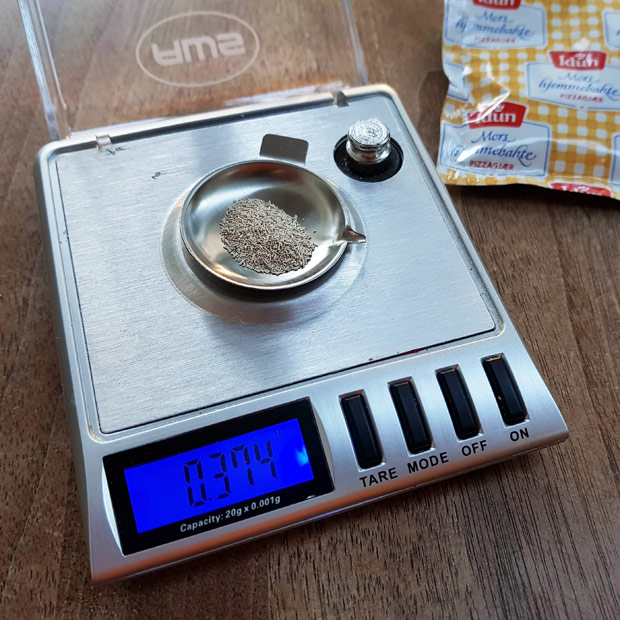
The only exception to the general advice on weighing ingredients is when very small quantities are used. This could be spices, food coloring or hydrocolloids. With normal kitchen scales, you’ll be better of using volume measurements for amounts less than 5 g (equal to a teaspoon if measuring water). Otherweise it’s worthwhile mentioning that scales with a 0.1 g and 0.01 g readout are getting cheaper and cheaper.

*

There is a summary of the “10 tips for practical molecular gastronomy” posts. The collection of books (favorite, molecular gastronomy, aroma/taste, reference/technique, food chemistry) and links (people/chefs/blogs, webresources, institutions, articles and audio/video) at khymos.org might also be of interest.

Kitchen gadgets

Thursday, October 11th, 2007

Popular science magazine has an amusing article on “The future of food” which portrays Dave Arnold, apparently the “man behind the curtain of today’s hottest movement in cooking”. I don’t buy all of this, but he’s no doubt had a central role in bringing lab equipment into the kitchens of North American chefs and teaching them a little science. You might also want to check out their gallery of kitchen gadgets. Some of my favorites include (click the pictures to lanuch the picture gallery at PopSci magazine):

kitchengadget_whipper.jpg
For the Pros: The Whipper. Adds a touch of air to every bite.

Within reach of the dedicated amateur chef, indispensible for the professional chef: a whipper which you can charge with either carbon dioxide (for instance to make carbonated fruit) or dinitrogen oxide (too make foams/espumas or simply whipped cream).

kitchengadget_circulator.jpg
For the Pros: The Sealer and Circulator. Cooks in a bag to lock in juiciness.

Sous vide cooking is perhaps one of the most fascinating examples of science inspired cooking. The picture shows a vacuum sealer and a thermostated water bath circulator. If this is too expensive, check out my post on a simple and easy DIY sous vide.

kitchengadget_chemicals.jpg
For the Pros: The New Spice Rack. Chemicals the experimental home chef shouldn’t be without.

Last but not least: the different chemicals which become more and more available. I’ve put together a collection of hydrocolloid recipes which will help you get started using these fascinating chemicals. If you have troubles getting hold of these, my list of suppliers might help you.

Of course I’d like to put my hands on a Pacojet, an Antigriddle or a Gastrovac as well, but for a home kitchen, this gets too exotic and far too expensive. But – the most surprising gadget was the vacuum meat tumbler from Reveo. Just like the extremely expensive Gastrovac, this little machine can be used for vacuum impregnation of meat and other foods (or at least this is something I assume from the description). IMHO vacuum impregnation is the most important feature of the Gastrovac – far more important than the heating capabilities. Perhaps someone owning a Reveo could report back?

kitchengadget_vacuummeattumbler.jpg
For the Home: Meat, Your Maker. This vacuum tumbler cuts marinating time by hours, first extracting air to expand the meat’s fibers and then spinning it so that every area is exposed to your sauce of choice. Probably doesn’t beat a good long soak, but perfect for when barbecue inspiration suddenly strikes.—Abby Seiff

But I was very dissapointed that my all-time favorite kitchen gadget didn’t make it into the gallery: a simple thermometer. As I have stated in one of my tips for practical molecular gastronomy, this is probably the single tool that can improve your cooking the most.

Clarification of stock and other liquids

Monday, September 3rd, 2007

In a comment to the last post, Chad asked how the clarification with laboratory glass ware works. Here’s how. Basically it’s a filtration. But if you would use a normal filter paper (such as a coffee filter) and let gravity pull the liquid through the filter, it would take ages. By applying a vacuum to the back side of the filter, the stock is sucked through (or pushed if you like by the atmospheric pressure). The are several possible sources of vacuum. The simplest and cheapest is a water aspirator or a handpump. More expensive solutions include a membrane pump or an oil pump. The particles you want to remove are from 0.0001 mm and upwards to > 1 mm. The best thing would be to first pass the stock through a cheese cloth or a muslin, followed by one or more filtrations using filter paper. This would gradually yield a perfectly clear solution. Pictures of a Büchner funnel, Erlenmeyer flask and a water aspirator can be found on the tools page of Khymos. Pictures of a complete setup can be found by googling. If doing this in a kitchen, you would want to have an Erlenmeyer flask of at least 2-3 L as this is where the clearified stock is collected. The Büchner funnel should preferably have a diameter of 12 cm or more.

stock-filtration.png

The fascinating thing about a filtration like this is that you can also remove color. At the EuroFoodChem XIV conference I was told by Jorge Ruiz of Lamaragaritaseagita that you can make perfectly clear tomato juice by succesive filtrations, starting with a coarse filter and moving to finer filters. All in all, 3-5 filtrations should be sufficient.

Carbonated fruit the iSi way

Monday, April 9th, 2007

I blogged about carbonated strawberries some while ago. Those were made using dry ice which unfortunately is not always easy to get hold of. Last week however I bought a iSi Gourmet Whipper – one of those Ferran Adria uses to make foams/espumas. I plan to experiment with that as well, but the first thing I decided to prepare was carbonated fruit. In fact this is a safe way (the only?) to make carbonated fruit at home using a pressurized container.

isi-whipper.jpg

The instruction booklet which comes with the iSi Gourmet Whipper only mentions cream chargers (filled with N2O, dinitrogen oxide), whereas soda chargers (filled with CO2, carbon dioxide) are not mentioned (I guess the opposite is true for the iSi Siphons?). This is quite amazing actually! Luckily however the cream and soda chargers are exactly the same size and both hold 8 g of gas. So it should be possible to make carbonated fruit with any of the iSi whippers (cream, easy, gourmet, dessert, thermo) or siphons available.

Here’s how you proceed:

  1. Fill you iSi whipper (or siphon) with fruit, preferably fruit which has a cut, wet surface to allow the carbon dioxide to dissolve in the water/juice.
  2. Screw on top securly
  3. Charge with one soda charger (two if you have the 1 L whipper)
  4. Leave in fridge over night
  5. Release pressure with valve (Important!)
  6. Unscrew top and serve immediately!
  7. Enjoy!

carbonated-grapes.jpg
This is what carbonated grapes look like. As you see, I decided to cut the grapes in to halves.

carbonated-grapes-closeup.jpg
Notice how they sizzle!

A quick recap of the chemistry: cold water dissolves more CO2 than tempered water, that’s why we leave it in the fridge. Also, remember that it takes some time for the carbon dioxide to dissolve in water, therefore it’s better not to be in a hurry. A quick calculation of the pressures gives the following: Both gases have molecular weights of 44 g/mol, so 8 g of gas corresponds to 0.1818 moles or 4.1 L at 25 °C and 1 atm pressure. The volume of the chargers is 0.01 L which gives an initial pressure in the chargers of impressive 445 atm! With an approximate volume of 0.7 L this gives a pressure (in an empty whipper) of nearly 6 atm – the same as in a bottle of champagne. However once you add water, the equilibriums will change and the pressure in the head space will drop. Anyone who remembers how to calculate the head space pressure at equilibrium if the container is filled with 0.5 L of water and cooled to 4 °C?

I’ve done some googling and there is also some mention of making carbonated fruit with an iSi whipper over at Ideas in food.

(The word play in the title works better for those with a mother tongue where iSi would be pronounced just like “easy”!)

First experiments with sodium alginate

Friday, March 30th, 2007

Here’s some pictures and a video of my first experiments with sodium alginate and spherification. I used sodium alginate from the Texturas series and calcium chloride from a drug store. Needless to say, I’m very fascinated by the texture and the whole process. I have blogged about the chemistry behind previously.

Materials used:
2.0 g sodium alginate
200 g water (with low calcium content!)
50 g blueberry syrup

2.5 g calcium chloride
500 g water

Procedure:
2 g sodium alginate and 200 g water were mixed vigourously in blender. The mixture was then left to stand for some hours to get rid of the air bubbles. 50 g blueberry syrup was then added to the sodium alginate solution. A calcium chloride bath was prepared by dissolving 2.5 g calcium chloride in 500 g water. The sodium alginate/blueberry mixture was dripped into the calcium chloride bath using a plastic syringe with a steel cannula. After 1-3 min the pearls were removed and rinsed with water.

More detailed procedure with pictures and video:
I had to obtain a scale with a 0.1 g accuracy to weigh out 2.0 g of sodium alginate (my first experiments using a normal kitchen scale failed). The model I got cost about $100 and is inteded for school laboratories. Amazon provides several scales with this accuracy.

alginate-1.jpg

I used a blender to dissolve sodium alginate in water. This incorporates a lot of air in the mixture which we don’t want. It could possibly be avoided by using an immersion blender/mixer. However, I just left the alginate solution on the bench and after 3-4 hours the air bubbles had all escaped from the solution.

alginate-2.jpg

Plastic syringes and cannulas can be obtained from your local drug store or pharmacist. I found it was easier to produce evenly sized drops with a sharp cannula (CAREFULL!) than with just the plastic tip of the syringe. This of course depends on the viscosity of the solution. By thickening (with xanthan for instance) you can produce larger drops.

alginate-6.jpg

After 1-3 min the spheres were removed from the calcium chloride solution and rinsed with clean water. I dried the spheres carefully using a kitchen towel or paper.

alginate-7.jpg

alginate-3.jpg

Definitely looks like caviar when presented on a spoon like this!

alginate-4.jpg

Larger spheres were made by filling a small measuring spoon with the alginate mixture (I used a syringe for this so the outsides of the spoon would not be covered with alginate solution) and carefully emptied it into the calcium chloride bath. It takes some trial and error to achieve good results.

alginate-5.jpg

The spheres are suprisingly robust and can be handled without rupturing.

alginate-8.jpg

If cut with a knife, the spheres rupture and the liquid contents flows out.

alginate-9.jpg

The small spheres didn’t taste much, so I could have added more blueberry syrup. The large spheres however had a nice taste. The surprise element when they rupture in your mouth is very nice!