Archive for the ‘experiments’ Category
Tuesday, February 9th, 2010

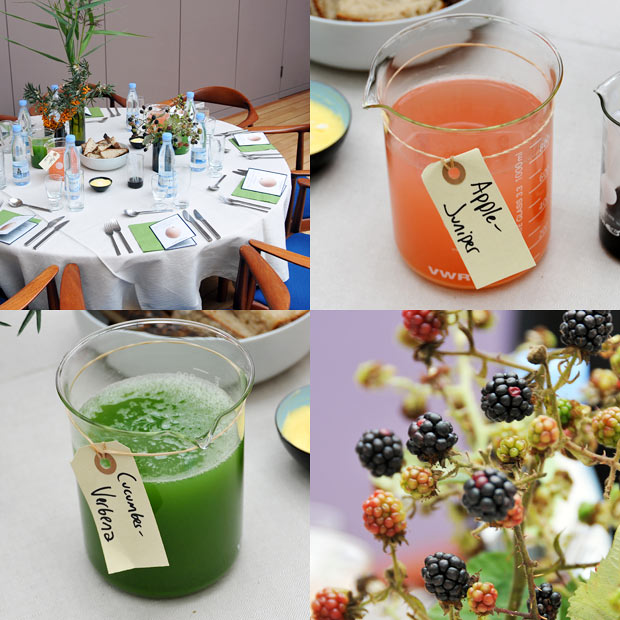
Again I was lukcy that all the practical details worked out so I could attend this year’s Flemish Primitives in Brugge. For some one who’s not attended, it’s not so easy to grasp the concept and ideas behind The Flemish Primitives (TFP). And I admit, even though I’ve been there twice it’s not so easy to convey it in a short way. First of all the name is rather cryptic (unless you’re into art) as it refers to early Netherlandish painting. The link to food is described as follows by the organizers of the event (my highlights):
In the 15th and 16th century, ’The Flemish Primitives’ were masters in combining their talent with new techniques. Techniques they developed by interacting with other disciplines like manuscripting, sculpting, etc. This way of working changed the painting techniques in all of Western Europe forever. The event ‘The Flemish Primitives’ wants to continue in the same spirit. Respect for food products and beverages, the knowledge of the classic cooking techniques combined with a stimulation of new techniques and creativity. By promoting interaction between scientists, the world’s most famous chefs and artists, the event wants to deliver a creative boost for the food industry and gastronomy in Belgium and the world.
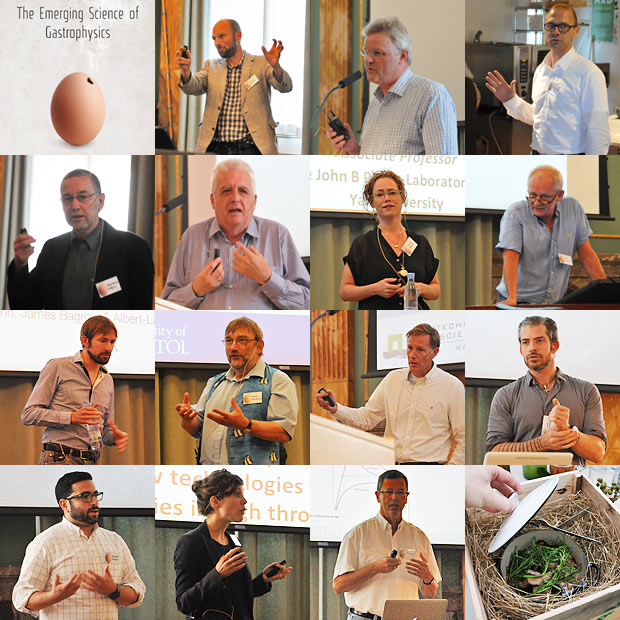
Considering last year’s sucess it was no big surprise that this year’s event was sold out (and the foyer of the Concertgebouw was equally full in the coffee breaks). And with the memories from last year I arrived in Brugge with great expectations. One main difference from previous years was that the scientific parts were much better integrated throughout the day. Scientists were on stage alongside the chefs, explaining their work. Also, contrary to last year’s back stage kitchen, they had now moved the kitchen onto the stage, flanked by a bar, some sofas and laboratory mezzanine. A good decision!
(more…)
Tags: Belgium, Bernard Lahousse, Brugge, flavor pairing, food bloggers, food pairing, gadgets, science, technology, The, the flemish primitives
Posted in equipment, experiments, flavor pairing, molecular gastronomy, science | 2 Comments »
Friday, December 11th, 2009
Tags: balancing fork trick, christmas, fun, science stunt, tricks, video
Posted in experiments, fun with food, science, tips & tricks, videos | No Comments »
Saturday, October 24th, 2009

Miss Silvia is full of surprises! She’s been around the house for a year, but only now did she reveal one of her hidden capabilities. Did you know that you can make scrambled eggs with the steam wand of your espresso machine? Me neither. It’s a brilliant idea and one can wonder why no one has done this before. I mean, espresso machines have been around for a while. And as it turns out – according to Kelly’s comment below this was done in San Francisco back in the 90’s. It seems as if the credits for rediscovering these scrambled eggs should go to Chef Jody Williams (and thanks to Jessica at FoodMayhem for posting this). I’ve tried it several times and it works very well. I’d even say that this gives you another reason to purchase an espresso machine with a proper steam wand! Many other reasons can be found in my first post about Miss Silvia. (more…)
Tags: aeration, custard, egg, espresso machine, Miss Silvia, Ranciliio, sabayon, scrambled eggs, steam, steam wand, video, zabaglione
Posted in equipment, experiments, molecular gastronomy, recipe, tips & tricks | 21 Comments »
Sunday, October 18th, 2009

A sourd dough bread made from a spontaneous starter
After 7 days of feeding my sour dough starter “took off” and was ready for baking. Even with a water bath set to 28 °C it took longer than expected.
I started off with 100% hydration as this is convenient when you have to feed your starter frequently. Using only whole grain rye flour and water, I fed my starter every 12 hours (I’ve included details of the “feeding schedule” at the end of this post). This time interval is based on the growth cycle of yeast, where the yeast after an exponential growth phase reaches a plateau after 8-12 hours. This is the best time for feeding the starter.
There seems to be a consensus that a wet starter (more…)
Tags: acetic acid, aeration, Baker's percentage, hydration, LAB, lactic acid, lactic acid bacteria, lactobacillus, pH, Saccharomyces exiguus, sourdough, sourdough starter, yeast
Posted in academic articles, books, equipment, experiments, molecular gastronomy, recipe, recommendations, science | 9 Comments »
Thursday, May 21st, 2009

Attempt to make a sourdough starter using dried apricots, using my immersion circulator for temperature control. I got some bubbling yeast activity, but the final bread dough never rose properly.
Inspired by the Swedish bread blog Pain de Martin which I recently discovered I decided it was time to have a go at sourdough breads! Although one of my favorite types of bread it’s a long time since I gave it a try and even longer since I actually succeeded. Leaving apple peel covered with water for two weeks in a cool place (15 °C) I got a light apple cider which I used to make a starter some years ago. I followed a recipe from the Norwegian artisan bakery Åpent bakeri and it gave a marvelous bread. But since then I’ve tried to repeat this twice without success. No wonder that even Rose Levy Beranbaum in her book “The Bread Bible” writes that she didn’t intend to include a chapter on sourdough at all. There’s no doubt that sourdoughs are tricky, but I was a litte surprised and disappointed that someone who sets of to write a 600+ page book on bread even considered to skip sourdough… Luckily she changed her mind and the introduction has a fascinating nice-to-know fact: 1 g flour contains about 320 lactic acid bacteria and 13000 yeast cells!
I believe one the reasons why sourdoughs seem to live their own lifes sometimes is that they need to be kept in a warm place. My kitchen isn’t that warm so I figured it was time to use my immersion circulator and give sourdough another chance (who says you can only use immersion circulators for sous vide anyway? – I think my next project will be to make yoghurt!). With a thermostated water bath keeping a sourdough starter at constant temperature is as easy as 1-2-3. But surprisingly I haven’t seen any blogposts yet from people using their sous vide water baths for sourdough starters (although some have built their own water baths for this purpose using aquarium equipment).
(more…)
Tags: bread, carbon dioxide, CO2, failed experiment, fermentation, immersion circulator, sourdough, temperature, thermostat, water bath, wild yeast, yeast
Posted in blogs, experiments, molecular gastronomy | 18 Comments »
Monday, April 27th, 2009
Rose foam at room temperature
Just a small reminder that the deadline for the current round of TGRWT #17 is a little later than usual: May 8th. I took the picture above for last month’s TGRWT (where it was combined with chicken) and came to think that it actually qualifies for this month’s TGRWT as well. It’s rose foam on a spoon with apple, celery and almonds, and the foam is sprinkled with a little pepper.
As an experiment I tried to freeze the leftover rose foam and was quite surprised by the resulting texture. (more…)
Tags: chewy, foam, frozen, ice cream, methyl cellulose, rose, rose water, sorbet, texture, xanthan
Posted in TGRWT, experiments, flavor pairing, hydrocolloids, molecular gastronomy | 11 Comments »
Thursday, April 9th, 2009

Many cookbooks suggest the following for boiling eggs: 3-6 min for a soft yolk, 6-8 min for a medium soft yolk and 8-10 min for a hard yolk. If you are satisfied with this, there is no need for you to continue reading. But if you’ve ever wondered whether the size of an egg has any impact on the cooking time you should read on. And if you search the ultimate soft boiled egg we share a common goal! From a scientific view point, a cooking time of approximately 3-8 minutes to obtain a soft yolk is not very precise. A number of important parameters remain unanswered: What size are the eggs? Are they taken from the fridge or are they room tempered? Are they put into cold or boiling water? And if using cold water – when should the timer be started? When the heat is turned on or when the water boils? And would the size of the pan, the amount of water and the power of the stove top matter?
(more…)
Tags: boiling eggs, Charles Williams, chemistry, cocotte, cooking, easter, egg, eggs, everyday science, formula, hard boiled, Jules Verne, maekbanseok gyeran, molecular gastronomy, onsen tamago, perfect eggs, Peter Barham, popular science, Robuchon, sauna, soft boiled, sous vide
Posted in experiments, molecular gastronomy | 35 Comments »
Monday, February 2nd, 2009

Can the natural process of aging wine in corked bottles be accelerated?
I recently found an interesting article on how an electric field can be used for maturation of wine (New Scientist news coverage of the article). Applying a AC field of 600 V/cm for 3 minutes resulted in an accelerated aging of wine and according to the authors of the paper, it made “harsh and pungent raw wine become harmonious and dainty”. They observed changes in concentrations of higher alcohols, aldehydes, esters and free amino acids. But I was quite surprised that they don’t say anthing about astringency and polyphenols (tannins). I’d expect some changes there as well, but alas it’s so much more difficult to measure the polyphenols than the low molecular compounds. A sensory panel identified both positive and negative effects of the electric treatment which helped identify an optimum treatment. Apparently several Chinese wine manufacturers are testing the technology on a pilot scale now. Many people have a romantic impression of how wine is made, but the extensive catalogues of “corrective chemicals” available to the modern wine maker should perhaps make you reconsider the romatic idea of wine making. Even professor Hervé Alexandre at the University of Burgundy has given the technology a thumbs up: “Using an electric field to accelerate ageing is a feasible way to shorten maturation times and improve the quality of young wine”. Who knows – maybe you’ll soon be drinking a wine that has been zapped?
(more…)
Tags: AC, ageing, aging, astringency, catalysis, desulfuration, desulfurization, electric field, everyday science, maturation, molecular gastronomy, polyphenos, stainless steel, sulfur, tannins, wine
Posted in equipment, experiments, molecular gastronomy, science, tips & tricks | 11 Comments »
Sunday, December 14th, 2008
Having received a real kitchen gadget before the weekend, I certainly had to do some sous-vide experiments. While shopping I looked specifically for meat that was already vacuum packed in plastic bags as I do not have a food saver. There is actually a decent selection available and I got a 1.5 kg roast beef and a chicken breast (a particularily nice one, bred according to the Label Rouge principles). The nice thing about the meat I got was that the packaging had temperature suggestions. Even though I have books and tables and access to the internet it’s always nice to have this information available exactly when and where you need it. And as I dropped the meat into the water bath it occured to me that this was so simple (not that I shun complex recipes), so clean (I’m not afraid of a messy kitchen) and so convenient (I’m not at all a fan of fast food) that given the expected end result this is probably how very many people will prepare their meat in a not to distant future! So to all farmers, butchers and producers of immersion circulators – I hope you read this and act accordingly

(more…)
Tags: beef, chicken, egg, egg white, egg yolk, eggs, immersion circulator, molecular gastronomy, steak, techniques, temperature, texture
Posted in experiments, molecular gastronomy, sous vide, tips & tricks | 23 Comments »
Tuesday, November 11th, 2008

I have recently come to know Miss Silvia. She’s from Italy, weighs a good 14 kg and even my wife welcomed her in our kitchen! As home brew espresso afficionados will know by know, I’ve become the proud owner of an espresso machine from Rancilio! She’s been around for a number of years, and is one of the most popular among prosumer espresso machines available before you take the step up to double boiler machines that allow simultaneous brewing and steaming. Every place that is (proud of) serving espresso uses these machines, but their price is well beyond most coffee lovers budget. The good news however is that even single boiler machines can produce excellent espresso!
The first time I offered the science of espresso any thought was when reading Jeffry Steingarten’s accounts of his espresso adventure (in “It must’ve been something I ate”) which brought him all the way to Italy and Illy and then back again to Manhatten where he set up 14 home espresso machines in his kitchen. This is also where I first was made aware of the fact that 7 g of coffee should be used for a single espresso (which is considerably more than the 5-6 grams found in the Nespresso capsules).
Since I decided to buy an espresso machine I have been devouring sites written by and for coffee enthusiasts: CoffeeGeek, Home Barista and Espresso! My Espresso! to mention a few. You’ll be surprised how much one can possibly write about espresso!
(more…)
Tags: carbon dioxide, CO2, coffee, espresso, extraction, illy, Miss Silvia, molecular gastronomy, Rancilio
Posted in equipment, experiments, molecular gastronomy, science | 12 Comments »
Friday, October 24th, 2008

Brazilian chiles in oil (very nice with Moqueca!)
Oils and fats are long molecules which are mainly non-polar and hence the opposite of water which is a polar molecule. Ethanol which has both a polar and a non-polar end falls in between oil and water. I’ve covered extractions using water and ethanol previously. That water and oil are opposites is easily observed by the fact that they don’t mix, and because of it’s lower density oil floats on top of water. This property allows us to easily separate water and oil.
Volatile molecules – the molecules that we detect by their smell – are mainly non-polar and therefore soluble in oil. This is one reason why foods with fat often have a different and often better flavor compared with their fat-free counterparts (fat of course also influences mouth feel etc.). Everytime you cook with oil it will actually help extract aroma (or smell flavorants) from the food ingredients and deliver these to your nose.
There are several oil extracts used in the kitchen, and the nice thing about them is that the oil extracts aromas and then protects them from the air. This is good as it prevents oxidation of the aroma molecules, but in some extreme cases bad because the anaerobic conditions may promote growth of botulinum spores – more on that in the last paragraph. When the flavored oil is added to a dish you get can immediately perceive the aroma. If the oil is tasted pure it serves as a carrier for the aroma giving a small explosion in the mouth (or nose to be more precise…). Some examples I can think of where the oil plays an important role in extracting and delivering aromas are: pesto, tapenade, mayonaise, aioli, curry paste (and all other spice pastes), chili oil and truffle oil to mention a few. Notice that in most of these the source of the aromas is still present in the oil.
(more…)
Tags: aroma, chili, extraction, flavor, fractionation, oil
Posted in experiments, molecular gastronomy, science, tips & tricks | 9 Comments »
Friday, September 26th, 2008

Ever thought about how pretzels and salt sticks get their nice brown color?
The products of the Maillard reaction provide tastes, smells and colors that are much desired and lend their charachteristics to a variety of foods. In this post I will focus on the factors that influence how fast the Maillard reaction proceeds. And more specifically I’ll give examples on how the Maillard reaction can be speeded up. This is not about fast food, nor is it about saving time. It’s more about controlling the browning reaction by speeding it up or slowing it down in order to get a desired end result.
The Maillard reaction is, to put it simple, a reaction between an amino acid and a sugar (there’s more on the chemistry at the end of the post). To speed it up you can do one or more of the following:
(more…)
Tags: acid, amino acid, baking soda, base, egg, eggs, everyday science, fructose, glucose, lactose, lye, maillard, Maillard reaction, milk, pH, protein, reducing sugar, temperature, video
Posted in experiments, molecular gastronomy | 24 Comments »
Thursday, June 19th, 2008

Picture by Michael Murphy (CC-BY-SA)
The soda fountain (Diet Coke + Mentos) has been around the net for quite a while with some spectacular videos available, and it has even made it into a news paper cartoon. People go crazy about this and the largest number of simultaneous fountains is steadily increasing.
Despite the interest, only now did a scientific paper appear on the subject. Many have speculated about what causes the reaction between Mentos and Diet Coke, and some have focused on possible acid-base reactions taking place. Mythbusters investigated this in 2006 (watch episode) and came up with the following factors that contribute to the bubble formation:
Diet coke
- carbon dioxide is what makes the bubbles form in the first place
- in synthetic mixtures aspartam, caffeine and potassium benzoate where shown give better fountains
Mentos
- the most important property is the rough surface which provides plenty of nucleation sites for bubble formation
- the density makes them sink which is ideal as the bubbles formed at the bottom of the bottle help expel much more soda
- mentos contains gelatin and gum arabic which could also reduce surface tension
In the paper “Diet Coke and Mentos: What is really behind this physical reaction?” by Tonya Shea Coffey the findings of the Mythbuster teams are largely confirmed.
By measuring contact angles it was shown that aspartame and potassium benzoate reduce the surface tension of water. Aspartame is a winner, and as an extra benefit clean up is much easier with Diet Coke than sugared Coke. The amount of caffeine however is too low to have any effect. The roughness of the Mentos surface was studied with special microscopes (see picture below). Fruit Mentos have smooth patches, but the coating is not uniform and contrary to the Mythbuster experiment normal Mentos and Fruit Mentos performed equally well with regards to foam formation. The roughness of the Mentos surface was inbetween that of rock salt and the Life savers which suggests that roughness is not a single factor determining the reaction. The Mentos surface is covered with gum arabic which reduces surface tension, and experiments showed that even without Mentos, gum arabic could cause a reaction to occur. It is the combined effects of reduced surface tension (due to ingredients in Diet Coke and Mentos) and the rough surface of Mentos which is the key to understand the reaction.
As expected, the article also confirms that the reaction is more vigours at higher temperatures (i.e. solubility of carbon dioxide deacreases with increasing temperature). It was also shown that Mentos sink faster to the bottom of a 2 L bottle compared with rock salt, Wint-O-Green Life savers and sand (this is a function of size and density, not only density). When bubbles are formed at the bottom of the bottle the bubble has more time to grow as it rises. This causes a more explosive reaction and more soda is expelled from the bottle.

The picture shows scanning electron microscopy images of Mint Mentos (a) and (c) and Fruit Mentos with a candy coating (b) and (d). The scale bars in each image represent the lengths (a) 200 μm, (b) 100 μm, (c) 20 μm, and (d) 20 μm. Fruit Mentos has smooth patches, but the coating is not uniform. (Reprinted with permission from Coffey, T. S, American Journal of Physics, Vol. 76, Issue 6, pp. 551-557, 2008. Copyright 2008, American Association of Physics Teachers)
The question which lingers on my mind is whether Diet Coke and Mentos represent the optimal combination of ingredients to create a soda fountain. With regard to convenience, I guess the answer is yes. But perhaps it’s possible to create an even more powerful reaction? Since lowering the surface tension of water is important, I’m wondering if it would be possible to find a surfactant that could be added without setting the reaction off? Mentos would of course still be needed for the rough surface to provide nucleation sites. In the above mentioned study addition of diluted dish washing liquid was enough to give a pretty good reaction, so this is not an option. But perhaps a couple of drops right on the Mentos surface would work? I definitely need to try this some time.
Tags: aspartame, bubble, bubble formation, caffein, carbon dioxide, CO2, coke, contact angle, detergent, diet coke, eruption, everyday science, fountain, gelatin, gum arabic, kitchen physics, mentos, nucleation, nucleation site, potassium benzoate, rough, roughness, soda, surface tension, surfactant
Posted in experiments, fun with food, science | 5 Comments »
Sunday, June 8th, 2008

Extraction of cherries with ~45% ethanol in water
Ethanol is a molecule with both a polar and a non-polar end, so it’s properties are somewhat in between those of water and oil (which will be the topic of the next post in this series about extraction). This is easily illustrated by the fact that both water and oil are soluble in pure ethanol (albeit not at the same time – adding water to ethanol reduces the solubility of oil). Many taste molecules are polar whereas most aroma molecules are non-polar, and the good thing is that ethanol can be used to extract both groups of compounds.
I belive the most widespread use of ethanol for extractions in the kitchen is for sweet liqueurs where fruits or berries are extracted with ethanol and the extract is sweetened with sugar. The word liqueur comes from the Latin word liquifacere which means “to dissolve”, and this is essentially what happens – the ethanol and water extract and dissolve flavor and color from the fruit.
Some also make their own spirits by infusing spices and herbs. One example is aquavit which is based on carraway combined with a number of other spices for complexity such as dill, coriander, anis, fennel, liquorice, cardamom and lemon. Commercial aquavits are distilled, but at home it’s suffices to filter of the spices and herbs. As a result home made aquavits are always amber colored (such as the one pictured in a previous post).
For extractions like these, one always uses diluted ethanol, typically 30-60% ethanol in water would be used, and most often somewhere around 40-50%. One reason for this is that higher concentrations of ethanol would extract to many bitter and astringent compounds. Another reason is that in some (most?) countries it is illegal to posess, buy and/or sell ethanol at higher concentrations for consumption (pure ethanol for technical use is denatured if sold in normal stores and requires special permissions if used in laboratories).
Apart from the steping herbs and spices in ethanol to make liqueurs, the only other example of relevance for the kitchen I can think of is for extraction of vanilla beans to make pure vanilla extract. This is quite surprising actually, and although I really don’t know if ethanol is used for extraction in professional kitchens, it is my impression that ethanol extractions are underutilized in the kitchen.
There are several benefits with ethanolic spice and herb extracts:
- fast – no need to wait for the spices to be extracted since they have been “pre extracted”, you can taste the dish immediately and add more spice extract if necessary
- no residues – seeds, leaves or bark are filtered off before use
- convenient – spice extracts are an excellent way of adding clean, concentrated aromas
- stable – spice extracts keep very well (although the storage may also change the flavor profile somewhat and “mature” the flavor)
- new flavors – some spices and in particular herbs will change upon extraction and storage and this can open up new possibilities (this needs quite some experimentation though – some herb flavors change to the worse…)
What are your experiences with ethanol extractions in the kitchen?

Tags: alcohol, aroma, astringency, astringent, bitter, cherries, cherry, ethanol, everyday science, extract, extraction, flavor, liqueur, liquor, non-polar, polar, taste
Posted in experiments, molecular gastronomy, science, tips & tricks | 17 Comments »
Tuesday, June 3rd, 2008

Extraction of peppermint leaves with hot water
Water is a polar molecule, meaning that one end has a small negative charge and the other a small positive charge. Because of this water is a very good solvent for other polar molecules and ions. For instance water is the solvent of choice for substances that provide taste, be it salt, sour, sweet or bitter as these are normally quite polar molecules.
A general rule is that the solubility of molecules and ions increases with the temperature of the water. Extractions are therefore faster if the water is boiling. This is the reason why we use hot water to extract tea leaves or ground coffee beans, even if we want to prepare ice tea or ice coffee. But by lowering the temperature and extending the extraction time we can change the relative proportion of what we extract. It therefore makes perfectly sense that different temperatures are recommended for different types of tea. Using different temperatures for the same kind of tea will of course also influence the flavor profile.
Polar molecules are more easily extracted than non-polar molecules. This is evident if we leave a tea bag for a long time in hot water. The bitter taste is due to the slow extraction of large polyphenol molecules which are less soluble in water. If tea is brewed at a lower temperature, less of the bitter tasting substances will be extracted.
Although water is polar, less polar and even non-polar substances can be extracted with water, especially if the water is boiling hot. You do this every day when prepare coffee. If you take a close look at cup of freshly brewed coffee you can notice small pools of oily substances floating on top of the coffee. The more severe conditions used when extracting coffee to make an espresso ensure that even more oily substances are extracted. Other examples of extraction using water in the kitchen include preparation of stock, soups and gravies.
The principle of extraction is simple, but a number of questions remain largely unexplored with regard to flavor: How do ions affect extraction? What role does pH play? How does temperature influence flavor? There is surprisingly little research on this that includes a sensory evalution.
Tags: astrigency, coffee, espresso, everyday science, extraction, flavor, non-polar, polar, solubility, taste, tea, temperature, water
Posted in experiments, molecular gastronomy, science, tips & tricks | 12 Comments »