Archive for the ‘experiments’ Category

Perfect steak with DIY “sous vide” cooking

Sunday, January 21st, 2007

One important aspect of molecular gastronomy is the application of scientific principles to food preparation in a normal kitchen. This can very well be illustrated by discussing the preparation of a steak. The surface of the meat needs to be heated to > 120 °C (250 F) for the Maillard reaction to take place at a reasonable rate. This gives meat much of it’s characteristic aroma. The interior of the meat however should not be heated to more than 50-65 °C (120-150 F) for a rare or a medium rare appearance. If the heat is provided by a frying pan with a temperature typically in the range 120-160 °C (250-320 F), the different temperature required for the interior and the surface of the meat can actually be quite difficult to achieve. Bringing the meat to room temperature before cooking by taking it out of the fridge 1-2 hours in advance helps. Also, half way through the cooking it’s advisable to let the meat rest on a plate to allow the heat to diffuse into the interior and to let the surface cool down a little.

There is however an easier way to make a perfect steak! In restaurants the method has been around since the 70′s and is known under the name sous vide (fr. under vacuum, more info on history of sous vide in this NY Times article). The meat is packed in plastic bags, vacuumed and put into thermostated water baths. This equipment is not (yet?) found in the average kitchen. So here is a simple DIY procedure. You just use a normal plastic bag, leave the meat in the water bath for 30 min (or longer) and then quickly fry both sides to generate the products of the Maillard reaction. You do need a thermometer though to control the temperature of the water bath, preferably one with a dip in probe.

1. Put the meat (I used a rib eye steak for this experiment) in a thick plastic bag. Only put one or two pieces of meat in each plastic bag – this ensures a greater contact surface with the water.

meat in plastic bag

2. Add any spices you like (salt and pepper always works well – for the experiment shown I used curry paste, soy sauce and chili sauce in stead), press (or suck) out the air and close the plastic bag tightly by tying a knot (or use a zip-lock bag). You don’t want any water to enter the bag!

meat in plastic bag

3. Heat a pot of water to the desired temperature (or use hot tap water) and place the plastic bag with meat in the water. Cover with a lid (not shown in the picture) to reduce heat loss. If you use a large pot of water it’s easier to keep the temperature constant. Also, it’s easier to control the temperature with an induction or gas stove top than with an electric plate since there is no additional heating once you turn them off. Regarding the temperature, start with 60 °C (140 F) and experiment from there (or check this table at Wikipedia for doneness temperatures of meat). You should leave the meat in the water for at least 30 minutes – more for a thicker cut. But the good thing is you can leave it for much longer (several hours) provided the temperature does not come above 60 °C (or whatever temperature you decided on). A convenient way to keep the temperature constant for a long time is to put the pan with water into the oven and use the thermostat of the oven.

meat in plasticbag, water at 59 C

4. Heat a frying pan, add a fat of you choice, remove meat from plastic bag and brown both sides of the meat. Since you take the meat directly from the water bath it’s already at about 60 °C. Therefore the browning is very fast.

meat-in-frying-pan

5. A temperature of 60 °C (140 F) gives the meat a pink interior. It’s succulent and juicy. The short frying gives it a nice browned crust and the chewing resistance is perfect. All in all a wonderful combination of taste, aroma, texture and mouth feel!

meat-interior

Note added January 2009:
Since I published this procedure the first time I’ve learnt a lot more about sous vide. The procedure above is a rather crude procedure, but it works. If the meat turns out grey you’ll need to turn the temperature somewhat down. If you’re interested in reading more about sous vide, the best discussion I know of which also includes important safety aspects is Douglas Baldwin’s “A Practical Guide to Sous Vide Cooking”.

Related posts:
A mathematician cooks sous vide
Sous vide cooking joy
Santa came early this year
Upcoming books on sous vide

McGee with column in NY Times

Thursday, December 14th, 2006

Under the heading “The Curious Cook” Harold McGee recently started an occasional column on food and chemistry and everything in between in the New York Times. It’s definitely worth reading as Harold McGee has time and opportunity to really dig into these matters. Also, don’t forget to check out his blog. The latest post on his blog provides more detail on the blue-green colors in garlic and onion, discussed in the NY Times column.

the curious cook

St. Lucia, saffron and turmeric

Thursday, December 14th, 2006

The day of St. Lucia is celebrated in Scandinavia and some countries in southern Europe on December 13th. In Scandinavia a traditional kind of bun, lussekatt, is normally made and eaten on this day.

lussekatt
Lussekatt (Photo by Jonas Bergsten)

What is exciting about this from a chemical perspective is that they are made with saffron, the world’s most expensive spice (a recipe can be found here). Because of the high price, saffron is sometimes adulterated with turmeric. There is however a simple chemical test to check whether your saffron has been adulterated or not.

The color of saffron comes mainly from crocin, a carotenoid with a sugar attached that makes it water soluble (this is why the color is so easily extracted into water containing foods):

crocin

The aroma arises mainly from the degradation of picrocrocin to release the terpene safranal:

picrocrocin

The yellow color of turmeric comes from curcumin.

curcumin

Upon reaction with a base, curcumin turns bright red whereas crocin is unchanged. Because of this it should be possible to detect whether saffron has been adulterated with turmeric. In the picture below, strips of coffe filters where inserted into suspensions of saffron and turmeric in water (two of each), and those on the right where then held over a bottle of aqueous ammonia. An immediate reaction takes place between ammonia and curcumin, producing a bright red color. I should quickly admit that I haven’t had the opportunity to test this on an “authentic” adulterated sample!

saffron-turmeric

BTW, the color change is very fast as is obvious from the video below (click here if it doesn’t play in the window below):

Carbonated strawberries

Sunday, October 22nd, 2006

Here’s some pictures of an experiment I did with strawberries and dry ice (solid carbon dioxide). Dry ice is frozen carbon dioxide which holds a temperature of -78 °C. What is fascinating is that dry ice does not melt – it sublimes, which means that it turns directly into carbon dioxide gas.

The idea was to create a carbonated fruit which gives a sparkling sensation in the mouth. I have used strawberries, but any juicy fruit with a moist surface could be used. Water melons would be perfect!

The chemistry explained in simple terms:

co2.jpg

A schematic drawing of the container:

strawberry-dryice.jpg

To prevent the plate from touching the dry ice (which would cause the strawberries to freeze), I put in a wooden triangle first.

p7110004.JPG

Put the plate with strawberry halves on top of the wooden triangle. Cover with a kitchen towel (do NOT cover with a tight fitting cover – remember that as CO2 sublimes, it expands, and this would create a huge pressure ultimately resulting in an explosion), and leave for 30 minutes.

p7110005.JPG

Eat and enjoy!

Update: Carbonated fruit the iSi way!

Suppression of bitterness

Sunday, October 1st, 2006

I received an email last week from a supertaster (read more: BBC, Wikipedia) with an interesting question: Certain foods contain bitter substances that only a fraction of the population can taste. Examples include a group of compounds called cucurbitacins, found in melon and cucumbers, and propylthiouracil in broccoli. The question was whether these compounds could be neutralized by any means.

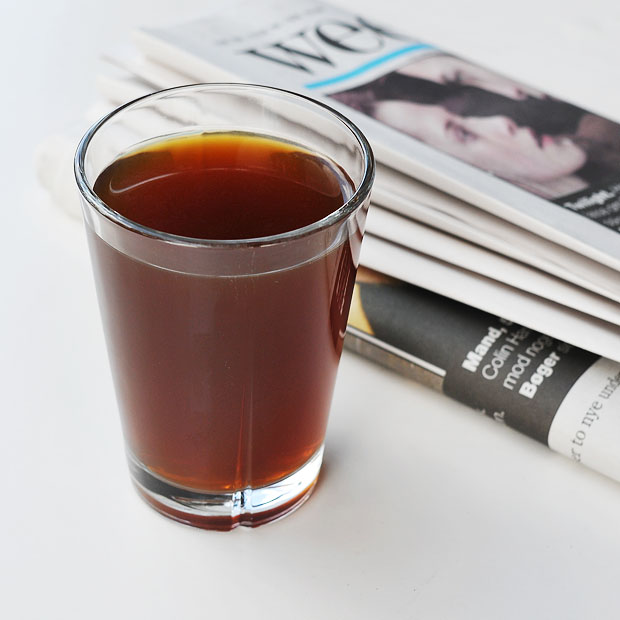
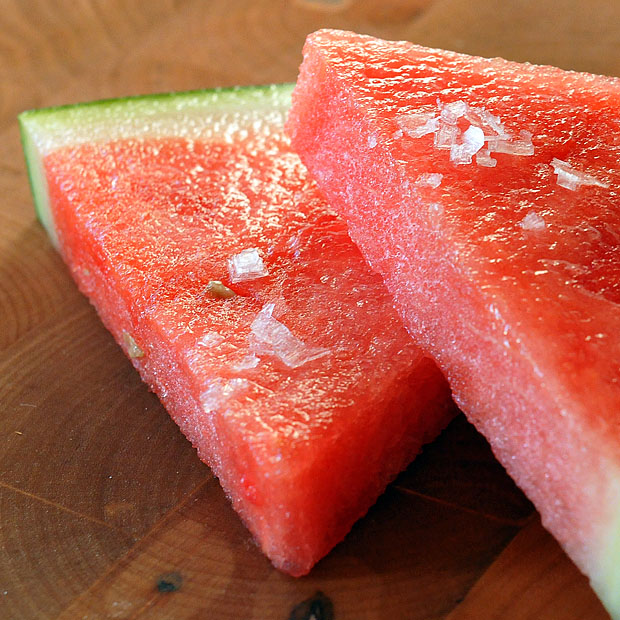
A very simple chemical that neutralized/modifies bitter taste is salt – and the best thing is that you don’t have to be a supertaster to test this. For a simple experiment, take tonic water, taste it and then stir in some salt (start with 1/2 teaspoon). Taste it again – if you can still taste the quinine, add a little more salt. At one point the bitter taste has almost disappeared! This principle might work for cucumbers and melons as well, but of cource there could be totally different taste mechanisms responsible for the bittertaste in the two cases.

tonic water

It might sound strange to add salt, but in Asia, it is not uncommon to eat different fruits with salt. I am aware of unripe mangoes, guavas and honey dew melon are eaten with salt, a salty spice and soy sauce respectively. Also – some people add a small amount of salt to the water when brewing coffee – this reduces bitterness and rounds of the taste. One last example is how salty food can make a young red wine with plenty of tannins more pleasent to drink. Tannins (polyphenolic compounds) can be both astringent and bitter, depending on their molecular weight (low molecular weight tannins are predominantely bitter whereas larger molecules are more astringent).

BTW, this has also been treated scientifically. See for instance: Breslin, P. A. S; G.K. Beauchamp, “Suppression of Bitterness by Sodium: Variation Among Bitter Taste Stimuli” Chemical Senses 1995, 20, 609-623 (link).

Flavor pairing – try this at home!

Sunday, October 1st, 2006

If two different foods share one or more volatile molecules, chances are they can taste pretty nice when eaten together. A further discussion of the science behind can be found here. I justed wanted to share a picture of the simplest possible way this can be done. White chocolate/black caviar (top left – this is one of Heston Blumenthals signature combinations!), strawberries and coriander leafs, pineapple and blue cheese, and banana and parsley. Definitely very strange, but when eaten together, the tastes more or less blend together. Convince yourself and try this at home!

examples of flavor pairing

Any readers with fantasy to create exciting dishes based on such flavor pairings? Suggestions and links are welcome!

Video on alginates

Sunday, September 17th, 2006

My fellow blogger on molecular gastronomy, Göde Schüler (check out his German MG blog Gourmetrics) found a great video on YouTube. The video shows how a red beet paste mixed with alginate solidifies when dripped into a solution of calcium lactate (this solution is normally clear, the yellow colour comes from extensive use).

Chef Simon (French, click here for babelfish translation) has a nice page on alginates as well. Another french page here (with english translation by babelfish). You can find links to more technical information (free pdf’s) on alginates in the static pages of khymos.org.

The chemical principles put simply are as follows:
Sodium alginate is water soluble and can be mixed with many different fruit/vegetable juices and purés. When dripped into a solution containing calcium ions, each calcium ion (which holds a charge of +2) knocks away two sodium ions (each holding a charge of +1). The alginate molecule contains loads of hydroxyl groups (OH’s) that can be coordinated to cations (that’s ions with a positive charge such as sodium and calcium).

calcium alginate

When alginate is coordinated to sodium, it’s a very flexible chain. When sodium is replaced by calcium however, each calcium ion (black dots in the image below) coordinates to two alginate chains, linking them together. The flexible chains become less flexible and form a huge network – a gel. The fun thing is that this happens within seconds after the alginate mixture is dripped into the water bath with the calcium ions.

Two alginate chains

Approximate concentrations:

  • Fruit/vegetalbe juice/puré with 1-2% sodium alginte
  • 2% calcium chloride solution (approx. 10g in 1/2 L of water) – because calcium chloride has a slightly bitter taste, it is a good idea to rince these pearls with water before consumption. This is also the reason why calcium lactate is often used in stead (as shown in the video).

Update: The Frog Blog has nice posts with pictures showing how Jay Veregge and Joel Robuchon utilize alginate gels. Also, check out this “caviar” maker for dripping 96 drops of sodium alginate solutions into calcium chloride at once.