Archive for the ‘hydrocolloids’ Category

Scientific chocolate tasting kits

Monday, February 19th, 2007

Dominique & Cindy Duby, chocolatiers based in Canada, have put together two “scientific chocolate tasting kits” (one, two). Some of the science behind is explained in their “tasting notes” (copy the text into a wordprocessor to read it). For a review of the first kit, check out Rob and Rachel’s blogpost over at Hungry in Hogtown.

The kits illustrate the use of various hydrocolloids to produce foams, gels, dispersions, emulsions and pearls. The principle of flavor pairing is illustrated and binary taste interactions are explored. They also include experiments to explore crunchy vs. soft textures. Each kit comes with four different experiments and enough ingredients to make 8 servings. Furthermore they let you serve every experiment at two different tempereatures. This is neat because is allows you to explore the great influence temperature has on texture and aroma. Each kit sells for $125 - expensive yes, but from the presentation it seems like a good bundle.

Science tasting kit no. 1
skv05.jpg

The following is illustrated in kit no. 1:

    Experiment 1: foaming of pectin and gelatin gels, spherification of a fruit juice/chocolate emulsion (there’s no info on this, but I guess the spherification is alginate based)
    Experiment 2: explore how temperature influences sweet and bitter tastes, make a chocolate emulsion (with cream, strawberry juice, wine, cocoa butter and oil) and serve it at two different temperatures
    Experiment 3: explore the fact that “taste” is 80% smell, illustrate how salt can suppress bitterness, use a special powder made from an aromatic liquid and maltodextrin which is then dried under vacuum with microwaves (sort of like freeze drying, only this uses microwaves in stead)
    Experiment 4: Hervé This’ double dispersion chocolate “cake” made with chocolate and egg white foam which is set in a microwave oven (described in his Angewante Chemie article on molecular gastronomy), short lived crunchy texture, flavor pairing is illustrated by combining cumin and coffe with chocolate

Science tasting kit no. 2
skv06.jpg

Kit no. 2 starts of by exploring culinary “equations” which are remarkably similar to (yet somewhat less comprehensive than) the CDS formalism described by Hervé This elsewhere. The following is illustrated in the second kit:

    Experiment no. 1: a “whisky” is constructed from ethanol lignin, aromatic aldehydes, sugars, acetic acid, oak flavor, vanilin, malt etc.
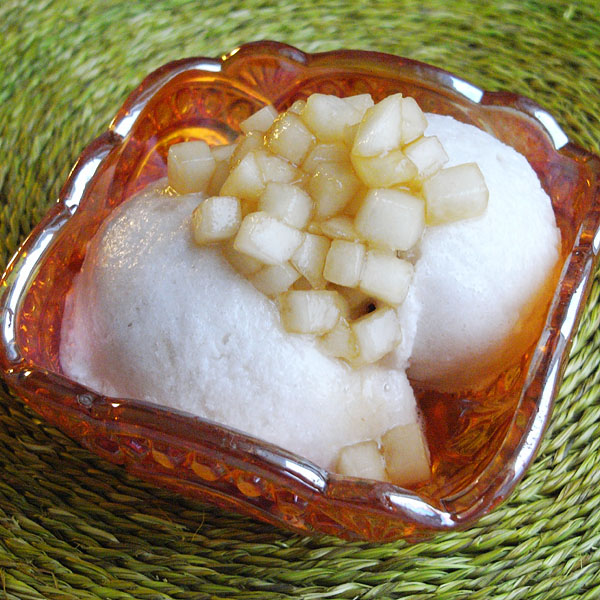
    Experiment no. 2: ice cream is made without churning using foamed egg whites to incorporate air (is this what Italians refer to as a frozen parfait?)
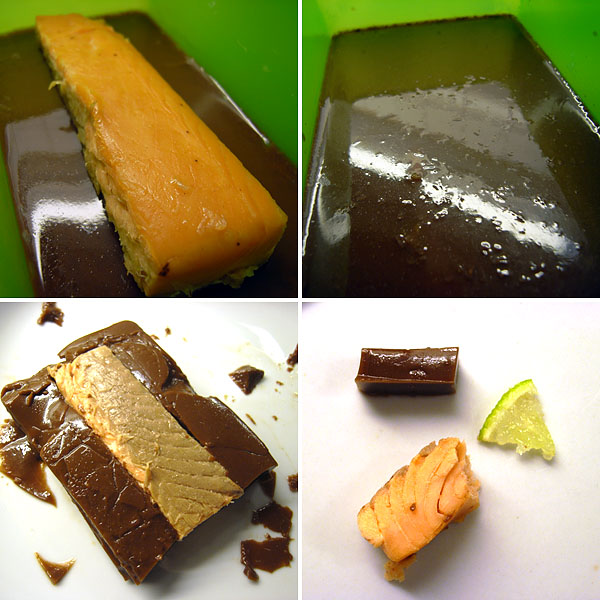
    Experiment no. 4: meringues floating on a pool of custard sauce drizzled with caramel

If you’d rather reverse engineer the dishes, my list of hydrocolloid suppliers might come handy. The “tasting notes” also gives you some hints if you want to have a go on your own.

Ten tips for practical molecular gastronomy

Saturday, January 27th, 2007

In a recent survey 72% of chefs say they may want to experiment with molecular gastronomy in 2007. That’s an impressive number and considering the attention molecular gastronomy gets in media I bet many home cooks would want to experiment in the kitchen as well. Here’s a list of things to consider if you want to make a scientific approach towards cooking:

1. Use good and fresh raw materials of the best quality available.

2. Know what temperature you’re cooking at. A dip probe thermometer with a digital read out is a cheap way to bring science into your kitchen.

3. Get a basic understanding of heat transfer, heat capacity and heat conductance. “Heat” in this context des not imply high temperature since it also applies to the understanding of freezing/thawing.

4. Learn how to control the texture of food. Some key points: temperature induced changes (freezing, heating), emulsifiers, thickeners, gelling agents, moisture content, pressure/vacuum, osmosis.

5. Learn how to control taste and flavor. Some key points: flavor pairings, spice synergies/antagonies, influence of temperature (Maillard reaction, caramelization, temperature stability, volatility), taste enhancers, taste suppresants, solubility of flavour compounds in fat/water, extraction.

6. Remember that prolonged exposure to a flavor causes desenzitation, meaning that your brain thinks the food smells less even though it’s still present in the same amount. Therefore, let different flavours enhance each other. Similarly, variation in taste, texture, temperature and color can open up new dimensions in a dish. This is referred to as “increased sensing by contrast amplification”.

7. Be critial to recipes and question authority - they do not necessarily represent “the truth”. Nevertheless, you can certainly learn a lot from the experts.

8. Dare to experiment and try new ingredients and procedures. Do control experiments so you can compare results. When evaluating the outcome, be aware that your own opinions will be biased. Have a friend help you perform a blind test, or even better a triangle test to evaluate the outcome of your experiments.

9. Keep a written record of what you do! It would be a pity if you couldn’t recreate that perfect concoction you made last week, simply because you forgot how you did it.

10. Have fun!

blue_gas_flame.jpg
Heat causes many changes in food, but few appreciate how important it is to know at what temperature they are cooking and at what temperature the desired change occurs.

These tips for molecular gastronomy relate to the technical and scientific aspects of food preparation and eating, and I plan to elaborate on each of the points in separate blog posts. However, according to Hervé This’ definition of molecular gastronomy, one should also investigate the social and artistic components of cooking. A good example of this is the “Five Aspects Meal Model” developed at Grythyttan in Sweden (Gustafsson, I.B. et al. Journal of Food Service, 2006, 84.). Although intended for a restaurant setting, the general idea can also be applied for home cooking.

The meal takes place in a room (room), where the consumer meets waiters and other consumers (meeting), and where dishes and drinks (products) are served. Backstage there are several rules, laws and economic and management resources (management control system) that are needed to make the meal possible and make the experience an entirety as a meal (entirety – expressing an atmosphere).

Or to put it differently: average food eaten together with good friends while you’re sitting on a terrace with the sun setting in the ocean will taste superior to excellent food served on plastic plates and eaten alone in a room with mess all over the place.

One last thing: once you’re finished in the kitchen with your culinary alchemy, your gastro physics, your cutting edge science cuisine, your molecular cooking, your hypermodern emotional cooking, your science food or whatever fancy name you attach to it - remember the social and artistic components when you serve the food. Just so people won’t refer to you as a techno chef, a mad scientist or a modern day Willy Wonka. After all, molecular gastronomy is about the science of deliciousness, not technical wizardry.

Questions and topics for future blog posts are welcome at webmaster [a] khymos.org (substitute @ for [a]) or as a comment below.

Ingredients for molecular gastronomy

Sunday, January 14th, 2007

Since The fat duck and El Bulli were announced “Best restaurant” in 2005 and 2006 respectively by Restaurant Magazine, molecular gastronomy has received increased attention. This has also resulted in a greater demand for the ingredients used, especially various thickeners, stabilizers and emulsifiers. In Europe, these have been given E-numbers ranging from E400-E499. The other ranges include colours (E100-199), preservatives (E200-E299), acidity regulators, anti-oxidants and anti cacking agents (E300-E399, E500-E599) and flavour enhancers (E600-E699). The European numbering is a sub-set of an international list of food additives, the Codex Alimentarius.

alchemist's pantry
The Alchemist’s pantry - an early predecessor to that of the modern cook! (picture source)

Some of the most used ingredients in restaurant kitchens are listed below:

E322 Lecithin
E327 Calcium lactate
E331 Sodium citrates
E400 Alginic acid
E401 Sodium alginate
E402 Potassium alginate
E403 Ammonium alginate
E404 Calcium alginate
E406 Agar
E407 Carrageenan
E407a Processed eucheuma seaweed
E410 Locust bean gum (Carob gum)
E412 Guar gum
E413 Tragacanth
E414 Acacia gum
E415 Xanthan gum
E416 Karaya gum
E417 Tara gum
E418 Gellan gum
E422 Glycerol
E425 Konjac
E440 Pectins
E441 Gelatine
E461 Methyl cellulose
E463 Hydroxypropyl cellulose
E464 Hydroxy propyl methyl cellulose
E466 Carboxymethyl cellulose
E473 Sucrose esters of fatty acids
E474 Sucroglycerides
E621 Monosodium glutamate
E631 Disodium inosinate
E636 Maltol
E953 Isomalt
E1103 Invertase
E1400 Dextrin
Transglutaminase (no E-number as far as I know)

(click here for the full list)

Unfortunately these ingredients are not available in normal stores (with one exception: gelatine). Of course they are readily available in large quantities to the food industry, but lately suppliers of sub-kilogram amounts have appeared. I have collected a list of these suppliers - if you’re not on the list, drop me a note at webmaster((a))khymos((dot))org). Recent additions to the list include Kalys, texturePro and DCDuby.

One challenge with the different shops is that some products come with little or no technical specification. For cellulose ethers for instance, Dow provides an extensive range to industrial customers (more on this in a previous blog post on cellulose ethers), just to give you an idea of the product range available.

I should also add a closing remark om tools: some companies sell syringes, measuring spoons etc in “nice boxes”. However, these tools can most often be obtained for a fraction of the price at any drug store, pharmacy or kitchen hardware store.

Once you have stocked up with your cooking chemicals, the next question is - how do you use them? I would recommend the information provided by INICON on molecular gastronomy and textures (MANY pdf’s to download). Also, many of the suppliers have recipes on their homepages.

Hot vanilla ice cream

Monday, November 27th, 2006

I’ve mentioned hydrocolloids at several occasions earlier in the blog, and today I found an interesting recipe I would like to share. Put simple, hydrocolloids are compounds that form gels when mixed with water. One particular hydrocolloid is methyl cellulose whose chemical structure is as follows:

Methyl cellulose

Methyl cellulose is made from cellulose. Methyl celluloses are available with varying degrees of methyl substitution. Typically 40-90% of the hydroxy groups are methylated. Often the degree of substitution (DS) is given as the average number of hydroxy groups that have been methylated per anhydroglucose unit, so the maximum DS is 3. The solubility in water decreases with increasing methyl substitution. One interesting property of methyl cellulose is the fact that it dissolves readily in cold water, but solidifies when you heat it (such gels are often referred to as thermoreversible). Using this property it is possible to make a hot “ice cream” that melts as it cools down. Does this sound weird? Here’s a recipe from Ideas in food so you can try it at home:

Hot Vanilla Ice Cream
306 g whole milk yogurt
230 g cream cheese
80 g agave nectar
154 g water
1 Bourbon vanilla bean scraped
pinch of sea salt
11.55g Methocel food gum (SGA150)

In a blender puree together the yogurt, cream cheese, agave nectar, the insides of the vanilla bean and the salt. Blend just until the mixture comes together as a smooth puree, but do not aerate. Meanwhile, heat the water up to a boil. As soon as the water boils remove from the heat and whisk in the Methocel. Once the Methocel is dispersed, add it to the blender and puree the contents until the mixture is homogenized, again avoid aeration.

Once the mixture is combined, pour it into a bowl over an ice bath to chill. Let the ice-cold mixture rest for at least an hour, preferably overnight before poaching the ice cream.

When ready to make the ice cream, heat a pot of water to a boil. When the water boils, shut off the heat and scoop the ice cream base. As you scoop, wipe the edges of the ice cream scoop, and then immerse the scoop and its contents into the hot water. You will see the ice cream set, and then dislodge it from the scoop. The ice cream should poach for about one minute for small scoops and longer for larger scoops. (Depending on how much ice cream you are poaching you may have to turn the heat back on to keep the water hot.)

Once the ice cream is set, remove the scoops, drain briefly on a paper towel and place into serving dishes with whatever garnishes you want. As the mixture chills the ice cream will “melt” in your dish, blending with the garnishes like and actual cold ice cream sundae.

First challenge is to get hold of methyl cellulose (also known as Methocel which is the trademark owned by Dow - BTW, they have very informative pages on food grade methyl cellulose). From Dow’s pages, it seems the SGA in the name refers to “METHOCEL Super Gelling A-Type Food Gums”. Methocell A has a DS = 1.8 and a 2% solution of this methyl cellulose sets at 50-55 °C, forming a firm gel. For a overview of Dow’s full range, check out this pdf. Click here for information about where to buy methocel (most likely in larger quantities).

For small quantities of methyl cellulose you can check out Will Goldfarb’s site (unfortunately, there’s no information about which type of methyl cellulose this is Update: It’s Dow’s F50 - a semi-firm gel forms at 62-68 °C). The Texturas series by elBulli includes Metil (with a methyl cellulose base, whatever that means), but again, I haven’t been able to find any information as to what kind of methyl cellulose this is (they do mention a gelling temperature in the range 40-60 °C however).

I’ll be happy to include further links to suppliers of methyl cellulose (and other hydrocolloids) both here and on my suppliers page if you know about any!

For those really interested, Ideas in food have several other recipes requiring methyl cellulose: hot mozarella sheets, hummus gnocchi and caramellized yoghurt gnocchi.

Gastro physics

Monday, October 23rd, 2006

There is certainly some overlap between molecular gastronomy, kitchen chemistry, gastro physics, culinary physics and everyday chemistry… That’s why I thought the January 2004 issue of Physics Education would be of interest. It features a section on food physics, covering topics such as melting of chocolate, popping of popcorn, photographing food with visible and infrared light etc. Most of the material is for subscribers only (your local university library probably has a subscription!), but the free material includes a nice article by Jon Ogborn (entitled “Soft matter: food for thought”) on foams, gels and emulsions. Did you for instance know that mayonnaise is thixotropic?

This means that it only flows after a certain minimum stress has been applied (figure 6). This is unusual. Liquids usually flow even under the smallest stress.

Non-drip paint is also thixotropic. It retains its shape, but becomes fluid when enough stress is applied, for example when a paint-roller moves through it. Once the stress is removed, the paint becomes stiff again, as it is then only affected by gravity, and does not flowdown the coated surface. It contains large molecules that form a gel, keeping the paint in place. The gel structure breaks down if enough stress is applied, only to re-form quickly once the stress has been removed. So, paint is liquid on the brush and solid on the wall. Try painting with mayonnaise!

Thixotropic materials are also referred to as shear thinningpedia. However, according to this page, the terms thixotropic and shear thinning are easily confused, so here’s the IUPAC definitions:

Shear thinning: If viscosity is a univalued function of the rate of shear, a decrease of the viscosity with increasing rate of shear is called shear thinning, and an increase of the viscosity shear thickening.

The application of a finite shear to a system after a long rest may result in a decrease of the viscosity or the consistency. If the decrease persists when the shear is discontinued, this behaviour is called work softening (or shear breakdown), whereas if the original viscosity or consistency is recovered this behaviour is called thixotropy.

Ketchup is shear thinning (or was it thixotropic?), and an amusing website has even been set up to investigate “The great Ketchup mystery”.

k_hz.jpg

Their conclusion so far is:

… the next time you whack the bottom of a ketchup bottle [consider this:] Even supercomputers can’t predict the outcome.

Spain’s top chefs display tools and techniques in NY

Friday, October 20th, 2006

Spain’s top 10 chefs, including Ferran Adria of El Bulli, were featured at the “Spain’s 10 - Cocina de Vanguardia” in New York. Off the broiler and foodite have nice reports. I particularly fancy their pictures, depicting how laboratory equipment, liquid nitrogen and dry ice is used more and more in restaurant kitchens. I have described a number of tools in this static page. Here’s a couple of pictures from Off the broiler (with my comments added):

Rotavap
Joan Roca uses a Rotavap (rotary evaporator) to capture the volatiles from a mixture of mud and water. The volatiles where then foamed and served with an oyster dish. The nice thing with a rotavap is that by reducing the pressure, you can perform distillations at room temperature.

methylcellulose for thickening
Methyl cellulose is a versatile thickening agent, although it’s not commonly available for home cooking.

coconut shells
Coconut milk was frozen by first dipping a large spoon into liquid nitrogen, then dipping it into the coconut milk. The shell was then freeze dried. Seems to give a nice texture!

dry ice
Grilled pineapple with a strawberry sauce that is carbonated using dry ice. This gives the sauce a nice sparkling sensation on the tounge.

Molecular mixology: Jellied G&T

Sunday, October 8th, 2006

Wired has a feature on “Better drinking through chemistry”. This includes a recipe for Eben Freeman’s jellied gin and tonic. This was made for Herve This’ molecular mixology masterclas held at the Ritz in Paris (hosted by Bols, more links here). I found the picture below a long time ago at Drink boy and though it was really cool, but I didn’t quite figure out how it was done. Until now! Enjoy the picture and the recipe.

gt.jpg

Jellied gin and tonic, by Eben Freeman
1 frozen lime
2 oz. simple syrup
1 1⁄4 tsp. citric acid
1⁄4 tsp. bicarbonate of soda
1⁄4 tsp. confectioner’s sugar
1 1⁄2 sheets of sheet gelatin
1 oz. gin
2 oz. tonic water
Freeze lime and cut into chips with deli slicer. Coat slices in simple syrup and 1 tsp. citric acid; bake at 150 degrees until crisp. Mix bicarbonate of soda, sugar, and remaining citric acid. Soften sheet gelatin in cold water for two minutes. Warm gin and add gelatin. Pour into a shallow baking pan lined with plastic wrap, add tonic, and refrigerate for two hours. Cut into 1⁄2-inch cubes. Put cube onto lime chip, sprinkle on sugar-soda-acid mixture (the acid combines with the baking soda for a carbonated feeling on the tongue), and serve.

Espesso - a thick, lucious espresso foam

Sunday, October 8th, 2006

Ferran Adria’s espresso foam, named “Espesso”, is indeed a fascinating concoction, created in cooperation with coffee producer Lavazza. The word espesso is a combination of espresso and the Italian word spesso, meaning thick. Just luck at the thick lucious foam.

closeup picture of cup with espesso

The invention has been commented on thoroughly in the blogosphere. See for instance Skillet Doux and Movable Feast - both feature some nice close-up pictures of espesso (including the one above).

Espesso has been available in Europe since 2002 (anyone know where?), but was just recently introduced in the US. Appearantly, the foam is served warm in Europe, but has been served cold in Chicago, at Lavazza’s three locations there.

According to the reports, espesso is made from espresso and a “secret” ingredient. The ingredients are mixed and left to settle for 12 hours under pressure. The product is then dispensed from the iSi Gourmet Whip (more info here, the propellant gas is nitrous oxide, N2O). As a chemist I certainly wonder what the “secret” ingredient is? If it is true that espesso has been served both warm and cold, they would need to use a thickening agent which is not very sensitive to temperature. Also, it appears that the foam once served is not stable for more than a couple of minutes.

My best guess would be xanthan and guar gum, or possibly a combination of the two. These hydrocolloids show thixotropic properties - when subjected to pressure/agitaion they soften, but then they jellify again afterwards. In other words - they could be easily dispensed through a siphon and would then solidify in the cup. Also, xanthan and guar gum are relatively temperature independent with regard to their thickening properties. Check out the INICON manuals on texture for great (and FREE!) information on these and several other hydrocolloids.

Update: The Lavazza homepage now features a video and a tool to find your nearest Espesso!

Video on alginates

Sunday, September 17th, 2006

My fellow blogger on molecular gastronomy, Göde Schüler (check out his German MG blog Gourmetrics) found a great video on YouTube. The video shows how a red beet paste mixed with alginate solidifies when dripped into a solution of calcium lactate (this solution is normally clear, the yellow colour comes from extensive use).

Chef Simon (French, click here for babelfish translation) has a nice page on alginates as well. Another french page here (with english translation by babelfish). You can find links to more technical information (free pdf’s) on alginates in the static pages of khymos.org.

The chemical principles put simply are as follows:
Sodium alginate is water soluble and can be mixed with many different fruit/vegetable juices and purés. When dripped into a solution containing calcium ions, each calcium ion (which holds a charge of +2) knocks away two sodium ions (each holding a charge of +1). The alginate molecule contains loads of hydroxyl groups (OH’s) that can be coordinated to cations (that’s ions with a positive charge such as sodium and calcium).

calcium alginate

When alginate is coordinated to sodium, it’s a very flexible chain. When sodium is replaced by calcium however, each calcium ion (black dots in the image below) coordinates to two alginate chains, linking them together. The flexible chains become less flexible and form a huge network - a gel. The fun thing is that this happens within seconds after the alginate mixture is dripped into the water bath with the calcium ions.

Two alginate chains

Approximate concentrations:

  • Fruit/vegetalbe juice/puré with 1-2% sodium alginte
  • 2% calcium chloride solution (approx. 10g in 1/2 L of water) - because calcium chloride has a slightly bitter taste, it is a good idea to rince these pearls with water before consumption. This is also the reason why calcium lactate is often used in stead (as shown in the video).

Update: The Frog Blog has nice posts with pictures showing how Jay Veregge and Joel Robuchon utilize alginate gels. Also, check out this “caviar” maker for dripping 96 drops of sodium alginate solutions into calcium chloride at once.