Archive for the ‘hydrocolloids’ Category

TGRWT #5: Grilled pork tenderloin with chocholate beef stock cream

Sunday, August 26th, 2007

chocolate-beef-stock-cream.jpg

This month’s TGRWT is hosted by Le Petite Boulanger, and the foods to pair are chocolate and meat. The recipe for the chocolate beef stock cream is inspired by the Iberian Ham Cream by Ferran Adrià/El Bulli (the recipe can be found on p. 21 in the hydrocolloid recipe collection). I used anis because it brings out the meatiness very well. After mixing in the olive oil I saw that the droplets were not properly dispersed. Addition of some lecithin which solved this problem.

Chocolate beef stock cream
100 g water
2 g beef stock powder
10 g chocolate (70%)
1/4 t anis, powdered
0.5 g xanthan
0.2 g lecithin
20 g olive oil
honey and chili oil to taste

Heat water to dilute beef stock and melt chocolate. Cool. Add xanthan and lecithin. Mix with immersion blender. Add olive oil. Mix until smooth texture. Sprinkle with chives.

Grilled pork tenderloin
pork tenderloin, cut in 3 cm thick pieces
oil
powdered anis
crushed garlic

Marinate meat with oil, garlic and anis mixture. Grill. Serve together with the chocolate meat broth cream.

pork-chocolate-beef-stock-cream.jpg

Verdict: The chocolate beef stock cream has very meaty and almost nutty flavour. Honey is important to round of the otherwise slightly bitter taste of the chocolate. Chili oil gives it a bite, but can be omitted.

You can get an impression of the texture from this video:

Hydrocolloid recipe collection

Tuesday, August 14th, 2007

I’m happy to finally announce the first edition of a recipe collection devoted mainly to hydrocolloids. Totaling 111 recipes, it’s available for download as a pdf file (29 pages, 433 kB).

Update: The collection has been revised and is now available for download (more than 220 recipe, 73 pages, 1.8 Mb).

The following text is from the introduction I’ve written to the recipe collection:

A hydrocolloid can simply be defined as a substance that forms a gel in contact with water. Such substances include both polysaccharides and proteins which are capable of one or more of the following: thickening and gelling aqueous solutions, stabilizing foams, emulsions and dispersions and preventing crystallization of saturated water or sugar solutions.

In the recent years there has been a tremendous interest in molecular gastronomy. Part of this interest has been directed towards the “new” hydrocolloids. The term “new” includes hydrocolloids such as xanthan which is a result of relatively recent research, but also hydrocolloids such as agar which has been unknown in western cooking, but used in Asia for decades. One fortunate consequence of the increased interest in molecular gastronomy and hydrocolloids is that hydrocolloids that were previously only available to the food industry have become available in small quantities at a reasonable price. A less fortunate consequence however is that many have come to regard molecular gastronomy as synonymous with the use of hydrocolloids to prepare foams and spheres. I should therefore emphasize that molecular gastronomy is not limited to the use of hydrocolloids and that it is not the intention of this collection of recipes to define molecular gastronomy.

One major challenge (at least for an amateur cook) is to find recipes and directions to utilize the “new” hydrocolloids. When purchasing hydrocolloids, typically only a few recipes are included. Personally I like to browse several recipes to get an idea of the different possibilities when cooking. Therefore I have collected more than 100 recipes which utilize hydrocolloids ranging from agar to xanthan. In addition to these some recipes with lecithin (not technically a hydrocolloid) have been included. Recipes for espumas that do not call for addition of gelatin or other thickening agents have also been included for completeness.
All recipes have been changed to SI units which are the ones preferred by the scientific community (and hopefully soon by the cooks as well). As far as possible, brand names have been replaced by generic names. Most of the recipes have been edited and some have been shortened significantly. In some recipes, obvious mistakes have been corrected. But unfortunately, the recipes have not been tested, so there is no guarantee that they actually work as intended and that the directions are complete, accurate and correct. The recipes have been collected from various printed and electronic sources and every attempt has been made to give the source of the recipes.

Since recipes can neither be patented nor copyrighted, every reader should feel free to download, print, use, modify, distribute and further develop the recipes contained in this compilation. The latest version will be available for download from http://khymos.org/recipe-collection.php and will also be announced at http://blog.khymos.org. Feedback, comments, corrections and new recipes are welcome at recipe.at.khymos.dot.org.

Martin Lersch
Oslo, August 2007

Banana marshmallows with parsley (v 1.5)

Saturday, June 23rd, 2007

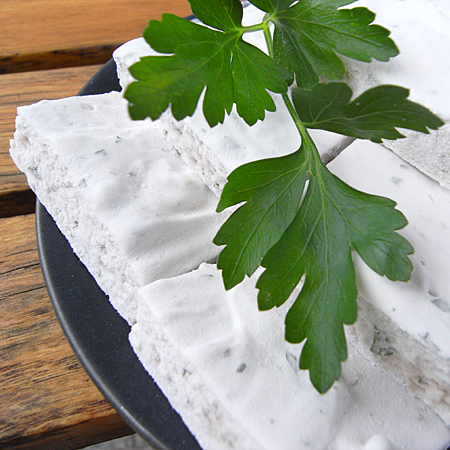
parsley-fresh-dried.jpg

For TGRWT #2 I made banana marshmallows with parsley. The texture came out nice, but the initially fresh parsley flavour had become grassy/hay-like over night. The litterature I referred to last time suggested that the off-flavour is produced by oxidation of unsaturated fatty acids or polyenes. There are several strategies to avoid this. The first would be not to mince the parsley as finely as I did last time to avoid exposure to the air’s oxygen. If the oxidation is enzymatic, blanching would be helpful. And it would also be worthwhile to see if addition of lemon juice (vitamin C and citric acid, are both antioxidants) would have any effect (however, on second thought this would be strange since parsley already has a lot of vitamin C!). Mirko Junge commented last time that freeze dried parsley would possibly retain more of the freshness and he most generously provided me with several samples of freeze dried parsley. I decided to proceed with the following six types of parsley for my marshmallows:

  1. fresh parsley leaves, chopped to pieces of about 2-3 mm (picture above, left)
  2. parsley leaves, blanched for 30 sec, chopped to pieces of about 2-3 mm
  3. parsley leaves, sprinkled with lemon jucie, chopped to pieces of about 2-3 mm
  4. parsley leaves, blached for 30 sec, sprinkled with lemon juice, chopped to pieces of about 2-3 mm
  5. freeze dried parsley from Goutess (picture above, right)
  6. plain, dried parsley from my local store (picture above, front)

I used the same recipe as last time, but split the whipped sugar-gelatin-banana mixture into six different bowls before mixing with the parsley. I used approximately 0.6-0.8 g of fresh parsley for each of the entries 1-4. I tried to estimate the amount of dried parsley to use by eye, comparing with the amount of fresh leaves. The amount of dried parsley used was less than 0.1 g, so my balance was not of much help. The picture below might give you an idea.

parsley-six-bowls.jpg
Six different types of parsley were prepared immediately prior to mixing with the marshmallow base to minimize oxidation.

marshmallow-six-bowls.jpg
If the term ‘parallel cooking’ has not been invented yet, this might be good time to introduce it.

parchment-paper-marshmallow.jpg
I let the marhsmallows set between two sheets of greased parchment paper.

banana-parsley-marshmallow-tasting.jpg
Blind tasting of banana parsley marshmallows.

My wife helped me do a blind tasting to avoid any bias. The six marshmallow samples were each associated with a three digit code and presented on a plate to the taster. We both did two rounds each (A1/A2 and B1/B2) and the results are summarised in the table below. The scoring only describes the parsley flavour unless otherwise noted.

Parsley used A1 A2 B1 B2 Sum
Fresh parsley 5 5 5 5 20
Blanched parsley 4/* 1 2/* 2 9
Parlsey with lemon juice 0 1 5 5 11
Blanched parsley with lemon juice 1 0/* 2/- 0/- 3
Freeze dried parsley 4 2 2 2 10
Dried parsley 0/- 0/- 0 2 2

Legend:
5 fresh parsley, strong
4 fresh parsley, weak
2 grassy/hay-like parsley, weak
1 grassy/hay-like parsley, strong
0 neither fresh nor grassy, weak overall
- disagreeable
* banana dominates

I was quite surprised once I had decoded the score sheets. Fresh parsley cut into relatively large pieces gave a parsley flavour without any hints of grassy or hay-like off flavours! Blanching or treatment with lemon juice were both detrimental to the parsley flavour, and even more so when combined. The variation observed for could be a result of an uneven distribution of the parsley in the marshmallow (increased parsley flavour if you happen to chew a leaf). The freeze dried parsley didn’t do very well compared with fresh parsley, but outperformed the dried parsley from my local store which didn’t have much flavour at all. Both samples of dried parsley however were dominated by a grassy/hay-like flavour. I should add that the grassy/hay-like flavour in itself is not especially disagreeable, but it does not go very well together with the banana.

The result is interesting and perhaps a little counter intuitive. Generally one would say that a larger surface area (= finely chopped) would enhance the flavour release. This experiment however shows that this is not universally true, especially if the flavours can be oxidized. So next time you make banana parsley marshmallows remember that less chopping gives better parsley flavour.

TGRWT #3: Foamy strawberries with coriander

Sunday, June 17th, 2007

strawberry-coriander-icecream.jpg

Previously I had only tasted sliced strawberries with a fresh coriander leaf, just as a very basic illustration of this pairing. I must say I liked the combination, even though it’s dominated by coriander (or cilantro as it’s called in North America). But I figured that once the strawberries are processed into a dish, one would probably have to reduced the amount of coriander, so I did quite a lot of tasting as I proceeded with this combination for the third round of “They go really well together” (previous rounds: TGRWT #1, TGRWT #2). And I was surprised how well the coriander came through, even when using as little as 0.5 g! So start with a small amount of coriander if you decide to try this. Several have commented that they’re not to fond of coriander or the strawberry/coriander combo, and I wonder if this could be because they used too much coriander?

Anyway, I decided to go for a warm strawberry foam and be carefull with the amount of coriander. I started out without sugar, but found that sugar was essential for the strawberry coriander pairing (unless I would have taken it all in a savory direction like M did). Balsamico vinegar emphasizes the strawberry aroma and adds acid which I find important. If you plan to prepare this dish, I would suggest to add coriander, sugar and vinegar a little at a time, just to make sure it fits your taste.

Foamy strawberries with coriander and balsamic vinegar
200 g strawberries
0.5 g fresh coriander leaves
30 g sugar
14 g balsamic vinegar
150 g water
1 g xanthan

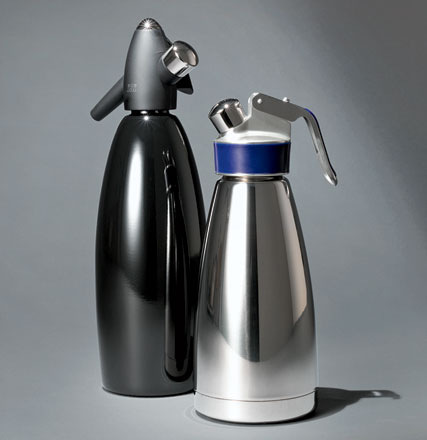
Make a purée of strawberries, coriander, sugar and balsamic vinegar with an immersion blender. In a separate container, mix water and xanthan using the same blender and add to the strawberry mix. Xanthan gives a viscous solution and helps retain the bubbles. The nice thing with xanthan is that it dissolves in cold liquid and requires no heating, but is stable at higher temperatures if you should want to heat the mixture. The immersion blender can be used to whip in some air, but for an even more airy texture, use an ISI whipper (many models available: cream, easy, gourmet, dessert, thermo) and charge with a cream charge (N2O). Important: you must filter out ALL the small stones from the strawberries using a cheese cloth or a towel, before transfering the mixture to the whipper, as these will clog the nozzle of the wipper (mine got clogged!). For a warm foam, heat the whipper in a water bath at 60-70 °C, but only do this if you have the ISI gourmet or thermo whippers which are designed for higher temperatures.

strawberry-coriander.jpg

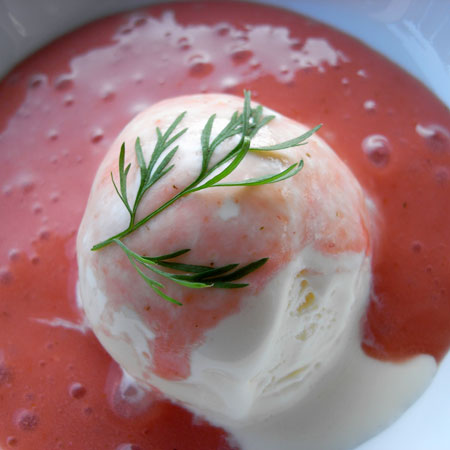
Verdict: I was very satisfied and my wife liked it too! There’s a good balance between the strawberry and coriander aroma. Sugar rounds of the taste and the balsamic vinegar balances the sugar with it’s tangyness. I served the foam warm together with plain vanilla ice cream – delicious! At room temperature the sugar/acid balance was perfect according to my taste, but when served warm the foam was perhaps a little on the sweet side (which comes as no surprise as sweetness decreases when lowering the temperature).

strawberry-coriander-foam-closeup.jpg
Closeup of a larger air bubble below the surface! Who can resist to taste this?

Banana marshmallows with parsley (TGRWT #2)

Sunday, May 20th, 2007

banana-parsley-marshmallow-4.jpg

A while back I saw Evelin’s post on how to make marshmallows for Valentine’s day, and I knew immediately that I would like to give it a try. With TGRWT #2 coming up (that’s the second round of the food blogging event “they go really well together”), I thought I’d make marshmallows with a banana parsley twist. I figured that the banana flavour should fit very well with the soft and airy, yet elastic texture of marshmallows. And I was very curious to find out how the parsley would fit in!

Marshmallows were originally made using egg whites and the sap of the root of the marshmallow plant which were cooked with sugar and whipped into a foam. Today the marshmallow sap and egg white have been replaced by gelatin which is a protein produced from collagen in the connective tissue of animals. Proteins are good at stabilising foams (see previous post on how to make a Vauqelin). Addition of sugar increases the viscosity which stabilizes the foam even more. In marshmallows this is taken to an extreme. A large amount of gelatin is added to a concentrated solution of sugar (and corn syrup). This mixture is whipped for about 10 minutes to incorporate air and to break up larger air bubbles into smaller ones.

The first challenge was to find a suitable recipe. There are recipes that call for sugar only whereas others call for sugar and corn syrup (this recipe also gives a hint on how to substitute fruit purree for water). Corn syrup is added to prevent crystallization. Also some recipes use egg whites which are said to give a lighter texture. I decided to go for a simple recipe and used only sugar. I would also need to substitute mashed bananas for some of the water. Addition of parsley shouldn’t need any special adjustments of the recipe. I ended up with a recipe which is more or less a mixture of all these.

If you’re unsure about the process of how to make marshmallows, Cooking for Engineers has a detailed step-by-step description with pictures. The pictures at the end of this post should also give you an idea of what the texture is like. If you’re still lost, check out this video (the first in a series of six) on how to make mango marshmallows.

Banana marshmallows with parsley
65 g water
200 g sugar
10 g gelatin, bloomed in plenty of water
65 g banana, mashed
parsley (see comment below on why it shouldn’t be finely chopped)

Bring water and sugar to boil while stirring. Remove from heat when temperature reaches 110-115 °C (230-240 F). Add bloomed gelatin sheets and mashed bananas. Whip for 10 minutes (much longer than you think!). Add parsley to taste. Grease a pan, sprinkle with powdered sugar and spread mixture in pan. When set, invert pan on a surface dusted with plenty of powdered sugar and starch. Cut up in desired pieces and coat every cut surface with powdered sugar and starch.

What about the taste? I tasted the mixture before it set and was surprised by how well the banana and parsley blended together. To be honest, it tasted really nice! The next day however, after I had cut the marshmallows into squares, they tasted quite different. The parsley aroma had changed significantly and was more reminiscent of hay, so I was quite disappointed. The banana flavour was still intact, but I felt it was somewhat weaker than in the fresh mixture. Nevertheless, some guests I served it to reached out for both a second and a third piece of my banana marshmallows with parsley, so they couldn’t have been that bad after all. Perhaps it had to do with the texture which was really, really nice!

It turns out that the hay like off flavour of parsley is well known and described in the litterature! See for instance “Hay-like off-flavour of dry parsley” or “Evaluation of the effect of drying on aroma of parsley by free choice profiling”. The molecule responsible for the hay-like off flavour is 3-methyl-2,4-nonanedione. And apparently vacuum-microwave drying of parsley gives less hay flavour.

It is suggested that the hay like off flavour is formed by oxidation of unsaturated fatty acids or polyenes. As a consequence, I would suggest not to chop the parsley (or at least leave large pieces intact) to limit the exposure to oxygen. After parsley has been added, the mixture should be mixed carefully to keep the leaves intact. I used finely chopped parsley when I made the marshmallows in order to increase the release of volatile compounds from the parsley, and I think this is the main reason why I got the hay like off flavour.

banana-parsley-marshmallow-1.jpg
Whip until you get a thick, creamy texture.

banana-parsley-marshmallow-2.jpg

banana-parsley-marshmallow-3.jpg
Spread in a pan greased with butter/fat and sprinkled with powdered sugar.

banana-parsley-marshmallow-5.jpg

First experiments with sodium alginate

Friday, March 30th, 2007

Here’s some pictures and a video of my first experiments with sodium alginate and spherification. I used sodium alginate from the Texturas series and calcium chloride from a drug store. Needless to say, I’m very fascinated by the texture and the whole process. I have blogged about the chemistry behind previously.

Materials used:
2.0 g sodium alginate
200 g water (with low calcium content!)
50 g blueberry syrup

2.5 g calcium chloride
500 g water

Procedure:
2 g sodium alginate and 200 g water were mixed vigourously in blender. The mixture was then left to stand for some hours to get rid of the air bubbles. 50 g blueberry syrup was then added to the sodium alginate solution. A calcium chloride bath was prepared by dissolving 2.5 g calcium chloride in 500 g water. The sodium alginate/blueberry mixture was dripped into the calcium chloride bath using a plastic syringe with a steel cannula. After 1-3 min the pearls were removed and rinsed with water.

More detailed procedure with pictures and video:
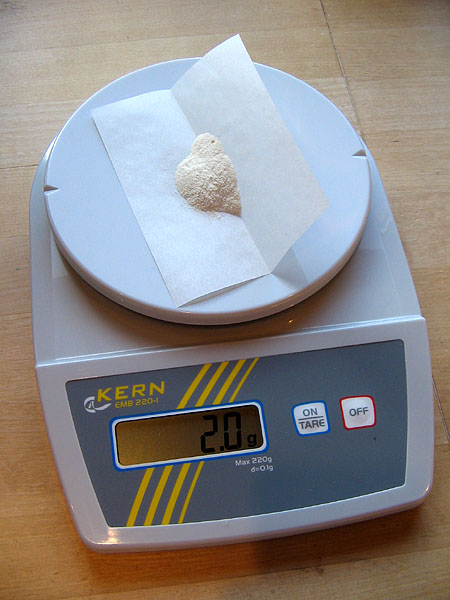
I had to obtain a scale with a 0.1 g accuracy to weigh out 2.0 g of sodium alginate (my first experiments using a normal kitchen scale failed). The model I got cost about $100 and is inteded for school laboratories. Amazon provides several scales with this accuracy.

alginate-1.jpg

I used a blender to dissolve sodium alginate in water. This incorporates a lot of air in the mixture which we don’t want. It could possibly be avoided by using an immersion blender/mixer. However, I just left the alginate solution on the bench and after 3-4 hours the air bubbles had all escaped from the solution.

alginate-2.jpg

Plastic syringes and cannulas can be obtained from your local drug store or pharmacist. I found it was easier to produce evenly sized drops with a sharp cannula (CAREFULL!) than with just the plastic tip of the syringe. This of course depends on the viscosity of the solution. By thickening (with xanthan for instance) you can produce larger drops.

alginate-6.jpg

After 1-3 min the spheres were removed from the calcium chloride solution and rinsed with clean water. I dried the spheres carefully using a kitchen towel or paper.

alginate-7.jpg

alginate-3.jpg

Definitely looks like caviar when presented on a spoon like this!

alginate-4.jpg

Larger spheres were made by filling a small measuring spoon with the alginate mixture (I used a syringe for this so the outsides of the spoon would not be covered with alginate solution) and carefully emptied it into the calcium chloride bath. It takes some trial and error to achieve good results.

alginate-5.jpg

The spheres are suprisingly robust and can be handled without rupturing.

alginate-8.jpg

If cut with a knife, the spheres rupture and the liquid contents flows out.

alginate-9.jpg

The small spheres didn’t taste much, so I could have added more blueberry syrup. The large spheres however had a nice taste. The surprise element when they rupture in your mouth is very nice!

Practical molecular gastronomy, part 4

Saturday, March 17th, 2007


(Photo by vintage_patrisha at flickr.com)

4. Learn how to control the texture of food

Taste and flavour normally get more attention when food is discussed, but the texture of food is equally important and our tongue is very sensitive, not only to taste and temperature, but also to the texture of food. The texture of food determines it’s mouthfeel and it is related to many physical properties of the food. Wikipedia lists the following aspects of mouthfeel (click to see the full description of each aspect) which can be useful when analyzing food:

Adhesiveness, Bounce/Springiness, Chewiness, Coarseness, Cohesiveness, Denseness, Dryness, Fracturability, Graininess, Gumminess, Hardness, Heaviness, Moisture absorption, Moisture release, Mouthcoating, Roughness, Slipperiness, Smoothness, Uniformity, Uniformity of chew, Uniformity of bite, Viscosity, Wetness

I will barely scratch the surface of how texture can be controlled by highlighting a couple of topics and point you to further resources. Hopefully it will spark your interest and give some new ideas for you to play with in the kitchen. Those interested in a comprehensive review of food texture are referred to the CRC handbooks on food texture (volume 1: semi-solid foods, volume 2: solid foods).

What determines the texture of food?
Put very simple, it’s the relative amounts of air, liquid and solids that determines the texture of food. This is complicated by the fact that liquids have different viscosities. Furthermore the air, liquid and solid ratio is not necessarily constant. A liquid can solidify or evaporate, solids can melt or dissolve, and air bubbles can escape during cooking or storage. An elegant but quite abstract way of describing the complicated mixtures of air, liquids and solids found in food, is to use the CDS formalism (CDS = complex disperse systems), introduced by Hervé This.


(Photo by Subspace at flickr.com)

How can texture be controlled and changed?
Texture can be controlled by temperature, pH, air/liquid/solid ratio, osmosis, hydrocolloids and emulsifiers – to mention a few. Here’s some examples:

  • Heating induces a change in the structure of proteins referred to as coagulation or denaturation. Typical examples are the boiling of eggs and the cooking of meat. When proteins denature they contract and become firmer. There are several helpful tables relating the doneness of different meats to temperature.
  • At around 70 °C (160 °F) collagen, the connective tissue in meat, turns into gelatin. As a result the meat becomes more tender, which is desireable in stews and other slow cooked meats.
  • Heat causes air/gas to expand and water to evaporate to give a foamy/airy texture. For example, experiments have shown that it is mainly the evaporation of water that causes a soufflé to rise.
  • Heat will cause certain hydrocolloids to solidify (for exaple methyl cellulose) whereas it will cause others to melt (such as gelatin).
  • Brining meat can greatly improve it’s texture and juicyness. This is done by immersing the meat in a 3-6% salt solution from anyhere between a few hours to two days before cooking.
  • Frozen water in the form of tiny ice crystals are important for the smooth texture of sorbets and ice cream. Ice cream that has been partly melted and frozen again will grow larger ice crystals that impart a coarser texture to the ice cream.
  • Acidic solutions (low pH) can cause proteins to denature. This allows fish to be cooked without the use of any heat. An example is the use of lime juice in ceviche.
  • Emulsifiers, thickeners and gelling agents have almost become synonymous with molecular gastronomy for many. They can greatly alter the texture of foods and typically only a very small amount is required. Where gelatin was the only gelling agent videly available to cooks in Europe and America only a decade ago, this has changed with the advent of many internet suppliers of speciality ingredients.
  • Cooking under vacuum can create new and exciting textures. First of all it’s a way of removing excess water without having to raise the temperature all the way up to 100 °C. When the water is removed, this will create pockets of air in the food, and when the pressure is released, the liquid surrounding the food that is prepared will rush in and fill these pockets. There is a commercially available vacuum cooker, but a DIY version can be made from a pressure cooker and a vacuum pump.

  • (Photo by Trinity at flickr.com)

  • Green leaf vegetables such as lettuce loose water upon storage. As the pressure inside the cells drops, the leaf becomes softer. By immersing the leaves in cold water for 15-30 min, thanks to osmosis, water will enter into the cells again. As the pressure increases, the leaves become crisper.
  • Air bubbles can greatly modify textures, and foams really are ubiquitious (which becomes obvious if you read the book “Universal foam – from cappuccino to the cosmos”). Ferran Adria’s espumas have become very popular, as has his recent invention, the Espesso. Air bubbles are also very important for the texture of ice cream, in fact ice cream is nearly 50% air (just consider the fact that ice cream is sold by volume, not by weight!).
  • A very recent addition to the modern kitchen pantry is the enzyme transglutaminase. The enzyme acts like a meat glue and Chadzilla has nice blog post on his transglutaminase experiments.
  • There are also enzymatic counterparts of transglutaminase available: proteolytic enzymes also known as proteases. You can find them in pineapple (bromelain/bromelin), papaya (papain), figs (ficin) and kiwi (actinidin) – and they are capable of degrading proteins and muscle tissue. Despite this, they have only found limited use in marinades, as their action can be difficult to control (as Nicholas Kurti experienced, look for the “But the crackling is superb” link).
  • When mixing flour and water, glutenin and gliadin react to form gluten which gives bread it’s elasticity and plasticity. Addition of 1-2% salt to bread tightens the gluten network and increases the volume of the finished loaf. Similarly, addition of 1% oil to the dough (after the first kneading) can further increase the volume. Larger amounts of fat added before kneading will interfere with the formation of long gluten strands, hence the name shortening.
  • The no-knead bread that recently hoovered around in the blogosphere challenges the conventional wisdom that bread needs kneading to get a good texture.
  • Once bread is baked, the staling process starts. Staling does not necessarily involve loss of water from the bread and is caused by crystallisation (or retrogradation) of starch. In this process water molecules are trapped. The process proceeds fastest at 14 °C, but is halted below -5 °C. This is the reason why bread should be stored at room temperature. The staling process can be slowed down by addition of an emulsifier such as lecithin which is abundant in egg yolk.
  • A way of turning high fat foods and oils into powders is by the use of tapioca maltodextrin. Hungry in Hogtown has shown how Nutella can be turned into a powder.
  • *

    Check out my previous blogpost for an overview of the tips for practical molecular gastronomy. The collection of books (favorite, molecular gastronomy, aroma/taste, reference/technique, food chemistry) and links (webresources, people/chefs/blogs, institutions, articles, audio/video) at khymos.org might also be of interest.

    Chow: Behind the scenes at Alinea

    Monday, February 26th, 2007

    deconstructing-alinea.jpg
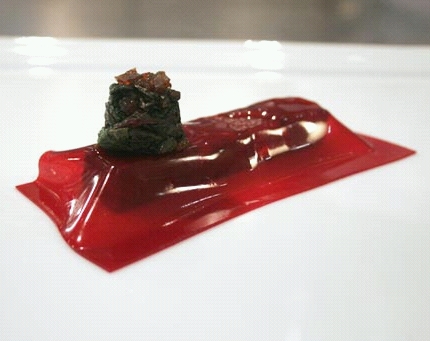
    The red sheet (in the not yet finished dish) is made by heating Campari, beet root juice, salt and sugar, followed by addition of agar agar. The color and texture look marvelous!

    Chow has a nice picture-by-picture guide (featuring photos by Stephanie Willis) to the dish “Short rib – beets, cranberry, Campari” served at Alinea.

    …If only it were that simple. Chef Grant Achatz says the actual ingredients are “short rib, beet-Campari juice, roasted baby golden beet, beet-green marmalade, braised beet greens, beet pâte de fruit, beet chips, three different types of fennel garnish, cranberry sauce, caramelized fennel purée … man, I guess that is a lot.” A colleague reminds him about fennel pollen, cranberry powder, and Murray River salt.

    Scientific chocolate tasting kits

    Monday, February 19th, 2007

    Dominique & Cindy Duby, chocolatiers based in Canada, have put together two “scientific chocolate tasting kits” (one, two). Some of the science behind is explained in their “tasting notes” (copy the text into a wordprocessor to read it). For a review of the first kit, check out Rob and Rachel’s blogpost over at Hungry in Hogtown.

    The kits illustrate the use of various hydrocolloids to produce foams, gels, dispersions, emulsions and pearls. The principle of flavor pairing is illustrated and binary taste interactions are explored. They also include experiments to explore crunchy vs. soft textures. Each kit comes with four different experiments and enough ingredients to make 8 servings. Furthermore they let you serve every experiment at two different tempereatures. This is neat because is allows you to explore the great influence temperature has on texture and aroma. Each kit sells for $125 – expensive yes, but from the presentation it seems like a good bundle.

    Science tasting kit no. 1
    skv05.jpg

    The following is illustrated in kit no. 1:

      Experiment 1: foaming of pectin and gelatin gels, spherification of a fruit juice/chocolate emulsion (there’s no info on this, but I guess the spherification is alginate based)
      Experiment 2: explore how temperature influences sweet and bitter tastes, make a chocolate emulsion (with cream, strawberry juice, wine, cocoa butter and oil) and serve it at two different temperatures
      Experiment 3: explore the fact that “taste” is 80% smell, illustrate how salt can suppress bitterness, use a special powder made from an aromatic liquid and maltodextrin which is then dried under vacuum with microwaves (sort of like freeze drying, only this uses microwaves in stead)
      Experiment 4: Hervé This’ double dispersion chocolate “cake” made with chocolate and egg white foam which is set in a microwave oven (described in his Angewante Chemie article on molecular gastronomy), short lived crunchy texture, flavor pairing is illustrated by combining cumin and coffe with chocolate

    Science tasting kit no. 2
    skv06.jpg

    Kit no. 2 starts of by exploring culinary “equations” which are remarkably similar to (yet somewhat less comprehensive than) the CDS formalism described by Hervé This elsewhere. The following is illustrated in the second kit:

      Experiment no. 1: a “whisky” is constructed from ethanol lignin, aromatic aldehydes, sugars, acetic acid, oak flavor, vanilin, malt etc.
      Experiment no. 2: ice cream is made without churning using foamed egg whites to incorporate air (is this what Italians refer to as a frozen parfait?)
      Experiment no. 4: meringues floating on a pool of custard sauce drizzled with caramel

    If you’d rather reverse engineer the dishes, my list of hydrocolloid suppliers might come handy. The “tasting notes” also gives you some hints if you want to have a go on your own.

    Ten tips for practical molecular gastronomy

    Saturday, January 27th, 2007

    In a recent survey 72% of chefs say they may want to experiment with molecular gastronomy in 2007. That’s an impressive number and considering the attention molecular gastronomy gets in media I bet many home cooks would want to experiment in the kitchen as well. Here’s a list of things to consider if you want to make a scientific approach towards cooking:

    1. Use good and fresh raw materials of the best quality available.

    2. Know what temperature you’re cooking at. A dip probe thermometer with a digital read out is a cheap way to bring science into your kitchen.

    3. Get a basic understanding of heat transfer, heat capacity and heat conductance. “Heat” in this context des not imply high temperature since it also applies to the understanding of freezing/thawing.

    4. Learn how to control the texture of food. Some key points: temperature induced changes (freezing, heating), emulsifiers, thickeners, gelling agents, moisture content, pressure/vacuum, osmosis.

    5. Learn how to control taste and flavor. Some key points: flavor pairings, spice synergies/antagonies, influence of temperature (Maillard reaction, caramelization, temperature stability, volatility), taste enhancers, taste suppresants, solubility of flavour compounds in fat/water, extraction.

    6. Remember that prolonged exposure to a flavor causes desenzitation, meaning that your brain thinks the food smells less even though it’s still present in the same amount. Therefore, let different flavours enhance each other. Similarly, variation in taste, texture, temperature and color can open up new dimensions in a dish. This is referred to as “increased sensing by contrast amplification”.

    7. Be critial to recipes and question authority – they do not necessarily represent “the truth”. Nevertheless, you can certainly learn a lot from the experts.

    8. Dare to experiment and try new ingredients and procedures. Do control experiments so you can compare results. When evaluating the outcome, be aware that your own opinions will be biased. Have a friend help you perform a blind test, or even better a triangle test to evaluate the outcome of your experiments.

    9. Keep a written record of what you do! It would be a pity if you couldn’t recreate that perfect concoction you made last week, simply because you forgot how you did it.

    10. Have fun!

    blue_gas_flame.jpg
    Heat causes many changes in food, but few appreciate how important it is to know at what temperature they are cooking and at what temperature the desired change occurs.

    These tips for molecular gastronomy relate to the technical and scientific aspects of food preparation and eating, and I plan to elaborate on each of the points in separate blog posts. However, according to Hervé This’ definition of molecular gastronomy, one should also investigate the social and artistic components of cooking. A good example of this is the “Five Aspects Meal Model” developed at Grythyttan in Sweden (Gustafsson, I.B. et al. Journal of Food Service, 2006, 84.). Although intended for a restaurant setting, the general idea can also be applied for home cooking.

    The meal takes place in a room (room), where the consumer meets waiters and other consumers (meeting), and where dishes and drinks (products) are served. Backstage there are several rules, laws and economic and management resources (management control system) that are needed to make the meal possible and make the experience an entirety as a meal (entirety – expressing an atmosphere).

    Or to put it differently: average food eaten together with good friends while you’re sitting on a terrace with the sun setting in the ocean will taste superior to excellent food served on plastic plates and eaten alone in a room with mess all over the place.

    One last thing: once you’re finished in the kitchen with your culinary alchemy, your gastro physics, your cutting edge science cuisine, your molecular cooking, your hypermodern emotional cooking, your science food or whatever fancy name you attach to it – remember the social and artistic components when you serve the food. Just so people won’t refer to you as a techno chef, a mad scientist or a modern day Willy Wonka. After all, molecular gastronomy is about the science of deliciousness, not technical wizardry.

    Questions and topics for future blog posts are welcome at webmaster [a] khymos.org (substitute @ for [a]) or as a comment below.