
Archive for the ‘modernist cuisine’ Category

TFP 2011: Interview with René Redzepi (part 3)

Saturday, May 14th, 2011


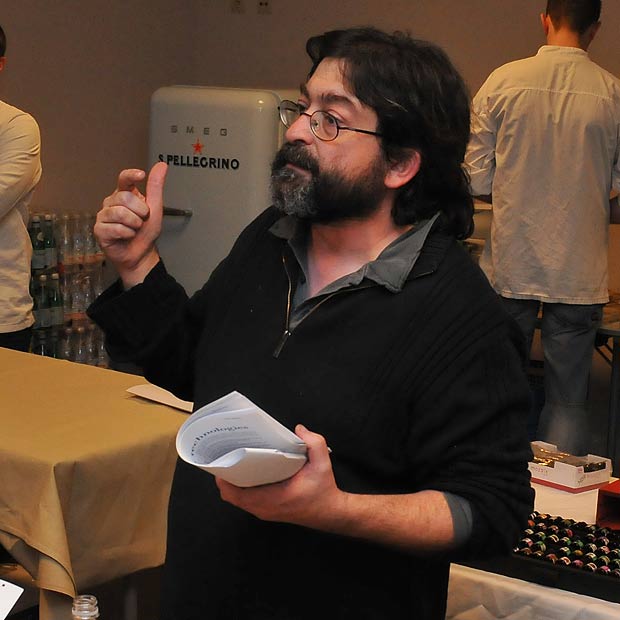
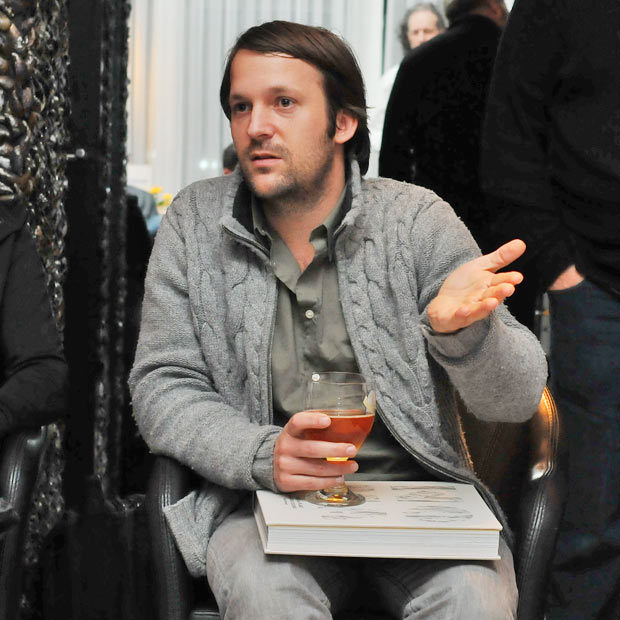
Rene Redzepi sees no contradiction between science and his style of cooking. He also promoted his book NOMA at the press conference at The Flemish Primitives 2011.

It came as no big surprise that NOMA defended its no. 1 position in April. A lot of the press coverage of NOMA and René Redzepi focuses on foraging (some even claim that we are in The Era of the ‘I Foraged With René Redzepi Piece’). It is all about nature and natural ingredients. Many would probably claim that NOMA is as far away from molecular gastronomy and science as you could possibly come. In March René Redzepi attended The Flemish Primitives in Oostende. I was there, and the one question I asked René at the press conference was this:

ML: The Flemish Primitives aims to bring together chefs, scientists and artists. There is also a co-operation between Noma and the University of Copenhagen. What have you learnt from from working with scientists?
(more…)

Flavour right around the corner

Wednesday, May 4th, 2011


The launch of Flavour, the journal I mentioned recently, is right around the corner. To celebrate the launch they give away 10 copies of Peter Barham’s Science of Cooking to anyone who registers for their article alerts before 1st July. The nice thing for those of us who don’t have free access to scientific litterature through an university library is that it’s an open access journal. There’s some more info in this blog post or you can follow them on Twitter.

Perfect egg yolks (part 2)

Saturday, April 23rd, 2011


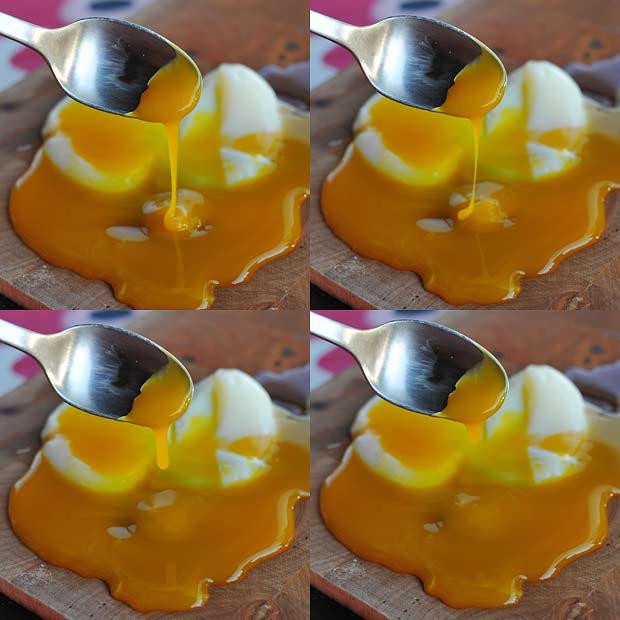
Egg cooked for 40 min at 63.0 °C. The pictures were taken within 6 seconds and are shown in the order they were taken.

My immersion circulator is working again! And the first thing I decided to do was to cook eggs at 63.0 °C for 40, 60, 75, 110 and 155 min and show you the results. If you read my last blog post on Perfect egg yolks or have stumbled across the paper Culinary Biophysics: on the Nature of the 6X°C Egg you may recognize that these times correspond to egg yolks with textures similar to sweetened condensed milk, mayonnaise, honey, cookie icing and Marmite respectively. I used the iso-viscosity graph from the paper mentioned to determine the cooking times as shown below. (more…)

Yet another journal looking for MG contributions

Monday, April 18th, 2011


Juan Valverde (a former student of Hervé This) who is now on the editorial board of the Journal of Culinary Science & Technology informed me that they are looking for new contributions in the molecular gastronomy field. The scope and coverage of the journal is as follows (quoting from their webpage):

  • Culinary innovation
  • Blurring lines between food technology and culinary arts
  • Issues and trends related to human nutrition
  • The collaboration between food science and culinary innovation
  • Techniques and technology and their role in quality of life/guest satisfaction associated with culinary, wine and food experiences
  • Trends in molecular gastronomy and its derivates
  • Annual review of trends in culinary science and technology
  • Applied research
  • Relevant research notes
  • Management styles, methods and principles
  • Techniques and innovations

While you wait for Flavour and International Journal of Gastronomy and Food Science to appear you can always browse through some back issues of this journal.

The Flemish Primitives 2011 (part 1)

Saturday, March 26th, 2011

The Flemish Primitives aims to bring together chefs and scientists to promote culinary innovation. The last two editions held in Brugge focused on food pairing and new technologies. This year the event had moved to Oostende and the more spacious Kursaal (a good choice!). The event had also been stretched over two days, starting with 10 master classes in five parallel sessions on Sunday followed by a Gala dinner prepared by 13 Belgian chefs. The second day followed the format from previous years. The focus was on a group of Belgian chefs, the so-called Flemish Primitives as well as specially invited guests from abroad including René Redzepi and Michel Bras. All chefs prepared food live on stage. In between the chefs there was also time for two sessions with researchers from KU Leuven and a presentation of Modernist Cuisine by Chris Young. (more…)

Open position in science and cooking at Harvard

Monday, March 21st, 2011

I recently blogged about the public science and cooking lectures at Harvard to let you know that videos from the lectures are available for download. The public lectures accompany the course SPU-27: Science and Cooking (non-official pdf with syllabus of the course). I just got an email that they have an open position for a preceptor (a kind of lecturer). Responsibilities include:

  • Work with (and report to) the faculty members who are the principal course instructors, to prepare lecture materials, lab experiments, homework assignments, and examination questions.
  • Assist with lecturing as necessary.
  • Manage the kitchen lab space, including maintaining the inventory of equipment and food supplies, as well as ensuring food-safety status.
  • Coordinate with visiting guest chefs and lecturers, including managing their itineraries during campus visits.

Interestingly they are looking for someone with an advanced degree in physics, chemistry or a related field, preferably with a PhD. But they do not ask for knowledge about or interest in food which is kind of surprising… But they hope to get someone who speaks Spanish or Catalan – take that as a pointer to all the great work done by Ferran Adria, Jose Andres and Joan Roca, as well as the Alicia Foundation. The application deadline is April 4th. More information can be found on their homepage

Copenhagen MG seminar: Playing with food (part 5)

Wednesday, March 16th, 2011

Sample #4: Precious instant coffee with hot and freezing milk. My favorite!

As part of the molecular gastronomy seminar in Copenhagen a group of food science students and aspiring chefs who meet regularily in Gastronomisk legestue (= gastronomic playroom) gave a short presentation of their work. With a yearly budget of €660 and no scientific or commercial obligations the goal is to let science and craft meet in order to foster culinary creativity. There are many notable chef-scientist collaborations in the realms of molecular gastronomy and modernist cuisine, but this is the first time I’ve heard about an initiative that establishes a dialogue between scientists and chefs while they are still students. Molecular gastronomy will always be an interdisciplinary field and what better way to encourage such a collaboration than in a “playroom”? The students are allowed to use course labs at Copenhagen University, and in return they are asked to do a least one event each year – in 2010 they contributed to Kulturnatten (= Culture night). I admire the initiative and I encouraged Mathias Skovmand-Larsen, one of the founders, to start blogging so the rest of the world can take part in their experiments. Their presentation included 4 samples for the audience to taste. My favorite was (more…)

Modernist Cuisine presented at The Flemish Primitives

Tuesday, March 15th, 2011

Flown in directly from Seattle, Chris Young presented Modernist Cuisine at The Flemish Primitives today. In the picture: presumably the first copy in Europe :) It’s backordered now (see Nathan’s long posts on this) due to high sales. It actually reached as high as #38 on Amazon’s overall sales rank.  I had 5 minutes to take a look at the books today and I can only say wow! These books mark a new era for everyone interested in a scientific and technological approach to cooking! Immediately the feeling struck me: there is nothing more to blog about now. But Chris reassured me (as he also did in my recent interview with him) that there is plenty more to dig into. Phew. Expect more about The Flemish Primitives 2011 in the coming days.

Interview with Chris Young

Thursday, February 24th, 2011

The authors of Modernist Cuisine: Maxime Bilet, Chris Young and Nathan Myhrvold

In 2003 Chris Young had an epiphany of a meal at The Fat Duck outside London, and by the end of the meal he knew he had to work with Heston Blumenthal. Things worked out well and after a stage he was hired to build and lead the experimental kitchen at The Fat Duck. In 2007 he returned to Seattle to work with Nathan Myhrvold who at that time was very active on the eGullet forum sharing his research on the sous vide cooking technique. The project that started off as a book on sous vide eventually grew into Modernist Cuisine with 6 volumes spanning more than 2400 pages. After many delays (one being due to Amazon’s drop test which showed that the casing wasn’t sturdy enough for the books totaling 20 kg) Modernist Cuisine is ready for release in March, and will be presented at The Flemish Primitives event in Oostende, Belgium on March 14. That’s one more reason to visit the event!

Martin Lersch: Congratulations with Modernist Cuisine – it is a truly amazing accomlishment! Will you be present in Oostende?
(more…)