Archive for the ‘recommendations’ Category

Wonders of extraction: Pressure

Saturday, August 21st, 2010


Cream chargers containing 8 g of nitrous oxide each (N2O) to be used with an iSi whipper for whipping cream, making foams/espumas or pressurized infusions.

A little more than a week ago Dave Arnold posted a great, new technique: pressure infusion using a conventional iSi whipper! Just think of it – the whipper has been around for decades, and years a go Ferran Adrià pioneered it’s use for espumas. Several have suggested it’s use for carbonation of fruit. But no one had thought of utilizing the whipper for infusions – until August 11th when Dave Arnold of Cooking issues posted the results of his experiments in “Infusion Profusion: Game-Changing Fast ‘N Cheap Technique”. The first blogger to pick up the technique and post about it on August 12th was Linda of playing with fire and water who termed it a revolutionary technique. A couple of days later, on August 17th Aki and Alex of Ideas in food posted a combined pressurized infusion of basil and marination of mozzarella. And then on August 20th James of Jim Seven describes his results comparing conventional cold brewed coffee to cold pressure brewed coffee. It’s really fascinating how fast the idea spread, and it illustrates the benefits of an open and sharing approach to food innovations.
(more…)

TGIF: Food related “Periodic videos”

Friday, August 20th, 2010

I believe most chemists are familiar with the “periodic videos” from the University of Nottingham, covering all the known chemical elements. The series features professor Martyn Poliakoff who’s grey hair is really worthy of a professor! They have now covered the complete periodic table of elements, and have even started to update some of their previously posted videos. There are also thematic videos as well as videos covering specific molecules appearing now. As a chemist I think the videos are great fun to watch since they show a number of exotic experiments I’ve never seen before combined with plenty of nice-to-know facts. I certainly recommend all these videos (for an overview, check out their website), but the reason I chose to blog about this is that I was delighted to find a number of more or less food related videos! These are definitely not going to make you a better cook. But some of them are quite amusing to watch, and you may even learn some chemistry as you go. But most of the food related videos are really just for fun :)

Cheeseburger in hydrochloric acid

(more…)

Modernist cuisine website up

Monday, August 9th, 2010

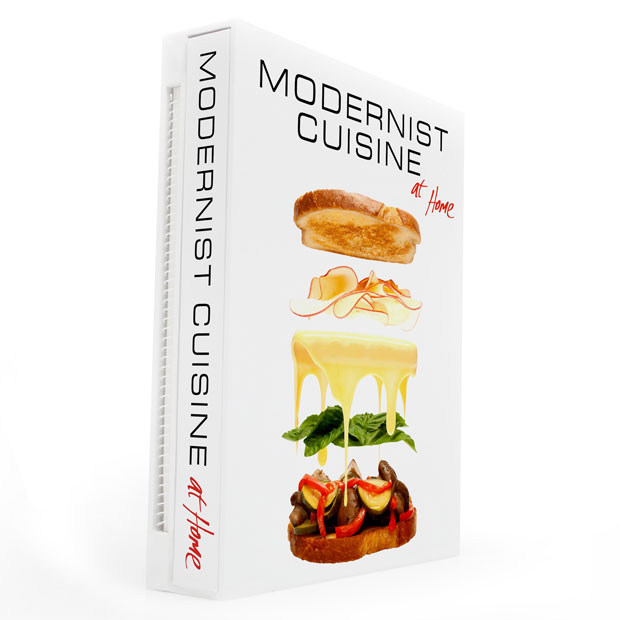
The website to accompany Modernist cuisine is up now. It showcases stunning pictures and example pages, the complete table of contents available in pdf format, details on the exceptional printing quality (stochastic screening and wide gamut inks in case you wondered…) as well as introductions to each volume: History and fundamentals, Techniques and equipment, Animals and plants, Ingredients and preparations, Plated dish recipes – and each page of these pages has additional pictures. It turns out that in addition to the five main volumes there is a 350 page spiral-bound kitchen manual printed on waterproof, tear-resistant synthetic paper (!) with condensed versions of the recipes. And their FAQ page let me know that the complete word count is 650,000. I’ve been looking forward to these books for quite some time, but seeing the pictures just got me to start counting down the days left until December 1st.
(more…)

Interesting books to appear in 2010

Tuesday, August 3rd, 2010

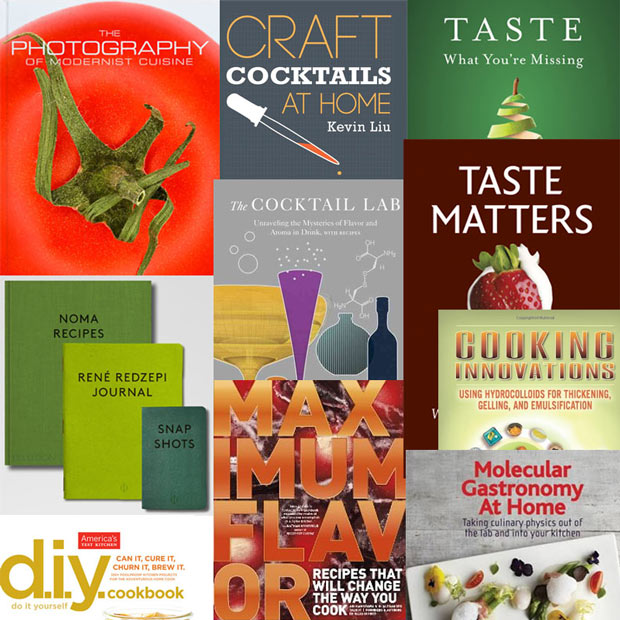
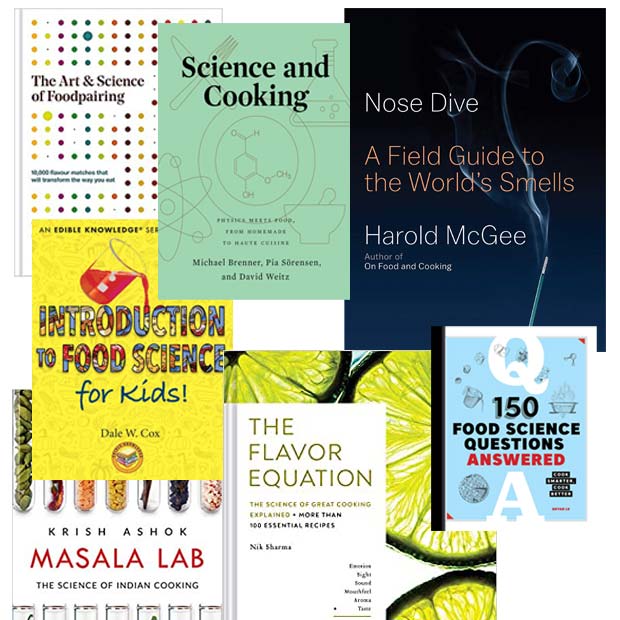
In addition to Modernist Cuisine and Keys to Good Cooking there are so many new books appearing this fall, so to save you from too many blog posts I’ve collected them here in a single posting. These are all books that I find interesting from my popular food science perspective combined with a strong interest for the actual cooking! The books are, in order of appearance: (more…)

New book from McGee: Keys to Good Cooking

Thursday, July 29th, 2010

Harold McGee, author of the seminal On food and cooking: The science and lore of the kitchen (which is one of my favorite non-recipe books for the kitchen) has done it again! The book Keys to Good Cooking: A Guide to Making the Best of Foods and Recipes is to appear in October, but is already available for pre-order as I write. The book is one step closer to the kitchen and the actual cooking than On food and cooking. In a mini Q&A with NY Times in 2008 Harold McGee said the following:

“I’ve heard from many cooks that while they value the scope and depth of “On Food & Cooking,” when they need practical help with a specific technique or ingredient it’s often hard for them to locate the information. So my next book will be nothing but practical information and directions, concise and brief.”

I think it’s fair to say that Harold McGee, more than any other person I know of, has been very successful at distilling scientific work into a very readable and accessible form. He did this back in 1984 with the first edition of On food and cooking, and then again in 2004 with a more or less rewritten edition in 2004. A complete book with practical information rooted in science can easily become the single most useful book in your kitchen!

Modernist Cuisine available for pre-order

Tuesday, July 6th, 2010

When I wrote about Nathan Myhrvold’s book project in November he estimated the book to reach 1500 pages. But what originally started out as a 300-page book on sous vide has now, with the help of a 20-person team, grown to a total of 2200 pages spanning five volumes! Need I say more? Finally the long wait is over: The Modernist Cuisine: The Art and Science of Cooking is now available for pre-order at Amazon, and the expected release date is December 1st. One could almost be afraid that there will not be anything more to blog about here at Khymos as everything will be covered in Modernist Cuisine :) (but I know better – every previous talk about “end of science” has turned out to be more a starting point than a final destination)

Ferran Adrià says that “This book will change the way we understand the kitchen”, and according to Heston Blumenthal it’s “A fascinating overview of the techniques of modern gastronomy”. And if that’s not enough – take a look at this 26 minute video which guides you through the almost endless amount of high-tech equipment Nathan Myhrvold and his team have available. Oh boy, oh boy!

Other links:
The lecture “Cooking in Silico: Understanding heat transfer in the modern kitchen” by Nathan Myhrvold and Chris Young is available for streaming/download from University of Washington.

Major review on molecular gastronomy published

Monday, February 22nd, 2010

I just received an alert today about a major review article on molecular gastronomy: Molecular Gastronomy: A New Emerging Scientific Discipline (DOI: 10.1021/cr900105w) is a British-Danish joint publication by Peter Barham, Leif H. Skibsted, Wender L. P. Bredie, Michael Bom Frøst, Per Møller, Jens Risbo, Pia Snitkjær, and Louise Mørch Mortensen. Peter Barham is a professor in polymer physics at the University of Bristol, author of The science of cooking and probably doesn’t need further introduction. The Danes are all associated with the Department of Food Science at the University of Copenhagen and have a varied background in chemistry, food science, sensory science and psychology background. Check out the links to their individual profiles more info on projects and publications. Leif H. Skibsted and Michael Bom Frøst head several molecular gastronomy related projects. The Danish scientists also work closely together with Claus Meyer, chef at Meyers madhus and visiting professor at Copenhagen University, and Torsten Vildgaard, assistant head chef at Denmark’s gastronomic shining star Noma (which Claus Meyer started together with René Redzepi in 2004 – they were ranked 3rd in Restaurant magazines top 50 list for 2009, only surpassed by el Bulli and The Fat Duck).

Considering the impact factor of Chemical Reviews (ranked as a clear no. 1 among chemistry journals), this review will likely remain the review on molecular gastronomy for years to come – so you can just as well go ahead and read it. It’s got a whopping 53 pages and more than 350 references, and will be very useful for further studies and research. Oh, and the authors have opted for sponsored access, meaning that you can download the whole review for free!


(more…)

Cheer up with some gingerbread for Christmas

Monday, December 14th, 2009

pepperkake
The gingerbread cookies pictured are made with ginger, cloves and cinnamon. I didn’t use ammonium carbonate as a leavening agent for these, so no amphetamines were created “in furno” in this case. But I’m sure the cookies can cheer you up anyway!

A while ago I came across the article “Christmas gingerbread (Lebkuchen) and Christmas cheer–review of the potential role of mood elevating amphetamine-like compounds formed in vivo and in furno” (abstract from NCBI, free full text pdf download from publisher). The paper reviews a hypothesis proposed by Alexander Shulgin in a series of papers appearing in Nature in the 60′s. Shulgin noted that allylbenzenes and propenylbenzens found in many spices are “merely lacking ammonia to become amphetamines”. The author reviews the evidence that such substances may be converted in the body to psychoactive metabolites, but concludes that the evidence is equivocal at best. However, the author launches an alternative theory:
(more…)

TGIF: Science stunts for Christmas parties

Friday, December 11th, 2009

Richard Wiseman has posted a lovely video with Top 10 science stunts for Christmas parties:


(more…)

Nathan Myhrvold in NYT – news on upcoming book

Wednesday, November 18th, 2009

Nathan Myhrvold giving a TED talk about some of his many interest (click image to see video). Photo by Neil Hunt from flickr.com (CC BY-NC 2.0).

Nathan Myhrvold giving a TED talk about some of his many interest (click image to see video). Photo by Neil Hunt from flickr.com (CC BY-NC 2.0).

I usually don’t post about newspaper articles, but Jack Lang sent out an email on the molegular gastronomy maillinglist today about an article in New York Times: “After Microsoft, Bringing a High-Tech Eye to Professional Kitchens” featuring Nathan Myhrvold. I thought this might be of interest to my readers as well.

If you’ve played around with sous vide cooking there’s a good chance that you’ve visited the massive eGullet thread on sous vide (currently spanning more than 100 pages and 3000 posts), and in that case you’ll be familiar with Nathan’s many well informed posts on sous vide. There have been rumours about an upcoming book for quite some time, and things are getting more and more exciting. The last I heard was that he had a team of 5 people working on a book about sous-vide. This has now increased to a team of 15 people, including 5 professional chefs, a photographer, an art director, writers and editors. And there’s more:

“The project has grown in size and scope. Originally planned as a 300-page discussion of sous vide, an increasingly popular restaurant technique of cooking food in vacuum-sealed bags in warm water baths, the book has swelled to 1,500 pages that will also cover microbiology, food safety, the physics of heat transfer on the stove and in the oven, formulas for turning fruit and vegetable juices into gels, and more.”

Wow! Let’s hope that Nathan’s “one year left” statement is actually true this time. I’m really looking forward to see this book!

London Gastronomy Seminars

Thursday, November 12th, 2009

lgs

In New York the Experimental Cuisine Collective has been arranging regular seminars since 2007, in Paris Hervé This’ monthly seminar has been running for many years – and now finally the London Gastronomy Seminars are about to launch. To their upcoming event on November 30th they have invited Hervé This, Tony Conigliaro and John Forbes to speak about on Flavor extraction. You might remember that I’ve blogged about the wonders of extraction here previously (focusing on water, ethanol, oil and more specifically on espresso and walnut liqueur) – it’s a really fascinating topic and I wish I could take part in the seminar! If you’re in London or live nearby I would strongly recommend you to visit the seminar :)

Sourdough work in progress (part II)

Sunday, October 18th, 2009

sd-bread-1
A sourd dough bread made from a spontaneous starter

After 7 days of feeding my sour dough starter “took off” and was ready for baking. Even with a water bath set to 28 °C it took longer than expected. yeast_kinetics I started off with 100% hydration as this is convenient when you have to feed your starter frequently. Using only whole grain rye flour and water, I fed my starter every 12 hours (I’ve included details of the “feeding schedule” at the end of this post). This time interval is based on the growth cycle of yeast, where the yeast after an exponential growth phase reaches a plateau after 8-12 hours. This is the best time for feeding the starter.

There seems to be a consensus that a wet starter (more…)

(Too many?) New books

Friday, September 11th, 2009

books-2008

Last year’s book bonanza (Remember The Big Fat Duck Cookbook, Alinea and Under pressure right? Not to mention BakeWise, The Flavor Bible (not science, but I love their systematic approach), Cooking – The Quintessential Art, A day at el Bulli, the bilingual Sous-Vide, the German Verwegen Kochen and the Danish Molekylær gastronomi – did I miss any?) will be difficult to beat, but several interesting books will appear this fall as well. It’s as if this field is exploding with books now. When I first set up the webpages which later evolved into Khymos only a handful of books were available (you can travel back in time and view the single page from 2003 – only in Norwegian, sorry), but even I have a hard time now keeping track with all the books which cover the interesting intersection between cooking and science, aka molecular gastronomy. Sometimes I think – is this book really necessary? Do we need it? What does it add? But addicted as I am, I can’t help it – so I’ll probably get hold of most of these books as they become available :)

(more…)

French book on flavor pairing of food and wine

Wednesday, July 22nd, 2009

papilles_molecules

The Canadian sommerlier François Chartier (he has an extensive website featuring several blogs, including a section named Sommellerie moléculaire) is out with a new book on food and wine pairing. It’s not just another (superfluous) book on the subject. As the title Papilles et molécules (= Tastebuds and Molecules, unfortunately not available in English) suggests there is some science involved. It turns out in fact that he has applied the principles of flavor pairing to food and wine. With help from Richard Béliveau from Agriculture and Agri-Food Canada and Martin Loignon from PerkinElmer he has analyzed wines and food and comes up with the following suggestions for lamb, as described in the article “Chemistry-set wine pairing”:
(more…)

Sourdough work in progress (part I)

Thursday, May 21st, 2009

apricot-starter
Attempt to make a sourdough starter using dried apricots, using my immersion circulator for temperature control. I got some bubbling yeast activity, but the final bread dough never rose properly.

Inspired by the Swedish bread blog Pain de Martin which I recently discovered I decided it was time to have a go at sourdough breads! Although one of my favorite types of bread it’s a long time since I gave it a try and even longer since I actually succeeded. Leaving apple peel covered with water for two weeks in a cool place (15 °C) I got a light apple cider which I used to make a starter some years ago. I followed a recipe from the Norwegian artisan bakery Åpent bakeri and it gave a marvelous bread. But since then I’ve tried to repeat this twice without success. No wonder that even Rose Levy Beranbaum in her book “The Bread Bible” writes that she didn’t intend to include a chapter on sourdough at all. There’s no doubt that sourdoughs are tricky, but I was a litte surprised and disappointed that someone who sets of to write a 600+ page book on bread even considered to skip sourdough… Luckily she changed her mind and the introduction has a fascinating nice-to-know fact: 1 g flour contains about 320 lactic acid bacteria and 13000 yeast cells!

I believe one the reasons why sourdoughs seem to live their own lifes sometimes is that they need to be kept in a warm place. My kitchen isn’t that warm so I figured it was time to use my immersion circulator and give sourdough another chance (who says you can only use immersion circulators for sous vide anyway? – I think my next project will be to make yoghurt!). With a thermostated water bath keeping a sourdough starter at constant temperature is as easy as 1-2-3. But surprisingly I haven’t seen any blogposts yet from people using their sous vide water baths for sourdough starters (although some have built their own water baths for this purpose using aquarium equipment).
(more…)