
Archive for the ‘academic articles’ Category

Flavour right around the corner

Wednesday, May 4th, 2011


The launch of Flavour, the journal I mentioned recently, is right around the corner. To celebrate the launch they give away 10 copies of Peter Barham’s Science of Cooking to anyone who registers for their article alerts before 1st July. The nice thing for those of us who don’t have free access to scientific litterature through an university library is that it’s an open access journal. There’s some more info in this blog post or you can follow them on Twitter.

Perfect egg yolks

Monday, April 18th, 2011


Maybe I have a hangup on soft boiled eggs, but I’m deeply fascinated by how something simple as an egg can be transformed into such a wide range of textures. I’m talking about pure eggs – no other ingredients added. Playing around with temperature and time can result in some very interesting yolk textures – yolks that are neither soft nor hard, but somewhere inbetween. Two examples from the blogosphere are Chad Galliano’s 90 min @ 63.8 °C egg yolk sheets and David Barzelay’s 17 min @ 70.0 °C egg yolk cylinders (both bloggers giving credit to Ideas in food and Wylie Dufresne respectively).

In 2009 I wrote about my journey towards the perfect soft boiled eggs. Equipped with a formula I knew what I wanted, but it wasn’t so easy after all. Since then I’ve tried to model experimental data from Douglas Baldwin as well as data from my own measurements of egg yolk tempereatures when cooked sous vide (pictures of how I did this at the end of this blog post). I never got around to blog about the results, and now there’s no need for it anymore: The egg yolk problem has been solved! And the question that remains is: How we can utilize this in the kitchen?

The break through came this year (more…)

Yet another journal looking for MG contributions

Monday, April 18th, 2011


Juan Valverde (a former student of Hervé This) who is now on the editorial board of the Journal of Culinary Science & Technology informed me that they are looking for new contributions in the molecular gastronomy field. The scope and coverage of the journal is as follows (quoting from their webpage):

  • Culinary innovation
  • Blurring lines between food technology and culinary arts
  • Issues and trends related to human nutrition
  • The collaboration between food science and culinary innovation
  • Techniques and technology and their role in quality of life/guest satisfaction associated with culinary, wine and food experiences
  • Trends in molecular gastronomy and its derivates
  • Annual review of trends in culinary science and technology
  • Applied research
  • Relevant research notes
  • Management styles, methods and principles
  • Techniques and innovations

While you wait for Flavour and International Journal of Gastronomy and Food Science to appear you can always browse through some back issues of this journal.

New journal to launch soon: Flavour

Thursday, April 7th, 2011

While we’re still waiting for the first edition of International Journal of Gastronomy and Food Science to appear: I learnt in the Copenhagen MG seminar that yet another journal is to launch soon – the Flavour journal published on BioMed Central. It’s open source (= free) which is good news for chefs and other enthusiasts without an academic afficiliation that gives access to journals. The chief editors are Per Møller and Peter Barham (co-authors of the highly recommended molecular gastronomy review). – I am passionate about good food and cooking, so I hope that the articles in Flavour will not only further our understanding of all the processes that go to developing and appreciating the flavour of the food we eat, but will also provide me, and many others with new ideas to try out in our own kitchens so we can prepare ever better dishes, says Peter Barham.
(more…)

Major review on molecular gastronomy published

Monday, February 22nd, 2010

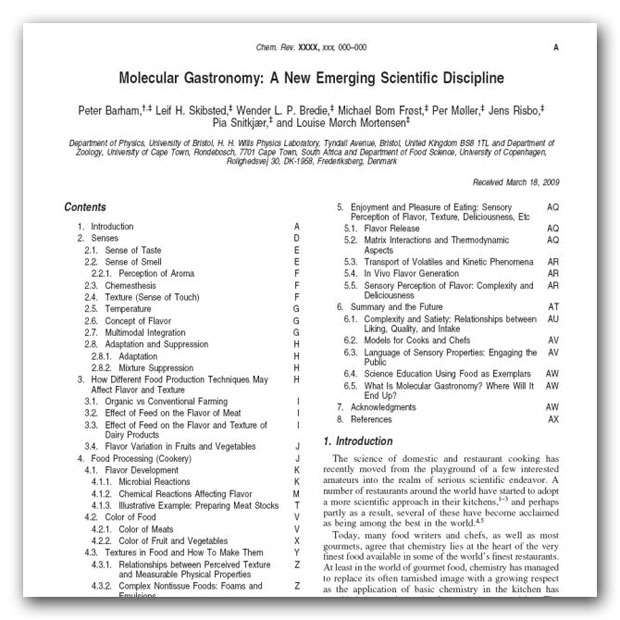
I just received an alert today about a major review article on molecular gastronomy: Molecular Gastronomy: A New Emerging Scientific Discipline (DOI: 10.1021/cr900105w) is a British-Danish joint publication by Peter Barham, Leif H. Skibsted, Wender L. P. Bredie, Michael Bom Frøst, Per Møller, Jens Risbo, Pia Snitkjær, and Louise Mørch Mortensen. Peter Barham is a professor in polymer physics at the University of Bristol, author of The science of cooking and probably doesn’t need further introduction. The Danes are all associated with the Department of Food Science at the University of Copenhagen and have a varied background in chemistry, food science, sensory science and psychology background. Check out the links to their individual profiles more info on projects and publications. Leif H. Skibsted and Michael Bom Frøst head several molecular gastronomy related projects. The Danish scientists also work closely together with Claus Meyer, chef at Meyers madhus and visiting professor at Copenhagen University, and Torsten Vildgaard, assistant head chef at Denmark’s gastronomic shining star Noma (which Claus Meyer started together with René Redzepi in 2004 – they were ranked 3rd in Restaurant magazines top 50 list for 2009, only surpassed by el Bulli and The Fat Duck).

Considering the impact factor of Chemical Reviews (ranked as a clear no. 1 among chemistry journals), this review will likely remain the review on molecular gastronomy for years to come – so you can just as well go ahead and read it. It’s got a whopping 53 pages and more than 350 references, and will be very useful for further studies and research. Oh, and the authors have opted for sponsored access, meaning that you can download the whole review for free!


(more…)

Cheer up with some gingerbread for Christmas

Monday, December 14th, 2009

pepperkake
The gingerbread cookies pictured are made with ginger, cloves and cinnamon. I didn’t use ammonium carbonate as a leavening agent for these, so no amphetamines were created “in furno” in this case. But I’m sure the cookies can cheer you up anyway!

A while ago I came across the article “Christmas gingerbread (Lebkuchen) and Christmas cheer–review of the potential role of mood elevating amphetamine-like compounds formed in vivo and in furno” (abstract from NCBI, free full text pdf download from publisher). The paper reviews a hypothesis proposed by Alexander Shulgin in a series of papers appearing in Nature in the 60′s. Shulgin noted that allylbenzenes and propenylbenzens found in many spices are “merely lacking ammonia to become amphetamines”. The author reviews the evidence that such substances may be converted in the body to psychoactive metabolites, but concludes that the evidence is equivocal at best. However, the author launches an alternative theory:
(more…)

Sourdough work in progress (part II)

Sunday, October 18th, 2009

sd-bread-1
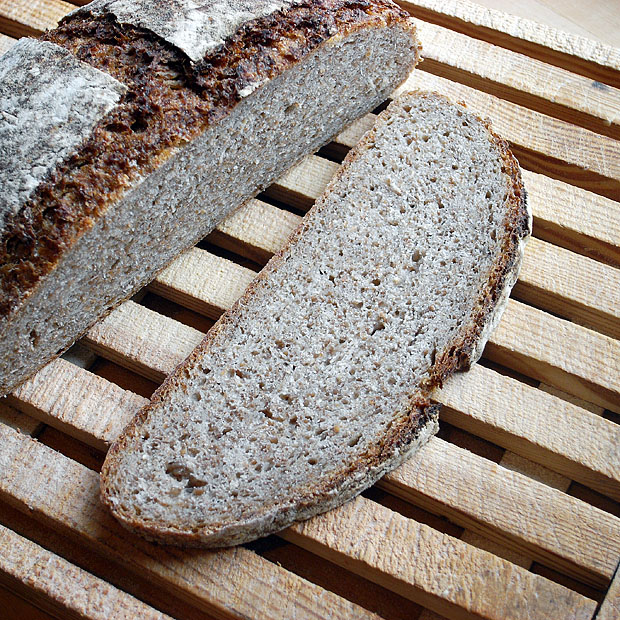
A sourd dough bread made from a spontaneous starter

After 7 days of feeding my sour dough starter “took off” and was ready for baking. Even with a water bath set to 28 °C it took longer than expected. yeast_kinetics I started off with 100% hydration as this is convenient when you have to feed your starter frequently. Using only whole grain rye flour and water, I fed my starter every 12 hours (I’ve included details of the “feeding schedule” at the end of this post). This time interval is based on the growth cycle of yeast, where the yeast after an exponential growth phase reaches a plateau after 8-12 hours. This is the best time for feeding the starter.

There seems to be a consensus that a wet starter (more…)

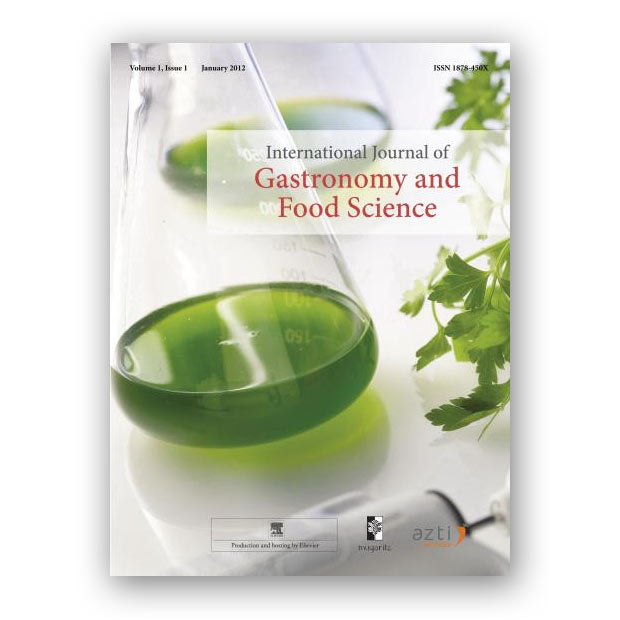
International Journal of Gastronomy and Food Science

Wednesday, March 25th, 2009

The International Journal of Gastronomy and Food Science (IJGFS) is planned for launch this year. Elsevir is mentioned as a publisher, but there is currently no further information on the Elsevir website. The journal is initiated by AZTI-tecnalia, a Spanish technology center specializing in marine and food research, in collaboration with ALICIA, a Catalan research centre focusing on technological innovation in kitchen science and the dissemination of agronourishment and gastronomic heritage. The restaurant Mugaritz and the websites aliment@tec and Ciencia y gastronomia also have their logos on the IJGFS website. The objective of the journal is to “fill the gap in the expanding fields of Gastronomy and Food Science, by adopting a scientific approach”.
(more…)

Recent academic articles

Saturday, November 8th, 2008

There are a couple of recent academic papers that have been published the last 2 years which I haven’t mentioned in blog posts, but they really deserve attention. Here’s the list (with quotes from the abstracts):

Molecular gastronomy: a food fad or science supporting innovative cuisine? Cesar Vega, Job Ubbink (Trends Food Sci Technol 2008, 19(7), 372-382)

The concepts, history and approaches of molecular gastronomy are discussed with an emphasis on the relation to food science and technology. A distinction is made between molecular gastronomy and science-based cooking (…) We discuss how chefs are dealing with the available systematic knowledge on food and cooking, and how molecular gastronomy can facilitate the cumbersome, but much needed discussions among food scientists and chefs.

Molecular Gastronomy: A Food Fad or an Interface for Science-based Cooking? Erik van der Linden, David Julian McClements and Job Ubbink (Food Biophysics, 2008, 3(2), 246-254)

A review is given over the field of molecular gastronomy and its relation to science and cooking. We begin with a brief history of the field of molecular gastronomy, the definition of the term itself, and the current controversy surrounding this term. (…) On the one hand, it can facilitate the implementation of new ideas and recipes in restaurants. On the other hand, it challenges scientists to apply their fundamental scientific understanding to the complexities of cooking, and it challenges them to expand the scientific understanding of many chemical and physical mechanisms beyond the common mass-produced food products.

The life of an anise-flavored alcoholic beverage: Does its stability cloud or confirm theory? Elke Scholten, Erik van der Linden, Hervé This (Langmuir 2008, 24(5), 1701-1706).

The well-known alcoholic beverage Pastis becomes turbid when mixed with water due to the poor solubility of trans-anethol, the anise-flavored component of Pastis in the water solution formed. This destabilization appears as the formation of micrometer-sized droplets that only very slowly grow in size, thus expanding the life of the anise-flavored beverage. (…) experiments on Ostwald ripening show an increase in stability with increasing ethanol concentration, the results based on our interfacial tension measurements in combination with the same Ostwald ripening model show a decrease in stability with an increase in ethanol concentration.

Formal descriptions for formulation, Hervé This (Int J Pharm 2007, 344(1-2), 4-8)

Two formalisms used to describe the physical microstructure and the organization of formulated products are given. The first, called “complex disperse systems formalism” (CDS formalism) is useful for the description of the physical nature of disperse matter. The second, called “non periodical organizational space formalism” (NPOS formalism) has the same operators as the CDS formalism, but different elements; it is useful to describe the arrangement of any objects in space. Both formalisms can be viewed as the same, applied to different orders of magnitude for spatial size.

Lavoisier and meat stock Hervé This, Robert Meric, Anne Cazor (Compt Rend Chim 2006, 9(11-12), 1510-1515).

Antoine-Laurent de Lavoisier published his results on meat stock’ preparations in 1783. Measuring density, he stated that food principles’ were better extracted using a large quantity of water. This result was checked.

Glutamic acid in tomatoes and parmesan

Friday, July 6th, 2007

mono-sodium-glutamate.jpg
Pure mono sodium glutamate from Taiwan

A recent article (found via Harold McGee’s News for curious cooks) featuring Heston Blumenthal as a co-author emphasizes the huge difference in glutamic acid contents between the flesh and pulp of tomatoes. Glutamic acid and it’s sodium salt (mono sodium glutamate or MSG) are responsible for the characteristic umami taste. On average the flesh contains 1.26 g/kg glutamic acid whereas the pulp on average contains 4.56 g/kg glutamic acid. Similar differences are found for several nucleotides which posess similar taste qualities. These differences can explain the perceived difference in umami taste between the flesh and pulp of tomatoes – and is worthwhile considering when cooking.

Those concerned about food with added MSG should read the chapter about MSG in John Emsley’s excellent book “Was it something you ate?”. First thing to note is that you can’t be allergic to MSG because our body needs glutamic acid to function properly. Emsley retraces the history of the Chinese restaurant syndrome (CRS) back to it’s roots in 1968 when a letter was published (R.H.M. Kwok, New Engl. J. Med. 1968, 278, 796) describing a series of symptoms experienced after having eaten at a Chinese restaurant. To make a long story short, in 1993 Tarasoff and Kelly reviewed previous studies and conducted a double blind test which led to the following conclusion:

… ‘Chinese Restaurant Syndrome’ is an anecdote applied to a variety of postprandial illnesses; rigorous and realistic scientific evidence linking the syndrome to MSG could not be found.

Following the publication, a critical reply was published by Adrianne Samuels, to which the authors have replied.

Anyway, it was in John Emsley’s book that I first read about the record levels of glutamic acid found in parmesan cheese: 12 g/kg! That’s nearly three times the amount found in tomato pulp. In some cheeses there is so much that it crystallises out in small white crystals visible to the naked eye. Think about this when you sprinkle your food with parmesan. And if you ever wondered why Italian food tastes so nice, now you know that MSG is one reason (but of course not the only one …).

pasta-tomatosauce-parmesan.jpg