A Christmas wish list
Tuesday, December 16th, 2008
The avalanche of books in the food/science intersection this fall has been truly amazing. Three books in particular have showcased special restaurants: el Bulli, Alinea and The Fat Duck.
(more…)

The avalanche of books in the food/science intersection this fall has been truly amazing. Three books in particular have showcased special restaurants: el Bulli, Alinea and The Fat Duck.
(more…)
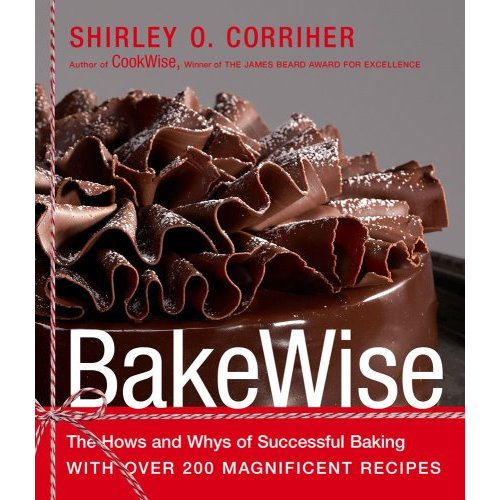
Now this is yet another book I’m looking forward to this fall – I’ve got quite a list now!. Shirley O’Corriher, best known for her book CookWise (not to mention her video “Shirley O. Corriher’s Kitchen Secrets Revealed” and TV appearance in case you live in the US), has been working on this book for a while (NYT article from 2004, free registration requried). Finally it is due to appear in October! The title BakeWise suggests it has the same structure as CookWise. The good thing about CookWise is that the food science theory is applied directly to recipes. In addition it has nice tables on what-went-wrong and what-to-do-about-it. In fact it’s a problem solving manual for the kitchen.
According to the publisher BakeWise “reads like a mystery novel as we follow sleuth Shirley while she solves everything from why cakes and muffins can be dry to génoise deflation and why the cookie crumbles”. And they continue:
Restaurant chefs and culinary students know her from their grease-splattered copies of CookWise, an encyclopedic work that has saved them from many a cooking disaster. With numerous “At-a-Glance” charts, BakeWise gives busy people information for quick problem solving. BakeWise also includes Shirley’s “What This Recipe Shows” in every recipe. This section is science and culinary information that can apply to hundreds of recipes, not just the one in which it appears.
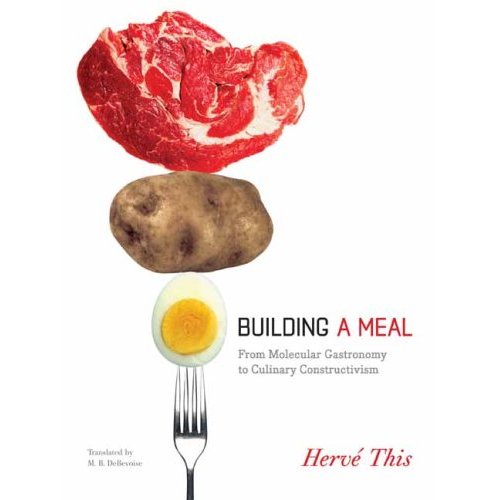
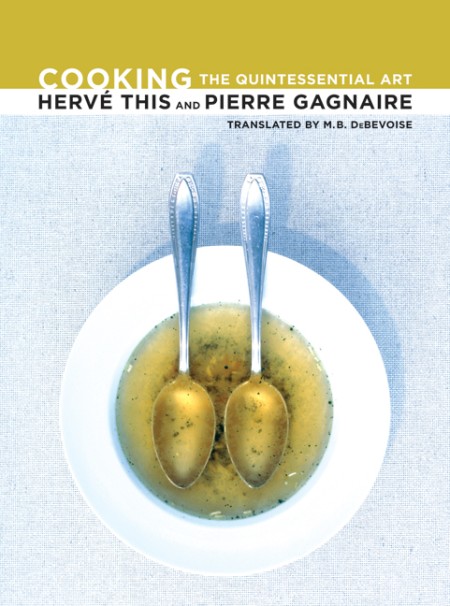
In the seemingly endless series of new books related to molecular gastronomy appearing this fall I just found out that Hervé This and Pierre Gagnaire also have a book due in October: “Cooking – The Quintessential Art”. The book is part of the California Studies in Food and Culture series which features interdisciplinary texts and has been characterized as “an intellectual exercise wholly removed from food-entertainment television”. The book is divided in five parts with the following titles which give further clues to the style of the book: The Beautiful Is the Good, Classical Ideas of Beauty, Beauty in the Middle Ages, Artistic Creativity Unbound, and The Present and Future of Cooking.
The book opens with the question “How can we reasonably judge a meal?”, signifying that this is not a cook book. According to the publisher:
This explores an astonishing variety of topics and elaborates a revolutionary method for judging the art of cooking. Many of the ideas he introduces in this culinary romance are illustrated by dishes created by Pierre Gagnaire, whose engaging commentaries provide rare insights into the creative inspiration of one of the world’s foremost chefs. The result is an enthralling, sophisticated, freewheeling dinner party of a book that also makes a powerful case for openness and change in the way we think about food.
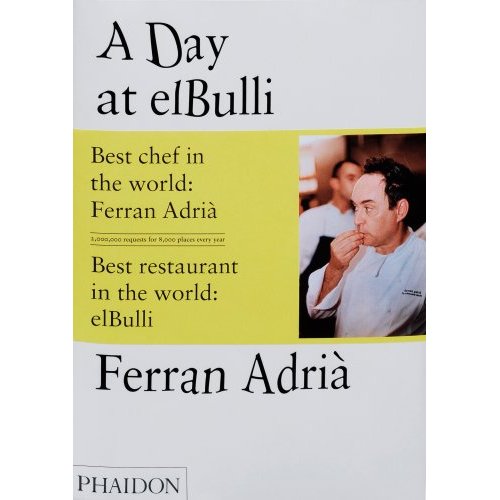
There is really no end to all the exciting books that will appear this fall! I just learnt from the molecular gastronomy mailing list that the book “A Day at el Bulli” by Ferran Adrià, Juli Soler and Albert Adrià will appear in October. The publisher let’s us know that the book
documents all the activities and processes that make up just one day of service with stunning colour and black and white photography of the kitchens, staff, creative workshop, dishes, the restaurant itself and its striking surroundings near the town of Roses, north east of Barcelona
The fact that a 600 page book covers a single day at el Bulli says a lot about how much thought they put into their cooking
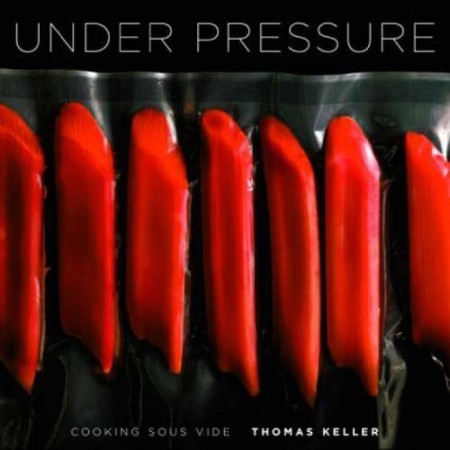
A number of books related to molecular gastronomy and food science will appear this fall – I’ve previously mentioned the Fat Duck and Alinea cookbooks. But there is more, much more! This time I would like to draw the attention to two books on sous vide which are due to appear in October. And notice how nice the titles compliment each other – one is under pressure, the other one under vacuum!
Thomas Keller, known from the French Laundry, Bouchon and per se, has written the book “Under Pressure – Cooking Sous Vide” (the Under Pressure title was also used by NY Times in a 2005 feature article on sous vide). According to the publisher, Keller and his chefs de cuisine have blazed the trail to perfection through years of trial and error and they show the way in this collection of never-before-published recipes from his landmark restaurants.
The book “Sous-Vide Garen im Vakuum” (Sous vide cooking under vacuum) by Viktor Stampfer (known from the Ritz-Carlton in Dubai) has received much less attention, but certainly deserves to mentioned. The title is in German, but do not despair – it seems to be a bilingual edition with German and English text (can anyone confirm this?), but so far it’s only available for preorder from the German Amazon. According to the publisher the book gives an introduction to the equipment used including sealing devices and recommended temperatures for cooking together with numerous recipes.
These are not the first books to appear on sous vide – enthusiasts have probably obtained one or more of the books by Roca, Farber, Ghazala, Leadbetter, Choain/Noël and Calmejane/Barrier – but I’m quite sure that the new books will complement these very nicely, and they will certainly be more available as several of the others have unavailable for some time.
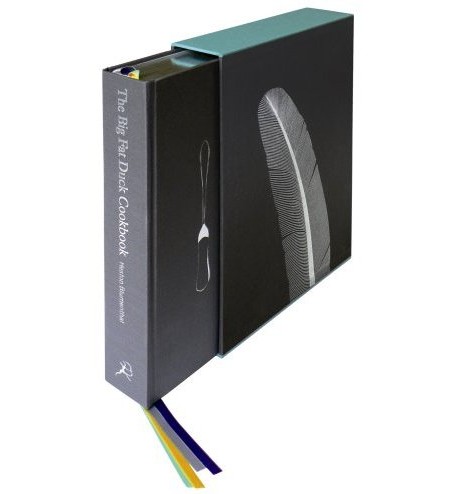
I recently blogged about the Alinea cookbook, and then in a Q&A with both Grant Achatz and Heston Blumenthal I discovered that there is another great cook book coming up this fall: The Big Fat Duck Cookbook! It’s quite amazing that these two books will be released within weeks of each other this fall.
This is what the publisher promises us:
In the first section of The Big Fat Duck Cookbook, we learn the history of the restaurant, from its humble beginnings to its third Michelin star (the day Heston received the news of this he had been wondering how exactly he would be able to pay his staff that month). Next we meet 50 of his signature recipes – sardine on toast sorbet, salmon poached with liquorice, hot and iced tea, chocolate wine – which, while challenging for anyone not equipped with ice baths, dehydrators, vacuum pumps and nitrogen on tap, will inspire home cooks and chefs alike. Finally, we hear from the experts whose scientific know-how has contributed to Heston’s topsy-turvy world, on subjects as diverse as synaesthesia, creaminess and flavour expectation.
With an introduction by Harold McGee, incredible colour photographs throughout, illustrations by Dave McKean, multiple ribbons, real cloth binding and a gorgeous slip case, The Big Fat Duck Cookbook is not only the nearest thing to an autobiography from the world’s most fascinating chef, but also a stunning, colourful and joyous work of art.
Compared to the Alinea cookbook this one is one is more expensive and has fewer recipes. But hey – who buys cookbooks based on the price/recipe anyway?
For more than a decade Ferran Adriá has allowed us to take part in the creative process through the magnificent El Bulli books. And now – finally – we will have the opportunity to look behind the curtains in another top restaurant where molecular gastronomy is practiced. The book Alinea, named after the Chicago restaurant headed by chef Grant Achatz, is due to appear in October this year. According to the publisher, this is what to expect:
A pioneer in American cuisine, chef Grant Achatz represents the best of the molecular gastronomy movement – brilliant fundamentals and exquisite taste paired with a groundbreaking approach to new techniques and equipment. ALINEA showcases Achatz’s cuisine with more than 100 dishes (totaling 600 recipes) and 600 photographs presented in a deluxe volume. Three feature pieces frame the book: Michael Ruhlman considers Alinea’s role in the global dining scene, Jeffrey Steingarten offers his distinctive take on dining at the restaurant, and Mark McClusky explores the role of technology in the Alinea kitchen. Buyers of the book will receive access to a website featuring video demonstrations, interviews, and an online forum that allows readers to interact with Achatz and his team.
More links:
Alinea book homepage
For some reason Heston’s follow up to to his book In search of perfection had passed my attention unoticed. Following the same scheme as in the first book, in Further adventures in search of perfection Heston examines eight classic dishes in great detail: Trifle, Baked Alaska, Fish Pie, Hamburger, Peking Duck, Chicken Tikka Masala, Risotto and Chilli Con Carne.
[Via Der Kompottsurfer]

Following the success of the English translation of Molecular gastronomy – Exploring the Science of Flavor (original title: Casseroles et éprouvettes), Hervé This book Kitchen mysteries (original title: Les secrets de la casserole) will appear in October 2007, and is already available for pre-order. As far as I know this book has already appeared in German as Rätsel der Kochkunst (and I guess in Spanish with the title La Cocina y Sus Misterios). As you can see from the list of foreign language books on molecular gastronomy, there’s still a whole number of books to be translated. Exciting times to come!

Click here for full size image
7. Question authorities and learn from the experts
A thick, nicely bound cook book with marvelous pictures and a professional layout signals quality and authority. But unfortunately the nice wrapping is no guarantee that the contents is scientifically sound. I would guess that the searing/sealing myth and adding salt to water used to boil vegetables are among the most ubiquitious of the myths. The challenge for everyone is to question the procedures and explanations given in cook books and those that are inherited from your parents and grand parents. Most of them are fine, but some are not. In fact Hervé This has collected more than 20.000 so called “precisions” from French culinary books that he wants to test.
My seventh tip for pursuing molecular gastronomy in your very own kitchen is to question the cook book authorities, but also to learn from the experts in the field. The site Khymos originally started out as a listing of books and web pages that could be useful for anyone interested in molecular gastronomy and popular food science. When giving presentations it was more convenient for me to refer to a webpage than to have people taking notes of all the references. My own collection of books is constantly growing as you can see from the picture (I justed crossed the 100 cm mark), and I am more than happy to share with you my favorite books. Most of what I know about food chemistry and molecular gastronomy is from these books.

Molecular gastronomy should of course never become a theoretical practice only, so remember that “the proof is in the pudding”, as Nicholas Kurti, one of the pioneers of molecular gastronomy often said. Let taste guide your cooking and learn how to conduct simple blind tastings (more on that in part 8). If possible, do an experiment: if there are two or more procedures, follow them and compare the end result.
Despite the many books and articles that have appeared on food chemistry and molecular gastronomy there are still many questions that remain unanswered. Scientifically, molecular gastronomy is tremendously complex. The science of deliciousness lies in the cross section of analytical, biological, inorganic, organic, physical, polymer and surface chemistry. But even though describing and understanding what happes is difficult, everyone is able to judge the end result! This is quite intriguing and because of this it is possible to become an excellent cook – even if you don’t understand the chemistry behind in every detail. This makes me confident that there will always be an “art” and a “love” component in cooking, as Hervé This puts it in his definition of molecular gastronomy.
*
Check out my previous blogpost for an overview of the 10 tips for practical molecular gastronomy series. The collection of books (favorite, molecular gastronomy, aroma/taste, reference/technique, food chemistry, presentation/photography) and links (webresources, people/chefs/blogs, institutions, articles, audio/video) at khymos.org might also be of interest.