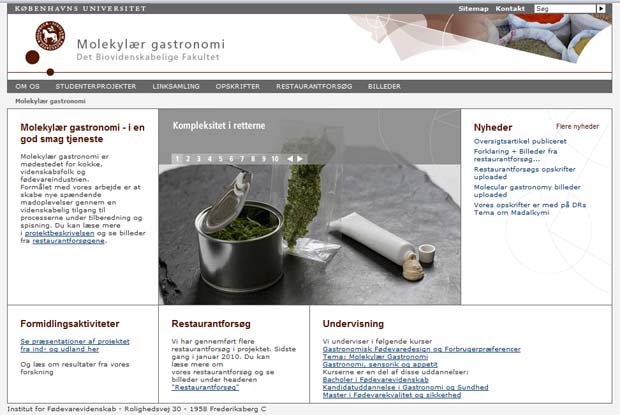
Homepage of the molecular gastronomy project at the University of Copenhagen (sorry – only in Danish as far as I know)
The research project Molecular gastronomy – the scientific study of deliciousness and its physical and chemical basis (Danish homepage) funded by The Danish Research Council was started in 2006. Led by prof. Leif Skibsted people from the Food Chemistry (Jens Risbo, Pia Snitkær Nielsen, Louise Mørch Mortensen) as well as the Sensory Science group (Michael Bom Frøst, Wender Bredie, Per Møller, Line Holler Mielby, Ditte Hartvig) at the Department of Food Science at Copenhagen University have been involved. In addition gastronomic entrepeneur Claus Meyer (noma co-founder) and physics professor Peter Barham (Bristol University) have contributed, as well as the chefs Thorsten Vildgaard (noma/Nordic Food Lab) and Bo Frederiksen (Meyers Madhus). Any of the names sound familiar? They should if you’ve read the recent review published in Chemical Reviews: Molecular Gastronomy: A New Emerging Scientific Discipline where several of the people involved in the project contributed as authors. This landmark paper summarizes and lays out research opportunities in molecular gastronomy, the branch of food science that deals with The art and science of choosing, preparing and eating good food to quote Thorvald Pedersens definition – he is a professor emeritus in chemistry that played an important role helping to establish molecular gastronomy as a research field at the University of Copenhagen.
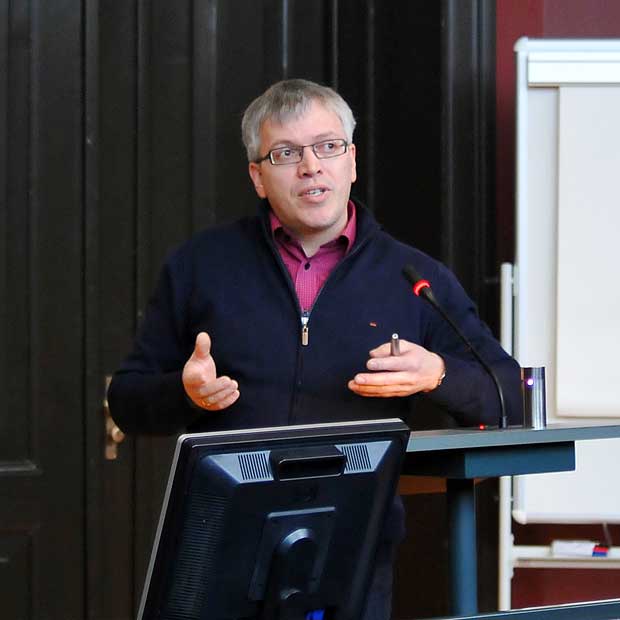
To mark the end of the project a seminar was organized on March 2nd 2011. The program included the following presentations: (more…)
The authors of Modernist Cuisine: Maxime Bilet, Chris Young and Nathan Myhrvold
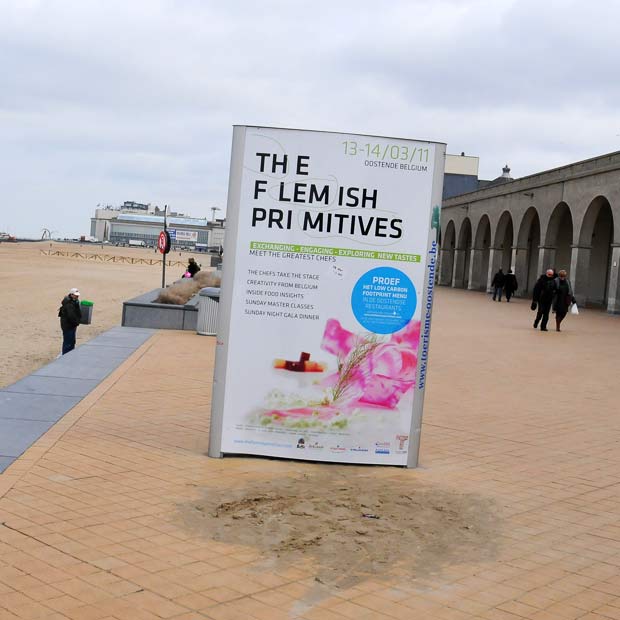
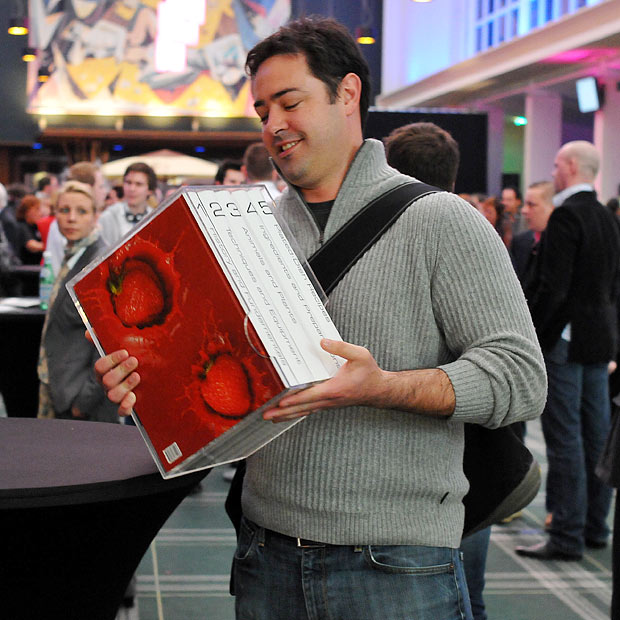
In 2003 Chris Young had an epiphany of a meal at The Fat Duck outside London, and by the end of the meal he knew he had to work with Heston Blumenthal. Things worked out well and after a stage he was hired to build and lead the experimental kitchen at The Fat Duck. In 2007 he returned to Seattle to work with Nathan Myhrvold who at that time was very active on the eGullet forum sharing his research on the sous vide cooking technique. The project that started off as a book on sous vide eventually grew into Modernist Cuisine with 6 volumes spanning more than 2400 pages. After many delays (one being due to Amazon’s drop test which showed that the casing wasn’t sturdy enough for the books totaling 20 kg) Modernist Cuisine is ready for release in March, and will be presented at The Flemish Primitives event in Oostende, Belgium on March 14. That’s one more reason to visit the event!
Martin Lersch: Congratulations with Modernist Cuisine – it is a truly amazing accomlishment! Will you be present in Oostende? (more…)
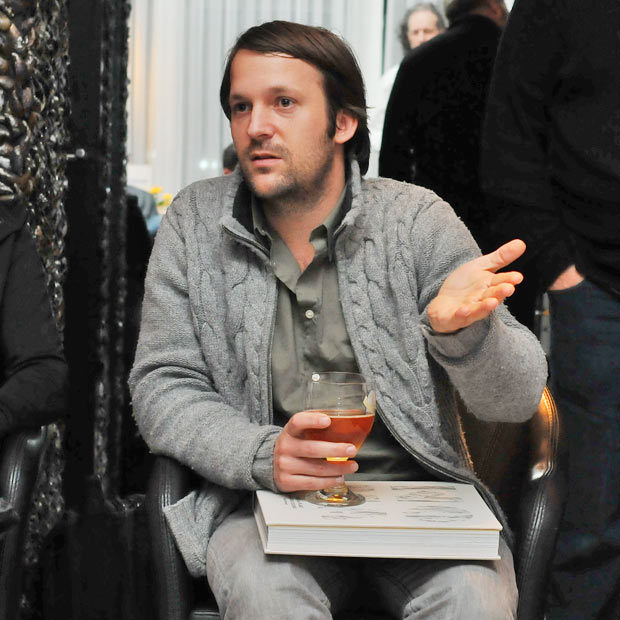
It’s soon time for the third edition of The Flemish Primitives and registration has now opened. The Flemish Primitives wants to challenge Belgian gastronomy and bring together chefs from all over the world to meet and exchange ideas built on innovation. The top name this year is without doubt the chef René Redzepi of Noma, the world’s best restaurant according to Restaurant magazine, but “the Flemish primitives” will be present (a group of Belgian chefs) as well as guests and scientists. And there are a lot of new things going on as well. (more…)
Update:I’ve written up a short post about no-knead bread in Norwegian – Brød uten å kna – to accompany my appearance in the popular science program Schrödingers katt.
I know – since the NY Times article about Jim Lahey in 2006 the no-knead breads have been all over the internet, newspapers and now even appear in numerousbooks – this is really old news. But the no-knead breads are really tasty as well, so I hope you’ll forgive me! When I give popular science talks about chemistry in the kitchen the one thing I’m always asked about is the no-knead recipe I show, so I thought it was about time to publish a recipe. Surely, everyone can google it – but regrettably many (if not most?) recipes are given in non-metric, volume based units – even Jim Lahey’s original recipe. And for baking this is really a drawback because the density of flour depends so much on how tight you pack it. Oh yeah, and I will also try to explain why and how the no-knead bread works. (more…)
Remember the public cooking lectures at Harvard that I mentioned in September? According to the website they are *very popular* and the auditoriums are packed! This is good news, but the best thing is that the lectures are made available through YouTube and iTunes for free! So far 9 of the sessions are available, but I guess all will be available soon. If the picture is difficult to read, here’s the list of all the lectures: (more…)
Cream chargers containing 8 g of nitrous oxide each (N2O) to be used with an iSi whipper for whipping cream, making foams/espumas or pressurized infusions.
I believe most chemists are familiar with the “periodic videos” from the University of Nottingham, covering all the known chemical elements. The series features professor Martyn Poliakoff who’s grey hair is really worthy of a professor! They have now covered the complete periodic table of elements, and have even started to update some of their previously posted videos. There are also thematic videos as well as videos covering specific molecules appearing now. As a chemist I think the videos are great fun to watch since they show a number of exotic experiments I’ve never seen before combined with plenty of nice-to-know facts. I certainly recommend all these videos (for an overview, check out their website), but the reason I chose to blog about this is that I was delighted to find a number of more or less food related videos! These are definitely not going to make you a better cook. But some of them are quite amusing to watch, and you may even learn some chemistry as you go. But most of the food related videos are really just for fun
The website to accompany Modernist cuisine is up now. It showcases stunning pictures and example pages, the complete table of contents available in pdf format, details on the exceptional printing quality (stochastic screening and wide gamut inks in case you wondered…) as well as introductions to each volume: History and fundamentals, Techniques and equipment, Animals and plants, Ingredients and preparations, Plated dish recipes – and each page of these pages has additional pictures. It turns out that in addition to the five main volumes there is a 350 page spiral-bound kitchen manual printed on waterproof, tear-resistant synthetic paper (!) with condensed versions of the recipes. And their FAQ page let me know that the complete word count is 650,000. I’ve been looking forward to these books for quite some time, but seeing the pictures just got me to start counting down the days left until December 1st. (more…)
In addition to Modernist Cuisine and Keys to Good Cooking there are so many new books appearing this fall, so to save you from too many blog posts I’ve collected them here in a single posting. These are all books that I find interesting from my popular food science perspective combined with a strong interest for the actual cooking! The books are, in order of appearance: (more…)
“I’ve heard from many cooks that while they value the scope and depth of “On Food & Cooking,” when they need practical help with a specific technique or ingredient it’s often hard for them to locate the information. So my next book will be nothing but practical information and directions, concise and brief.”
I think it’s fair to say that Harold McGee, more than any other person I know of, has been very successful at distilling scientific work into a very readable and accessible form. He did this back in 1984 with the first edition of On food and cooking, and then again in 2004 with a more or less rewritten edition in 2004. A complete book with practical information rooted in science can easily become the single most useful book in your kitchen!