Archive for the ‘science’ Category

Nordic food lab

Wednesday, January 9th, 2013


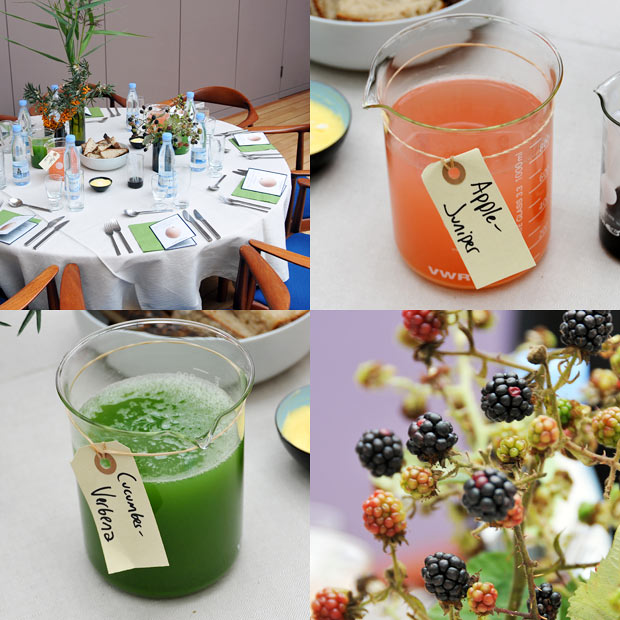
Tables set and decorated for the best lunch at a scientific conference ever!

I mentioned in my blog post on “The Emerging Science of Gastrophysics” symposium held at the Royal Danish Academy of Sciences and Letters in Copenhagen that we were treated with what was for me the best conference lunch ever. Later on the same day we even had a chance to visit the Nordic food lab, located on a house boat anchored up in Christianshavn, right next to restaurant noma. Here are some pictures and impressions from the lunch and the following visit to the Nordic food lab. (more…)

Gastrophysics symposium in Copenhagen

Sunday, September 9th, 2012

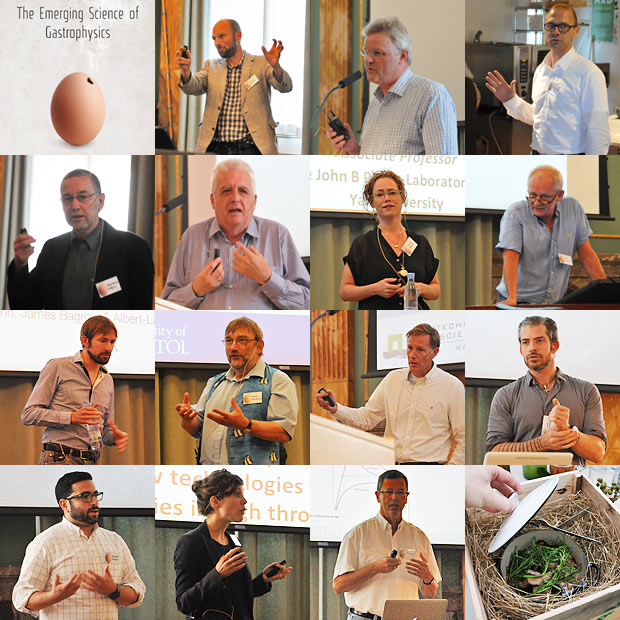
On August 27-28 the symposium “The Emerging Science of Gastrophysics” was held at the Royal Danish Academy of Sciences and Letters in Copenhagen. The symposium poster said “interdisciplinary”, and with presentations by scientists in fields ranging from physics and chemistry to neuroscience and psychology I think it lived up to its name. In this post I share with you what I found interesting and useful from my own, subjective perspective. I must admit that I didn’t understand everything presented. Perhaps this is even a general challenge for the whole field. It illustrates how difficult it is to do science that is simple enough for chefs to understand yet scientific enough for scientists. César Vega and Ruben Mercadé-Prieto’s study on egg yolks is perhaps one of the best examples of a paper that manages to balance the two. A couple of the presentations were very successful at this, and I think that if we continue to meet at similar symposiums we will see many more papers that manage to catch the attention of chefs and scientists at the same time.

Throughout the symposium (more…)

Maximizing Food Flavor by Speeding Up the Maillard Reaction

Monday, June 4th, 2012


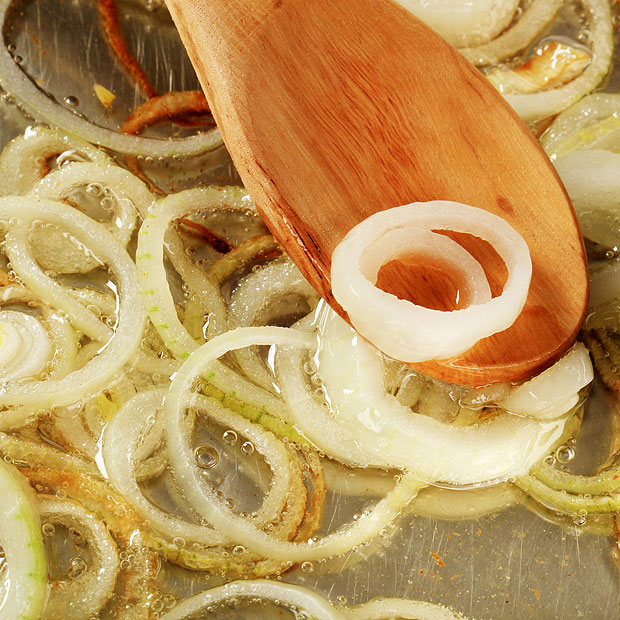
Is there a way to speed up the browning of onions? (Photo: Frying onion from Bigstock)

An idea that struck me once was to add baking soda to browning onions. I chopped an onion, melted butter in a frying pan, and added the onions together with a pinch of baking soda. And voilà (as Louis-Camille Maillard himself would have said): the color of the onions changed faster than without the baking soda. The taste of the browned onions was remarkably sweet and caramel-like, and compared with conventionally browned onions, they were softer—almost a little mushy. By the addition of baking soda, I had changed the outcome of an otherwise trivial and everyday chemical reaction, and the result seemed interesting from a gastronomic perspective!

The idea of the baking soda addition was not taken out of the blue but based on (more…)

Help needed on “natural sous vide”

Thursday, April 26th, 2012


Eggs boiled in onsen (japanese: hotspring), Nagano, Japan (Photo: Miya.m. Permission: GFDL, cc-by-sa-2.1-jp).

In Japan eggs cooked in hot springs (onsen) are known as onsen tamago. I’ve also read that Māori women used boiling pools at Whakarewarewa to cook. In fact I wouldn’t be surprised if many people with access to hot springs would have considered using them for cooking. But finding examples isn’t so easy, so now I need your help: Are you aware of other examples of “natural sous vide”? By this I mean cooking of food at temperature below 100 °C/212 °F without the use of a temperature controlled water bath. It could be in a hot spring, near volcanoes, in steam baths or even in saunas (in a previous post on eggs I mentioned Finnish sauna eggs and Korean Maekbanseok gyeran). Any help finding other examples would be greatly appreciated! I’m interested in modern-day examples as well as traditional practices.

The new journal Flavour went live today

Wednesday, March 21st, 2012

It’s quite amazing that two journals so relevant to gastronomy and science have gone live within little more than a month. Last month we saw the appearance of International Journal of Gastronomy and Food Science, and today the first few articles in Flavour appeared, a few days ahead of the official launch event on March 28. If you’re in London you should consider attending the seminar “Flavour and the new nordic cuisine” jointly hosted by the London Gastronomy Seminars, the Centre for the Study of the Senses and BioMed Central, the publisher of Flavour.

The articles that appeared today include a paper on umami from the Nordic food lab, a study which shows that you take smaller bites of food with a strong aroma and finally an interesting paper exploring why you often perceive taste and smell as one. Oh, one more thing – did I mention that Flavour is an Open Access journal? I suggest you check out their content section immediately!

First issue of International Journal of Gastronomy and Food Science is out

Saturday, February 18th, 2012


I first wrote about this journal in March 2009 and finally it is here, the International Journal of Gastronomy and Food Science. The official launch of the paper version was during Madrid Fusion 2012, but last week the electronic version became available. All 10 articles, nearly 80 pages in total, are available for free download. At the moment I’m not sure if IJGFS will remain an open source journal, but let’s hope so! I see no point in listing all the contributions here, just head over to the table of contents and start reading!

Recreational kitchen mathematics: Cookie tessellations

Thursday, January 19th, 2012


Is there a way to avoid all that extra dough in between the cookies? (Photo: Christmas Tree Cookie Cutter from Bigstock)

It should come as no surprise that food, chemistry and mathematics meet in baking. For once I will leave the chemistry aside for a while and turn to the mathematical aspects of baking. More precisely I will delve into geometrical problems encountered in baking. When cutting cookies from a rolled out dough or placing cookies on a sheet for baking you actually attempt to solve a mathematical problem known as a packing problem. The purpose is to maximize the distance between the cookies and maximize the size of the cookies, paying attention that the cookies should not touch. Many will perhaps start with a square packing (see below), but soon figure out that a hexagonal packing will fit even more cookies onto the rolled out dough or onto the baking sheet (especially when the dough/sheet is large compared to the cookies). The optimum way of placing 2-17 circles in a square are shown below (and the solution for up to 10.000 circles is also available).

My challenge for you however is a different one as I’m interested in eliminating the leftover dough when cutting cookies. To achieve this the cookies cannot be circular. Using a square cookie cutter (or simply a knife) would be the easiest way to leave no gaps, but how cool are square cookies? What I’m really looking for are cookie tessallations which are aesthetically pleasing, and at the same time transferable to a baking sheet. Oh yeah: a tessallation “is the process of creating a two-dimensional plane using the repetition of a geometric shape with no overlaps and no gap” according to Wikipedia. So – no gaps – no leftover cookie dough! (more…)

Mineral waters à la carte

Wednesday, January 4th, 2012


Cloning popular brands of mineral water is now simpler then ever before with the updated version of the mineral water calculator!

When I blogged about DIY mineral water last year it was mainly a theoretical exercise since I didn’t have the required salts at hand. My experience was limited to adding some baking soda (sodium bicarbonate) to water before carbonation. Luckily Paul Hinrichs tested the calculator! In the meantime I have purchased the required salts and with several kilograms in total I’m probably well stocked for the next decade! Based on the output from the calculator, I mixed the salts required to clone San Pellegrino, added water and carbonated the mixture. And the good news is that it works! The water tastes great and I’ve been enjoying cloned mineral waters every day now for the last couple of weeks.
(more…)

New project: Exploring culinary claims

Saturday, December 17th, 2011

My fellow bloggers Anu Hopia (Molekyyligastronomia) and Erik Fooladi (Fooducation) together with Jenni Vartiainen and Maija Aksela have embarked on a collaboration project to explore claims about food and cooking. If you are a researcher (from any field), teacher at any level, chef or simply a foodie who finds this interesting you can find info at the end of this email on how to contact them. I bring here their description of the project in extenso:
(more…)

Wonders of extraction: Brewing beer

Wednesday, October 26th, 2011

Talking to a friend last year who is an avid home brewer made me realize how little I knew about beer and brewing. Inspired by what I learnt from the conversation I started reading Palmer’s How to brew which is essential for starters, but soon I also turned to Brigg’s Brewing – Science and practice and Priest’s Handbook of Brewing which are more rewarding if you’re a scientist. The first two steps in brewing beer – mashing and wort boiling – are really quite sophisticated extractions. And there is a lot of chemistry involved, so brewing beer seemed to me like an obvious extension of all my other interests. This is also the reason why I wanted to include a post about brewing in the Wonders of extraction series. The pictures for this blog post were taken as I brewed and bottled my latest batch, an American India Pale Ale.

Having read quite a lot about beer I soon found myself in the kitchen brewing my very first German wheat beer in August last year. I had decided that to familiarize myself with brewing (more…)