Archive for the ‘science’ Category
Friday, March 4th, 2011

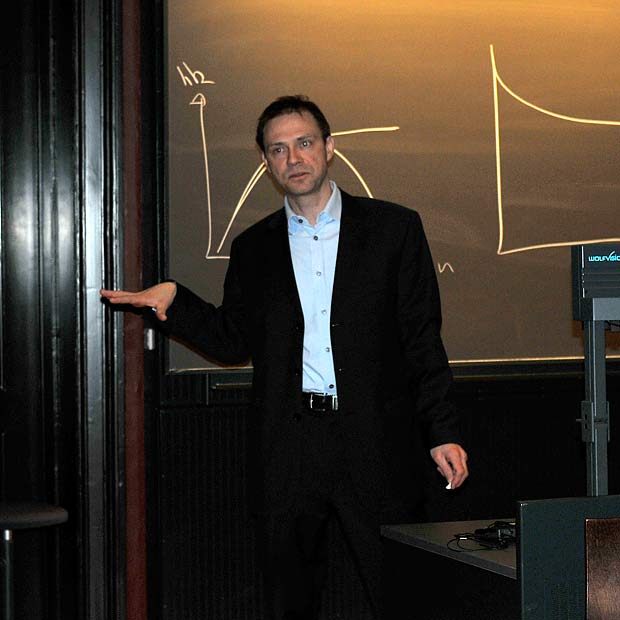
Wender Bredie presented results from experiments designed to test the flavor pairing hypothesis
A topic that I was particularily excited to hear about at the molecular gastronomy seminar in Copenhagen was flavor pairing. Since Heston Blumenthal presented his white chocolate and caviar combination based on amines in 2002 and Francois Benzi of Firmenich the pork liver-jasmine combination based on indole the idea has been further elaborated by Bernard Lahousse and Lieven De Couvreur who launched the foodpairing website and by me in the TGRWT food blogging event. Despite the interest and fascination it is fair to say the flavor pairing is still controversial – see for instance the discussion with in particular Jorge Ruiz. What is clearly lacking in the field is a more stringent scientific approach (as well as someone with time, interest, a sensory panel and the money to finance the activities…). It was therefore great to hear that sensory science professor Wender Bredie together with PhD student Ditte Hartvig actually set out to test the flavor pairing hypothesis formulated as: if major volatiles are shared between two foods it may very well be that they go well together. To achieve this they used a sensory panel to assess the odor of food pairs mixed and unmixed. Bredie proposed that a hyper addition of odor intensities would perhaps be the holy grail of flavor pairing – that is if the intensity of the mixed odors would be more than the sum of the unmixed intensities. Or even better: if there would be a hyper additive effect on pleasantness. (more…)
Tags: flavor pairing, flavour pairing, Heston Blumenthal, Wender Bredie
Posted in events, flavor pairing, molecular gastronomy, science | 6 Comments »
Friday, March 4th, 2011

Homepage of the molecular gastronomy project at the University of Copenhagen (sorry – only in Danish as far as I know)
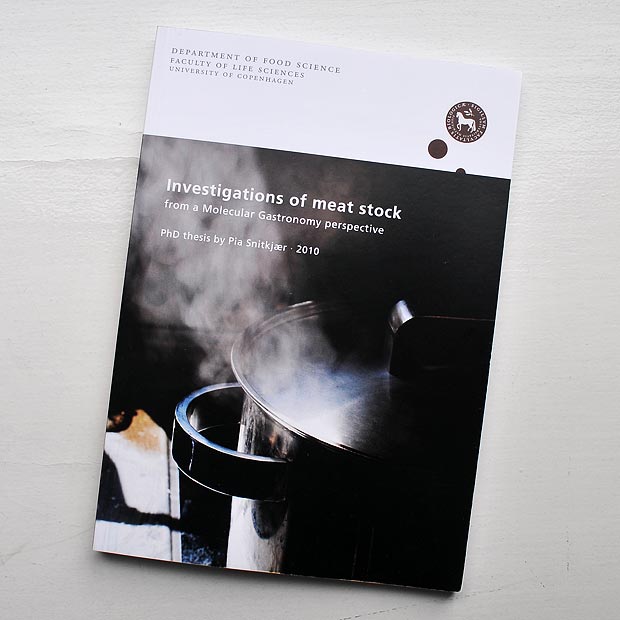
The research project Molecular gastronomy – the scientific study of deliciousness and its physical and chemical basis (Danish homepage) funded by The Danish Research Council was started in 2006. Led by prof. Leif Skibsted people from the Food Chemistry (Jens Risbo, Pia Snitkær Nielsen, Louise Mørch Mortensen) as well as the Sensory Science group (Michael Bom Frøst, Wender Bredie, Per Møller, Line Holler Mielby, Ditte Hartvig) at the Department of Food Science at Copenhagen University have been involved. In addition gastronomic entrepeneur Claus Meyer (noma co-founder) and physics professor Peter Barham (Bristol University) have contributed, as well as the chefs Thorsten Vildgaard (noma/Nordic Food Lab) and Bo Frederiksen (Meyers Madhus). Any of the names sound familiar? They should if you’ve read the recent review published in Chemical Reviews: Molecular Gastronomy: A New Emerging Scientific Discipline where several of the people involved in the project contributed as authors. This landmark paper summarizes and lays out research opportunities in molecular gastronomy, the branch of food science that deals with The art and science of choosing, preparing and eating good food to quote Thorvald Pedersens definition – he is a professor emeritus in chemistry that played an important role helping to establish molecular gastronomy as a research field at the University of Copenhagen.
To mark the end of the project a seminar was organized on March 2nd 2011. The program included the following presentations:
(more…)
Tags: Gastronomisk legestue, Jens Risbo, Leif Skibsted, Louise Mortensen, Michael Bom Frøst, Per Møller, Peter Barham, Pia Snitkjær, Thorvald Pedersen, Wender Bredie
Posted in events, molecular gastronomy, science | 1 Comment »
Thursday, February 24th, 2011

The authors of Modernist Cuisine: Maxime Bilet, Chris Young and Nathan Myhrvold
In 2003 Chris Young had an epiphany of a meal at The Fat Duck outside London, and by the end of the meal he knew he had to work with Heston Blumenthal. Things worked out well and after a stage he was hired to build and lead the experimental kitchen at The Fat Duck. In 2007 he returned to Seattle to work with Nathan Myhrvold who at that time was very active on the eGullet forum sharing his research on the sous vide cooking technique. The project that started off as a book on sous vide eventually grew into Modernist Cuisine with 6 volumes spanning more than 2400 pages. After many delays (one being due to Amazon’s drop test which showed that the casing wasn’t sturdy enough for the books totaling 20 kg) Modernist Cuisine is ready for release in March, and will be presented at The Flemish Primitives event in Oostende, Belgium on March 14. That’s one more reason to visit the event!
Martin Lersch: Congratulations with Modernist Cuisine – it is a truly amazing accomlishment! Will you be present in Oostende?
(more…)
Tags: Chris Young, Harold McGee, Heston Blumenthal, Maxime Bilet, Modernist cuisine, Nathan Myhrvold, the fat duck
Posted in books, equipment, experiments, interview, modernist cuisine, molecular gastronomy, science | 3 Comments »
Friday, January 7th, 2011

It’s soon time for the third edition of The Flemish Primitives and registration has now opened. The Flemish Primitives wants to challenge Belgian gastronomy and bring together chefs from all over the world to meet and exchange ideas built on innovation. The top name this year is without doubt the chef René Redzepi of Noma, the world’s best restaurant according to Restaurant magazine, but “the Flemish primitives” will be present (a group of Belgian chefs) as well as guests and scientists. And there are a lot of new things going on as well. (more…)
Tags: Belgium, Bernard Lahousse, Noma, René Redzepi, the flemish primitives
Posted in events, molecular gastronomy, science, tips & tricks | 2 Comments »
Wednesday, December 22nd, 2010

Update: I’ve written up a short post about no-knead bread in Norwegian – Brød uten å kna – to accompany my appearance in the popular science program Schrödingers katt.
I know – since the NY Times article about Jim Lahey in 2006 the no-knead breads have been all over the internet, newspapers and now even appear in numerous books – this is really old news. But the no-knead breads are really tasty as well, so I hope you’ll forgive me! When I give popular science talks about chemistry in the kitchen the one thing I’m always asked about is the no-knead recipe I show, so I thought it was about time to publish a recipe. Surely, everyone can google it – but regrettably many (if not most?) recipes are given in non-metric, volume based units – even Jim Lahey’s original recipe. And for baking this is really a drawback because the density of flour depends so much on how tight you pack it. Oh yeah, and I will also try to explain why and how the no-knead bread works.
(more…)
Tags: Baker's percentage, baker's yeast, baking, bread, cast iron, Dutch oven, flour, hydration, Jim Lahey, molecular gastronomy, no-knead, Saccharomyces cerevisiae, volume measurement, weight measurement, yeast, yeast viability
Posted in equipment, molecular gastronomy, news articles, recipe, science | 26 Comments »
Friday, December 17th, 2010

Mixing tomato ketchup with horseradish causes it to gel over night
A while ago a reader sent me a very interesting question regarding a gelled seafood sauce. It is made by mixing tomato ketchup with horseradish and his question was very simple: Why and how does this sauce gel? He speculated about pectin (which is present in tomatoes), but wondered why ketchup then doesn’t gel on it’s own? And he also noted that horseradish ground with water does not have any gel like properties. So how come they can form a gel when mixed together?
(more…)
Tags: enzyme, gelling, HM pectin, horseradish, horseradish peroxidase, HRP, ketchup, LM pectin, pectin, pectin methylesterase, PME, tomato
Posted in experiments, hydrocolloids, molecular gastronomy, recipe, science | 9 Comments »
Sunday, November 21st, 2010

Remember the public cooking lectures at Harvard that I mentioned in September? According to the website they are *very popular* and the auditoriums are packed! This is good news, but the best thing is that the lectures are made available through YouTube and iTunes for free! So far 9 of the sessions are available, but I guess all will be available soon. If the picture is difficult to read, here’s the list of all the lectures:
(more…)
Tags: Ferran Adria, Grant Achatz, Harold McGee, Harvard, Joan Roca, José Andrés, video, Wylie Dufresne
Posted in molecular gastronomy, science, videos | 9 Comments »
Monday, September 6th, 2010

Wheat beers such as hefeweizen, weissbier and wit are all light beers made from a mix of malted barley and wheat. In southern Germany the typical hefeweizen is fermented with a non-flocculating yeast, and it is not filtered before bottling. This gives the beer a yeasty, bread like flavor accompanied by aromas reminiscent of banan, cloves (we’ve encountered that combo before), coriander and citrus. I’ve just begun to read up on brewing and my first batch of a partial mash hefeweizen is bubling along. As I pitched the liquid hefeweizen yeast into the wort I decided to keep a tiny amount for baking. If hefeweizen beer is reminiscent of bread, why not use the yeast for making bread? In particular I was curious whether some of the aroma top notes characterizing hefeweizen beer would stand out in bread made using the same yeast.
(more…)
Tags: baker's yeast, baking, baking stone, beer, beer yeast, bread, emmer, farro, hefeweizen, Saccharomyces carlsbergensis, Saccharomyces cerevisiae, steam oven, weizen, wit, yeast
Posted in experiments, molecular gastronomy, recipe, science | 23 Comments »
Monday, September 6th, 2010
The Harvard School of Engineering and Applied Sciences (“SEAS”) and the Alícia Foundation have developed a new General Education science course, “Science and Cooking: From Haute Cuisine to the Science of Soft Matter”. The class is limited to currently enrolled Harvard undergrads, but the general public will have an opportunity to attend topic-related public lectures given by the guest chefs and faculty affiliated with the course. The lectures are not a replication of the course, but will consist of a brief introduction by Harvard professors followed by a broad-based talk by the chef. The first public lecture tomorrow features Harold McGee, Ferran Adria and José Andrés, so it would be well worth a visit if you live nearby. More info on venue, times and schedule here.
[Thank's to Matthew Pierce for the tip!]
Tags: education, Ferran Adria, Harold McGee, public lecture
Posted in molecular gastronomy, science | Comments Off
Saturday, August 21st, 2010

Cream chargers containing 8 g of nitrous oxide each (N2O) to be used with an iSi whipper for whipping cream, making foams/espumas or pressurized infusions.
A little more than a week ago Dave Arnold posted a great, new technique: pressure infusion using a conventional iSi whipper! Just think of it – the whipper has been around for decades, and years a go Ferran Adrià pioneered it’s use for espumas. Several have suggested it’s use for carbonation of fruit. But no one had thought of utilizing the whipper for infusions – until August 11th when Dave Arnold of Cooking issues posted the results of his experiments in “Infusion Profusion: Game-Changing Fast ‘N Cheap Technique”. The first blogger to pick up the technique and post about it on August 12th was Linda of playing with fire and water who termed it a revolutionary technique. A couple of days later, on August 17th Aki and Alex of Ideas in food posted a combined pressurized infusion of basil and marination of mozzarella. And then on August 20th James of Jim Seven describes his results comparing conventional cold brewed coffee to cold pressure brewed coffee. It’s really fascinating how fast the idea spread, and it illustrates the benefits of an open and sharing approach to food innovations.
(more…)
Tags: cavitation, Dave Arnold, extraction, infusion, innovation, iSi, nitrous oxide, parsley, whipper
Posted in blogs, equipment, molecular gastronomy, science, tips & tricks | 17 Comments »