Archive for the ‘tips & tricks’ Category

Gastrophysics symposium in Copenhagen

Sunday, September 9th, 2012

On August 27-28 the symposium “The Emerging Science of Gastrophysics” was held at the Royal Danish Academy of Sciences and Letters in Copenhagen. The symposium poster said “interdisciplinary”, and with presentations by scientists in fields ranging from physics and chemistry to neuroscience and psychology I think it lived up to its name. In this post I share with you what I found interesting and useful from my own, subjective perspective. I must admit that I didn’t understand everything presented. Perhaps this is even a general challenge for the whole field. It illustrates how difficult it is to do science that is simple enough for chefs to understand yet scientific enough for scientists. César Vega and Ruben Mercadé-Prieto’s study on egg yolks is perhaps one of the best examples of a paper that manages to balance the two. A couple of the presentations were very successful at this, and I think that if we continue to meet at similar symposiums we will see many more papers that manage to catch the attention of chefs and scientists at the same time.

Throughout the symposium (more…)

Recreational kitchen mathematics: Cookie tessellations

Thursday, January 19th, 2012


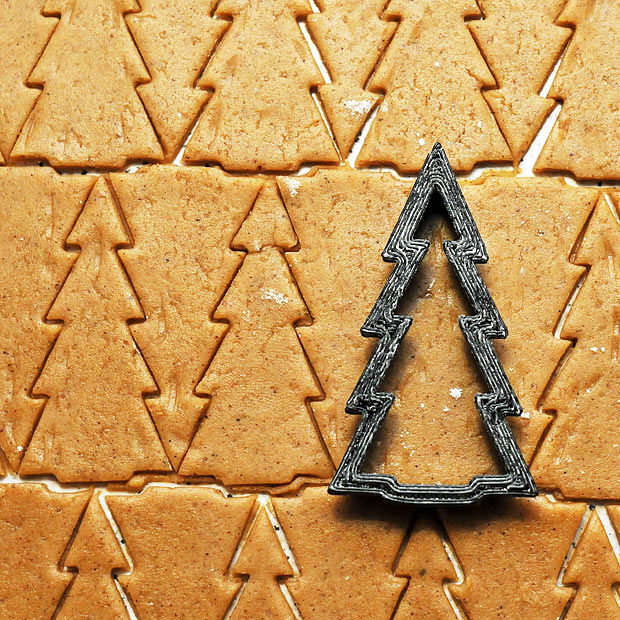
Is there a way to avoid all that extra dough in between the cookies? (Photo: Christmas Tree Cookie Cutter from Bigstock)

It should come as no surprise that food, chemistry and mathematics meet in baking. For once I will leave the chemistry aside for a while and turn to the mathematical aspects of baking. More precisely I will delve into geometrical problems encountered in baking. When cutting cookies from a rolled out dough or placing cookies on a sheet for baking you actually attempt to solve a mathematical problem known as a packing problem. The purpose is to maximize the distance between the cookies and maximize the size of the cookies, paying attention that the cookies should not touch. Many will perhaps start with a square packing (see below), but soon figure out that a hexagonal packing will fit even more cookies onto the rolled out dough or onto the baking sheet (especially when the dough/sheet is large compared to the cookies). The optimum way of placing 2-17 circles in a square are shown below (and the solution for up to 10.000 circles is also available).

My challenge for you however is a different one as I’m interested in eliminating the leftover dough when cutting cookies. To achieve this the cookies cannot be circular. Using a square cookie cutter (or simply a knife) would be the easiest way to leave no gaps, but how cool are square cookies? What I’m really looking for are cookie tessallations which are aesthetically pleasing, and at the same time transferable to a baking sheet. Oh yeah: a tessallation “is the process of creating a two-dimensional plane using the repetition of a geometric shape with no overlaps and no gap” according to Wikipedia. So – no gaps – no leftover cookie dough! (more…)

Mineral waters à la carte

Wednesday, January 4th, 2012


Cloning popular brands of mineral water is now simpler then ever before with the updated version of the mineral water calculator!

When I blogged about DIY mineral water last year it was mainly a theoretical exercise since I didn’t have the required salts at hand. My experience was limited to adding some baking soda (sodium bicarbonate) to water before carbonation. Luckily Paul Hinrichs tested the calculator! In the meantime I have purchased the required salts and with several kilograms in total I’m probably well stocked for the next decade! Based on the output from the calculator, I mixed the salts required to clone San Pellegrino, added water and carbonated the mixture. And the good news is that it works! The water tastes great and I’ve been enjoying cloned mineral waters every day now for the last couple of weeks.
(more…)

Book review: Cooking for geeks

Monday, June 13th, 2011


Jeff working on a recipe in his kitchen. (Photo by Shimon Rura. © 2009 Atof Inc.)

For a book about food this is a rather unusual book. The author states in the preface that the goal of the book is to “point out new ways of thinking about the tools” that are found in the kitchen. It’s not a book you’ll pick up for its recipes, even though the 100+ recipes included are fine. And it’s not a book you would pick up because of mouthwatering photographs of food. It is however a book that could trigger a lifelong interest in cooking among those who are scientifically minded. Where an experienced chef can read between the lines of a recipe, the rest of us can turn to books like Cooking for geeks to get hints on how to turn a recipe into a tasty dish.
(more…)

Perfect egg yolks

Monday, April 18th, 2011


Maybe I have a hangup on soft boiled eggs, but I’m deeply fascinated by how something simple as an egg can be transformed into such a wide range of textures. I’m talking about pure eggs – no other ingredients added. Playing around with temperature and time can result in some very interesting yolk textures – yolks that are neither soft nor hard, but somewhere inbetween. Two examples from the blogosphere are Chad Galliano’s 90 min @ 63.8 °C egg yolk sheets and David Barzelay’s 17 min @ 70.0 °C egg yolk cylinders (both bloggers giving credit to Ideas in food and Wylie Dufresne respectively).

In 2009 I wrote about my journey towards the perfect soft boiled eggs. Equipped with a formula I knew what I wanted, but it wasn’t so easy after all. Since then I’ve tried to model experimental data from Douglas Baldwin as well as data from my own measurements of egg yolk tempereatures when cooked sous vide (pictures of how I did this at the end of this blog post). I never got around to blog about the results, and now there’s no need for it anymore: The egg yolk problem has been solved! And the question that remains is: How we can utilize this in the kitchen?

The break through came this year (more…)

The Flemish Primitives 2011

Friday, January 7th, 2011

It’s soon time for the third edition of The Flemish Primitives and registration has now opened. The Flemish Primitives wants to challenge Belgian gastronomy and bring together chefs from all over the world to meet and exchange ideas built on innovation. The top name this year is without doubt the chef René Redzepi of Noma, the world’s best restaurant according to Restaurant magazine, but “the Flemish primitives” will be present (a group of Belgian chefs) as well as guests and scientists. And there are a lot of new things going on as well. (more…)

Wonders of extraction: Pressure

Saturday, August 21st, 2010


Cream chargers containing 8 g of nitrous oxide each (N2O) to be used with an iSi whipper for whipping cream, making foams/espumas or pressurized infusions.

A little more than a week ago Dave Arnold posted a great, new technique: pressure infusion using a conventional iSi whipper! Just think of it – the whipper has been around for decades, and years a go Ferran Adrià pioneered it’s use for espumas. Several have suggested it’s use for carbonation of fruit. But no one had thought of utilizing the whipper for infusions – until August 11th when Dave Arnold of Cooking issues posted the results of his experiments in “Infusion Profusion: Game-Changing Fast ‘N Cheap Technique”. The first blogger to pick up the technique and post about it on August 12th was Linda of playing with fire and water who termed it a revolutionary technique. A couple of days later, on August 17th Aki and Alex of Ideas in food posted a combined pressurized infusion of basil and marination of mozzarella. And then on August 20th James of Jim Seven describes his results comparing conventional cold brewed coffee to cold pressure brewed coffee. It’s really fascinating how fast the idea spread, and it illustrates the benefits of an open and sharing approach to food innovations.
(more…)

Norwegian egg coffee

Wednesday, August 4th, 2010


Egg coffee – a mild and refreshing drink that can be served warm as well as cold

I recently stumbled over “Norwegian egg coffee”. At first I thought it was a joke, but it turned out that this is indeed an “egg coffee” – coffee prepared with an egg! I have never heard about it here in Norway, but the fact that it’s popular among Americans of Scandinavian origin in the Midwest suggests that it could be something immigrants brought with them from Norway (feel free to fill me out on the historic origins of this!). I mentioned egg coffee to my mom, and although she had never heard of it before, she did mention that skin or swim bladders from fish were used when boiling coffee to help clearify it. In fact the Norwegian name for this – klareskinn – literally means “clearing skin”. The English name is isinglass (thank’s Rob!). Could it be that the fish skin originally used was replaced by eggs, perhaps due to a limited availability of fish in the Midwest? After all, both are good protein sources.
(more…)

Update: Texture version 2.3

Tuesday, May 4th, 2010

An updated version of “Texture – A hydrocolloid recipe collection” is now available for download (version 2.3). The longer I work on this, the more I realize that it will never really “finish” – there’s always more to add. And believe me – my todo list is still quite long (and I even have some feedback which I haven’t had time to incorporate yet). But I thought that since it’s more than a year since the last update, it was about time to share with you the things that have been changed. Major changes and updates include:

Pictures: This is the biggest visual change! Some recipes are now equipped with pictures which may give you an idea of the texture AND they indicate that the recipe has indeed been tested. But I need your help to add more pictures to the recipe collection (please follow the link to read more about how you can contribute pictures)! And of course - a big thanks to those of you who have already contributed your pictures!

Recipes: Recipes have been added and the total number is about 310 now. I’m getting a little more picky now with regards to which recipes I add. Ideally each new recipe added now should illustrate something new.

I should mention that I’m very grateful for feedback from readers and users of this recipe collection. Thank you very much with helping me improve the document! If you find typos, wish to comment on something or have suggestions on how to improve the collection, please do not hesitate to write me an email at webmaster (at) khymos (.) org or just write a comment in the field below.

Please head over to the download page for the links.

A pinch of salt for your coffee, Sir?

Sunday, March 21st, 2010


A small sprinkle of salt will suppress bitterness – and in some cases it can benefit the overall coffee flavor. I’ve tried it with an espresso and somehow it works, but it’s difficult to describe the flavor.

I prefer my coffee black, and politely decline when offered milk and sugar. However, if offered salt I would probably smile and say “Yes, please!” Salt???! It turns out that adding salt to coffee is not as weird as it may sound at first. There is a tradition for adding a pinch of salt to coffee in Northern Scandinavia, Sibir, Turkey and Hungary. And when available, such as in coastal areas where fresh water from rivers mixes with the salt sea, one would simply use brackish water when preparing coffee. This water typically has a salt content of 0.5-3%, which is lower than the average 3.5% in seawater. This results in a more intense taste and more foaming. And if living far from the sea, the Swedish food blogger Lisa Förare Winbladh let me know that in Northern Sweden one would deliberately add salt if using melt water from glaciers for making coffee. But tradition aside, is there a scientific explanation of this widespread tradition of preparing coffee with addition of salt?
(more…)