Archive for the ‘tips & tricks’ Category

TGRWT #8: White chocolate soufflé with caviar

Wednesday, January 30th, 2008

white-chocolate-caviar-2.jpg

As a late (but just in time for the deadline) response to TGRWT #8 which was announced by Chadzilla in December last year – here is finally my write up on a recipe and a little on the background of this flavor combination which has become a classic in molecular gastronomy.

Heston Blumenthal introduced it around 2002 at The Fat Duck. It’s well worth reading what Heston wrote about this combination back then. He describes how salt can help bring out the flavor of many desserts. At one point he tried caviar and white chocolate – the effect was stunning. He then wanted to find out why this combination was so successful:

I gave some caviar and chocolate to François Benzi, who works for Firmenich, the flavourings and perfumes company based in Geneva. He was so surprised at the way that the caviar and chocolate melded together that he excused himself for half an hour while he tried to discover the reason behind the success of this union.

When he returned, the response was that both the chocolate and caviar contain high levels of amines. These are a group of proteins that have broken down from their amino acid state but not so far as to become ammonia. Amines contribute to the desirable flavours that we find in cooked meats and cheeses, among other things.

Some might object to using caviar but remember that there is no need to turn to sturgeon caviar as this species is endangered. I used caviar from Capelin which costs less than $4/€3 for a box of 50 g. As I have never tasted the “real” stuff I’m not the right person to judge about similarity or difference in aroma. And in case you also wondered about the terminology – roe is the fully ripe egg masses of fish whereas caviar refers to processed, salted roe. I decided to make a soufflé and based the recipe loosely on one of the soufflé recipes in my Larousse Gastronomique.

white-chocolate-caviar-3.jpg

White chocolate soufflé with caviar
40 g white chocolate
30 g flour
1 dL milk
35 g caviar
3 eggs, separated
nutmeg

Melt chocolate on very low heat. Add 1/3 of the flour and stir, heating gently. Add a 1/3 of the milk and mix thoroughly. Add another 1/3 of the flour, then more milk and so on. Add finely ground nutmeg. Add 3 egg yolks and heat until right before the mixture sets (yeah – I admit – this is not very precise…). Then add the caviar. Beat egg whites stiff and fold them in. Pour into greased soufflé dish and bake at 220 °C for about 15 min.

Verdict: Aromas blend well together, but when eaten alone it’s perhaps a little bland. But I’m quite sure that it could be succesfully incorporated into a menu together with something acidic. The texture was nice, but the soufflé quickly falls together once it’s removed from the oven (I’ll have to post more on the chemistry of soufflés some other time – Hervé This has written a lot about this).

If you try to make this – note that white chocolate doesn’t behave excately like butter when you add the flour. It all got very thick, very fast – that’s why I started adding milk early. I also guess you have to be really careful when heating the whtie chocolate, but I didn’t do any stress tests here.

white-chocolate-caviar-1.jpg
This is what the mix looks like before I folded in the egg whites.

For my first attempt at this recipe I used 20 g flour and 15 g caviar. The result was that the caviar sedimented before the soufflé had set, besides the fact that one could hardly taste the caviar at all. On my second attempt however, there was enough flour to keep the caviar suspended until the soufflé set. And one could actually also taste the caviar.

white-chocolate-caviar-4.jpg

And now on to the chemistry behind:
I promised that I would come back with more information about the chemistry behind this pairing, but there isn’t very much information out there. There is one paper on aroma development in block-milk which used in the production of white chocolate. This paper lists a couple of volatiles, but only with their relative peak areas. Turning to caviar (or roe), there is a recent paper on flavor characterization of ripened cod roe, and this paper includes qualitative information about odor intensity.

Comparing the list of volatiles, the following volatiles which contribute substantially to the odor of ripened cod roe are also found in block milk (followed by odor thresholds in water, given in ppb, taken from this page):

2-butanone (50000 ppb)
2-methylbutanal (1 ppb)
3-methylbutanal (0.2-2 ppb)
pentanal (na)

Of these, the first has a high odor threshold, so it’s not likely to be an impact odorant in block-milk (and white chocolate). The methylbutanals however probably contribute to the overlapping aroma of roe and white chocolate. I didn’t find any threshold value for pentanal.

One group of compounds which was not mentioned in the paper on cod roe odor from 2004, but which was mentioned in a Russian paper from 1967 are amines (Golovnya: “Gas-chromatographic analysis of amines in volatile substances of salmon caviar”). Considering the fact that trimethylamine has a threshold in the range of 0.37-1.06 ppb, and that trimethylamine is found in block-milk suggests that it might contribute significantly to the odor of both white chocolate and roe. I guess the reason trimethylamine (and the whole range of other, closely related amines) is not found in the odor analysis in the 2004 paper has to do with the analytical method used.

The fact that amines are crucial is further supported by the Guardian article I quoted from in the beginning where Heston Blumenthal describes how he turned to François Benzi, a flavor chemist at Firmenich, to find out why white chocolate and caviar is such a good match. Benzi concludes that it is due to the presence of similar amines in white chocolate and caviar.

Clarification of stock and other liquids

Monday, September 3rd, 2007

In a comment to the last post, Chad asked how the clarification with laboratory glass ware works. Here’s how. Basically it’s a filtration. But if you would use a normal filter paper (such as a coffee filter) and let gravity pull the liquid through the filter, it would take ages. By applying a vacuum to the back side of the filter, the stock is sucked through (or pushed if you like by the atmospheric pressure). The are several possible sources of vacuum. The simplest and cheapest is a water aspirator or a handpump. More expensive solutions include a membrane pump or an oil pump. The particles you want to remove are from 0.0001 mm and upwards to > 1 mm. The best thing would be to first pass the stock through a cheese cloth or a muslin, followed by one or more filtrations using filter paper. This would gradually yield a perfectly clear solution. Pictures of a Büchner funnel, Erlenmeyer flask and a water aspirator can be found on the tools page of Khymos. Pictures of a complete setup can be found by googling. If doing this in a kitchen, you would want to have an Erlenmeyer flask of at least 2-3 L as this is where the clearified stock is collected. The Büchner funnel should preferably have a diameter of 12 cm or more.

stock-filtration.png

The fascinating thing about a filtration like this is that you can also remove color. At the EuroFoodChem XIV conference I was told by Jorge Ruiz of Lamaragaritaseagita that you can make perfectly clear tomato juice by succesive filtrations, starting with a coarse filter and moving to finer filters. All in all, 3-5 filtrations should be sufficient.

Molecular gastronomy at EuroFoodChem XIV

Sunday, September 2nd, 2007

efc14-paris.jpg
The conference venue was right next to the Eiffel tower

I’ve just returned from the conference Euro Food Chem XIV which took place in Paris from August 29th to 31st 2007. One of the topics was “Molecular Gastronomy: objectives, development, international collaboration”, which as you might have guessed, was the reason I went there. There were several oral presentations and a whole number of poster presentations of interest to molecular gastronomists. It was great meeting again people who attended the 2004 Erice meeting. I also had the pleasure of interacting with several of Hervé This’ former and present students who share the same enthusiasm for molecular gastronomy and the application of scientific thinking to home cooking.

conference-dinner-efc14.jpg
Hervé This and myself at the conference dinner (Photo by Daniel Kalnin)

Molecular gastronomy was only one of four topics at the conference, but fortunately Hervé This had arranged a special “Chefs meet scientists” session on the second day of the conference which attracted a large number of people in addition to those attending the EuroFoodChem conference.

chefs-meet-scientists-audit.jpg
The auditorium was packed for the “Chefs meet scientists” session

Following an introduction by Hervé This, there were presentations of molecular gastronomy activities in France, Spain and Portugal. These activities are directed towards both chefs and the general public. Representatives from Air liquide, a manufacturer of liquid nitrogen, had a presentation of various uses of liquid nitrogen for “cooking” purposes, followed by shorter presentations of tools, techniques and ingredients. The molecular gastronomy blogging community was well represented, and I was delighted to meet the people behind Food for design (Bernard Lahousse from Belgium), Jocooking (Joana Moura from Portugal) and Lamargueritaseagita (Jorge Ruiz Carracal from Spain) – their blogs are hereby recommended!

chefs-meet-scientists-herve.jpg
Hervé This fills in on Joana Moura’s presentation

chefs-meet-scientists-air-l.jpg
Representatives from Air liquide demonstrating liquid nitrogen applications. In the picture a stainless steel disk has been cooled and is then used as an “inverted griddle”

chefs-meet-scientists-cazor.jpg
Anne Cazor from Cuisine Innovation explains clarification of stock using traditional organic chemistry glass ware

All in all the conference and in particular the “Cheefs meet scientists” session and talking to people was truly inspiring and an excellent opportunity for me to catch up on what is moving in molecular gastronomy these days!

Ten tips for practical molecular gastronomy, part 7

Monday, August 27th, 2007

book-pile-450px.jpg
Click here for full size image

7. Question authorities and learn from the experts

A thick, nicely bound cook book with marvelous pictures and a professional layout signals quality and authority. But unfortunately the nice wrapping is no guarantee that the contents is scientifically sound. I would guess that the searing/sealing myth and adding salt to water used to boil vegetables are among the most ubiquitious of the myths. The challenge for everyone is to question the procedures and explanations given in cook books and those that are inherited from your parents and grand parents. Most of them are fine, but some are not. In fact Hervé This has collected more than 20.000 so called “precisions” from French culinary books that he wants to test.

My seventh tip for pursuing molecular gastronomy in your very own kitchen is to question the cook book authorities, but also to learn from the experts in the field. The site Khymos originally started out as a listing of books and web pages that could be useful for anyone interested in molecular gastronomy and popular food science. When giving presentations it was more convenient for me to refer to a webpage than to have people taking notes of all the references. My own collection of books is constantly growing as you can see from the picture (I justed crossed the 100 cm mark), and I am more than happy to share with you my favorite books. Most of what I know about food chemistry and molecular gastronomy is from these books.

book-pile-meter.jpg

Molecular gastronomy should of course never become a theoretical practice only, so remember that “the proof is in the pudding”, as Nicholas Kurti, one of the pioneers of molecular gastronomy often said. Let taste guide your cooking and learn how to conduct simple blind tastings (more on that in part 8). If possible, do an experiment: if there are two or more procedures, follow them and compare the end result.

Despite the many books and articles that have appeared on food chemistry and molecular gastronomy there are still many questions that remain unanswered. Scientifically, molecular gastronomy is tremendously complex. The science of deliciousness lies in the cross section of analytical, biological, inorganic, organic, physical, polymer and surface chemistry. But even though describing and understanding what happes is difficult, everyone is able to judge the end result! This is quite intriguing and because of this it is possible to become an excellent cook – even if you don’t understand the chemistry behind in every detail. This makes me confident that there will always be an “art” and a “love” component in cooking, as Hervé This puts it in his definition of molecular gastronomy.

*

Check out my previous blogpost for an overview of the 10 tips for practical molecular gastronomy series. The collection of books (favorite, molecular gastronomy, aroma/taste, reference/technique, food chemistry, presentation/photography) and links (webresources, people/chefs/blogs, institutions, articles, audio/video) at khymos.org might also be of interest.

TGRWT #5: Grilled pork tenderloin with chocholate beef stock cream

Sunday, August 26th, 2007

chocolate-beef-stock-cream.jpg

This month’s TGRWT is hosted by Le Petite Boulanger, and the foods to pair are chocolate and meat. The recipe for the chocolate beef stock cream is inspired by the Iberian Ham Cream by Ferran Adrià/El Bulli (the recipe can be found on p. 21 in the hydrocolloid recipe collection). I used anis because it brings out the meatiness very well. After mixing in the olive oil I saw that the droplets were not properly dispersed. Addition of some lecithin which solved this problem.

Chocolate beef stock cream
100 g water
2 g beef stock powder
10 g chocolate (70%)
1/4 t anis, powdered
0.5 g xanthan
0.2 g lecithin
20 g olive oil
honey and chili oil to taste

Heat water to dilute beef stock and melt chocolate. Cool. Add xanthan and lecithin. Mix with immersion blender. Add olive oil. Mix until smooth texture. Sprinkle with chives.

Grilled pork tenderloin
pork tenderloin, cut in 3 cm thick pieces
oil
powdered anis
crushed garlic

Marinate meat with oil, garlic and anis mixture. Grill. Serve together with the chocolate meat broth cream.

pork-chocolate-beef-stock-cream.jpg

Verdict: The chocolate beef stock cream has very meaty and almost nutty flavour. Honey is important to round of the otherwise slightly bitter taste of the chocolate. Chili oil gives it a bite, but can be omitted.

You can get an impression of the texture from this video:

Hydrocolloid recipe collection

Tuesday, August 14th, 2007

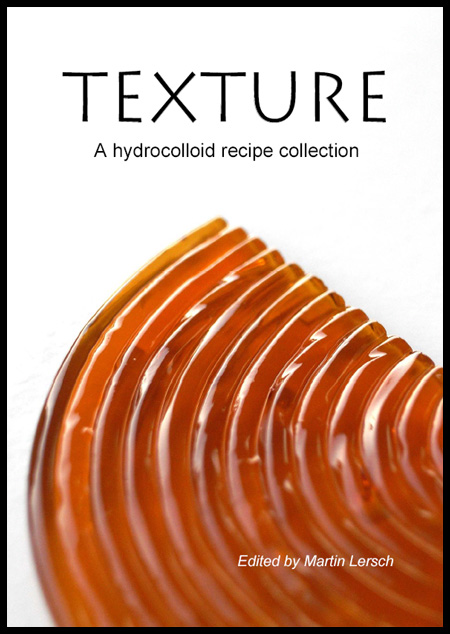
I’m happy to finally announce the first edition of a recipe collection devoted mainly to hydrocolloids. Totaling 111 recipes, it’s available for download as a pdf file (29 pages, 433 kB).

Update: The collection has been revised and is now available for download (more than 220 recipe, 73 pages, 1.8 Mb).

The following text is from the introduction I’ve written to the recipe collection:

A hydrocolloid can simply be defined as a substance that forms a gel in contact with water. Such substances include both polysaccharides and proteins which are capable of one or more of the following: thickening and gelling aqueous solutions, stabilizing foams, emulsions and dispersions and preventing crystallization of saturated water or sugar solutions.

In the recent years there has been a tremendous interest in molecular gastronomy. Part of this interest has been directed towards the “new” hydrocolloids. The term “new” includes hydrocolloids such as xanthan which is a result of relatively recent research, but also hydrocolloids such as agar which has been unknown in western cooking, but used in Asia for decades. One fortunate consequence of the increased interest in molecular gastronomy and hydrocolloids is that hydrocolloids that were previously only available to the food industry have become available in small quantities at a reasonable price. A less fortunate consequence however is that many have come to regard molecular gastronomy as synonymous with the use of hydrocolloids to prepare foams and spheres. I should therefore emphasize that molecular gastronomy is not limited to the use of hydrocolloids and that it is not the intention of this collection of recipes to define molecular gastronomy.

One major challenge (at least for an amateur cook) is to find recipes and directions to utilize the “new” hydrocolloids. When purchasing hydrocolloids, typically only a few recipes are included. Personally I like to browse several recipes to get an idea of the different possibilities when cooking. Therefore I have collected more than 100 recipes which utilize hydrocolloids ranging from agar to xanthan. In addition to these some recipes with lecithin (not technically a hydrocolloid) have been included. Recipes for espumas that do not call for addition of gelatin or other thickening agents have also been included for completeness.
All recipes have been changed to SI units which are the ones preferred by the scientific community (and hopefully soon by the cooks as well). As far as possible, brand names have been replaced by generic names. Most of the recipes have been edited and some have been shortened significantly. In some recipes, obvious mistakes have been corrected. But unfortunately, the recipes have not been tested, so there is no guarantee that they actually work as intended and that the directions are complete, accurate and correct. The recipes have been collected from various printed and electronic sources and every attempt has been made to give the source of the recipes.

Since recipes can neither be patented nor copyrighted, every reader should feel free to download, print, use, modify, distribute and further develop the recipes contained in this compilation. The latest version will be available for download from http://khymos.org/recipe-collection.php and will also be announced at http://blog.khymos.org. Feedback, comments, corrections and new recipes are welcome at recipe.at.khymos.dot.org.

Martin Lersch
Oslo, August 2007

Ten tips for practical molecular gastronomy, part 6

Sunday, July 1st, 2007

cherry-1.jpg

6. Learn how our senses work

Prolonged exposure to a flavor causes adaption and habituation, meaning that your brain thinks the food smells less even though it’s still present in the same amount. Back in 1953 Lloyd M. Beidler isolated nerves from the tongue of rats to study these phenomena. The nerves were situated in a flow-chamber through which aquous solutions with salty, sweet, acidic and bitter compounds could be flushed. The electric signal produced by the nerve was then recorded and fed to an amplifier and a plotter. Very simplified, the perceived intensity of the stimulus looked something like this (the curve is not to scale in any dimension and it’s my own qualitative interpretation of the data presented in the article):

physiochemical-response-curve.png

After a short initial latency period a transient is followed by a slower prolonged decrement. There is even some nerve activity after the stimulus has been removed. What is interesting from a molecular gastronomy perspective is that the initial burst of taste quickly fades away – some call it fatigue or adaption. If the same stimulus is applied repeatedly, the maximum intensity of the initial taste burst decreases for each time it is applied. This is known as habituation and is illustrated in the figure below. As the time between stimulation of the receptor increases, the receptor recovers from the habituation and the intensity of the second stimulus increases to match the intensity of the first.

habituation-recovery.png

Adaption and habituation are also observed with odor. If you have used eau de cologne or perfume you might have noticed that you can smell it very well once applied, but after some minutes or hours you hardly notice it unless you sniff intentionally for it. The same applies for food.

Variation is the spice of life, and variation helps our senses to overcome adaption and habituation. More technically this has been referred to as “increased sensing by contrast amplification” which I think is a good way putting it. An illustrative example is Heston Blumenthal’s potato purée with small pieces of lime jelly (made with agar agar which is heat stable once it has set). The idea was that to avoid the adaption to the flavour and texture of the potatoe purée, small pieces of lime jelly would help “reset” the taste buds and thereby lead to an increased overall perception of the purée. I’m personally very fond of the variation provided by multiple component dishes. A curry sauce for instance is normally not served alone but alongside many other dishes: rice, dal, chicken/meat/fish, chutney, raita, nan, chapati, pakora, lime juice, salt etc. The different components contrast each other and help bring out the most of the meal.

Contrasts also help us smell better. When we sniff there is an abrupt change in the amount of air passing through our nose. More molecules pass the receptors and the sudden change in their concentration makes it easier to sense them. It has been shown that sniffing in fact gives an optimal odor perception.

face.jpg

Our senses are not unrelated, and there are many interesting articles illustrating this. For instance, adding color to make white wine darker or even red influences the perception of the wine aroma. Along the same lines, consider crystal pepsi which wasn’t a great success after all, probably due to the lack of color. With juice and soups it has been demonstrated that odors smelled through the mouth are perceived differently than those smelled through the nose. Similarily colors can either enhance of suppress the intensity of odors depending on whether they are smelled through the nose or through the mouth.

There are a number of odor-taste interactions. For example, through repeated pairing with sugar, odors become “sweeter”. We become better at detecting sugar solutions if strawberry aroma is added to them, but worse if ham aroma is added. And you shouldn’t be to surprised that both perceived and imagined odors influence taste (that’s right – think of strawberries, and sucrose will taste sweeter!). Heston Blumenthal uses this in the savory ice creams he makes. We associate the cold and rich mouthfeel of ice cream with something sweet, and this influences our perception of the flavour, making it sweeter. In general, the “sweeter” an odor is perceived, the more it enhances tasted sweetness and the more it suppresses sourness. Preliminary experiments suggest that even pure tastants have a smell.

A thing to consider when eating is that our body position influences olfactory sensitivity. And don’t forget that your emotional state also has an effect on the olfactory perception. Emotionally labile people are more sensitive to certain smells and less sensitive to others.

The examples of how our senses are not independant has some practical implications for cooking and eating:

Presentation is paramount, and it is worthwile to consider the art of food presentation. There is a lot to learn from food photography blogs and food blogs with good photos: still life with…, matt bites, 101 cookbooks, la tartine gourmande too mention but a few. Also check out the pictures submitted to the monthly food photography blogging event does my blog look good in this (google DMBLGiT to find out which blog hosts this month’s event).

Taste, smell, texture, mouth feel, temperature and appearance will all contribute to the overall experience when eating and drinking. But also the room, the atmosphere and the people present have an influence. I have previously mentioned the five aspects meal model which has been developed for restaurant settings and takes all of this into account.

Many of the ideas found in this blog post can be expressed in appetizers. With small, well prepared amuses bouche there is variation with every bite, creating excitement and anticipation.

And remember that average food eaten in the company of good friends while you’re sitting on a terrace with the sun setting in the ocean will taste superior to excellent food served on plastic plates and eaten alone in a room with mess all over the place.

Update: I submitted the picture of the cherries in the heading to the monthly “Does my blog look good in this” (or DMBLGIT for short) photo competition for food blogs – and guess what – the picture was the winner of the August 2007 round. This is a great honour, because there are so many good photographers out there with food blogs. Click to view the complete gallery of the August 2007 round.

*

Check out my previous blogpost for an overview of the 10 tips for practical molecular gastronomy series. The collection of books (favorite, molecular gastronomy, aroma/taste, reference/technique, food chemistry, presentation/photography) and links (webresources, people/chefs/blogs, institutions, articles, audio/video) at khymos.org might also be of interest.

Banana marshmallows with parsley (v 1.5)

Saturday, June 23rd, 2007

parsley-fresh-dried.jpg

For TGRWT #2 I made banana marshmallows with parsley. The texture came out nice, but the initially fresh parsley flavour had become grassy/hay-like over night. The litterature I referred to last time suggested that the off-flavour is produced by oxidation of unsaturated fatty acids or polyenes. There are several strategies to avoid this. The first would be not to mince the parsley as finely as I did last time to avoid exposure to the air’s oxygen. If the oxidation is enzymatic, blanching would be helpful. And it would also be worthwhile to see if addition of lemon juice (vitamin C and citric acid, are both antioxidants) would have any effect (however, on second thought this would be strange since parsley already has a lot of vitamin C!). Mirko Junge commented last time that freeze dried parsley would possibly retain more of the freshness and he most generously provided me with several samples of freeze dried parsley. I decided to proceed with the following six types of parsley for my marshmallows:

  1. fresh parsley leaves, chopped to pieces of about 2-3 mm (picture above, left)
  2. parsley leaves, blanched for 30 sec, chopped to pieces of about 2-3 mm
  3. parsley leaves, sprinkled with lemon jucie, chopped to pieces of about 2-3 mm
  4. parsley leaves, blached for 30 sec, sprinkled with lemon juice, chopped to pieces of about 2-3 mm
  5. freeze dried parsley from Goutess (picture above, right)
  6. plain, dried parsley from my local store (picture above, front)

I used the same recipe as last time, but split the whipped sugar-gelatin-banana mixture into six different bowls before mixing with the parsley. I used approximately 0.6-0.8 g of fresh parsley for each of the entries 1-4. I tried to estimate the amount of dried parsley to use by eye, comparing with the amount of fresh leaves. The amount of dried parsley used was less than 0.1 g, so my balance was not of much help. The picture below might give you an idea.

parsley-six-bowls.jpg
Six different types of parsley were prepared immediately prior to mixing with the marshmallow base to minimize oxidation.

marshmallow-six-bowls.jpg
If the term ‘parallel cooking’ has not been invented yet, this might be good time to introduce it.

parchment-paper-marshmallow.jpg
I let the marhsmallows set between two sheets of greased parchment paper.

banana-parsley-marshmallow-tasting.jpg
Blind tasting of banana parsley marshmallows.

My wife helped me do a blind tasting to avoid any bias. The six marshmallow samples were each associated with a three digit code and presented on a plate to the taster. We both did two rounds each (A1/A2 and B1/B2) and the results are summarised in the table below. The scoring only describes the parsley flavour unless otherwise noted.

Parsley used A1 A2 B1 B2 Sum
Fresh parsley 5 5 5 5 20
Blanched parsley 4/* 1 2/* 2 9
Parlsey with lemon juice 0 1 5 5 11
Blanched parsley with lemon juice 1 0/* 2/- 0/- 3
Freeze dried parsley 4 2 2 2 10
Dried parsley 0/- 0/- 0 2 2

Legend:
5 fresh parsley, strong
4 fresh parsley, weak
2 grassy/hay-like parsley, weak
1 grassy/hay-like parsley, strong
0 neither fresh nor grassy, weak overall
- disagreeable
* banana dominates

I was quite surprised once I had decoded the score sheets. Fresh parsley cut into relatively large pieces gave a parsley flavour without any hints of grassy or hay-like off flavours! Blanching or treatment with lemon juice were both detrimental to the parsley flavour, and even more so when combined. The variation observed for could be a result of an uneven distribution of the parsley in the marshmallow (increased parsley flavour if you happen to chew a leaf). The freeze dried parsley didn’t do very well compared with fresh parsley, but outperformed the dried parsley from my local store which didn’t have much flavour at all. Both samples of dried parsley however were dominated by a grassy/hay-like flavour. I should add that the grassy/hay-like flavour in itself is not especially disagreeable, but it does not go very well together with the banana.

The result is interesting and perhaps a little counter intuitive. Generally one would say that a larger surface area (= finely chopped) would enhance the flavour release. This experiment however shows that this is not universally true, especially if the flavours can be oxidized. So next time you make banana parsley marshmallows remember that less chopping gives better parsley flavour.

New perspectives on whisky and water

Sunday, June 3rd, 2007

whisky.jpg

Among dedicated whisky/whiskey drinkers it is customary to add a little water as this “helps to unlock and release the esters, or flavours, from the fats”. Another site claims that dilution helps “breaking down the ester chains and freeing the volatile aromatics”. Does this make sense from a chemical perspective?

When Erik posted me a question some months ago about why we add water to whisky and the chemistry that is involved, I started to speculate about possible mechanisms and discussed them with Erik. Perhaps the most obvious effect is that the alcohol concentration is lowered. High alcohol concentrations anaesthetises the nose and sears the tongue (as the site metioned above correctly states). This is especially true for cask strength whisky which can exceed 60% ethanol. We considered the possibility of a temperature effect. The obvious effect could be achieved by adding water with a different temperature to either cool or warm the whisky. The less obvious effect could be due to a possible release of heat when adding water to a concentrated ethanol solution. Having thought about the different possibilities I did a search and found a very fascinating article: “Release of distillate flavour compounds in Scotch malt whisky”. It was published in 1999, but was new to me and gave me some totally new perspectives on whisky and water. When reading the article, it seems to me that the motivation for adding water to whisky is in fact to mask some aromas and release others!

Malt whisky contains high concentrations of esters and alcohols with long hydrocarbon chains. When water is added, the solubility of these esters and alcohols decreases, and a supersaturated solution results. In extreme cases, the decreased solubility of fat-soluble, volatile organic compounds can lead to clouding due to precipitation of small droplets as seen with anise/liquorise liqours such as Pastis, Pernod, Arak, Raki, Sambuca, Ouzo… (I think I’ll post about that later some time). This can also occur with whiskys that haven’t been chill-filtered. But even in whisky that has been filtered at low temperature a form of “invisible” clouding will occur. The excess of esters and alcohols in the diluted whisky form aggregates (or micelles) which can incorporate esters, alcohols and aldehydes with shorter hydrocarbon chains. Once these compounds are trapped in the aggregates, surrounded by longer chain esters and alcohols, they smell much less since they have a harder time escaping from the liquid! Fortunately, some of the compounds that are trapped have less desireable aromas described as oily, soapy and grassy.

The presence of wood extracts originating from the aging in oak barrels also influences aroma release. One effect is that wood extracts displace hydrophobic (fat soluble) compounds from the surface layer of the whisky (this effect is significant at room temperature when smelling the whisky, less so at 37 °C in your mouth). Furthermore the presence of wood extracts increases the incorporation of hydrophobic compounds into the agglomerates mentioned above.

diluted-whisky.jpg

So far I’ve only discussed the aggregates formed by long chain esters. But studies have shown that when an aqueous solution contains more than 20% ethanol, the ethanol molecules aggregate to form micelles, just like the long chain esters do. These micelles can also trap flavour compounds. Unlike the micelles formed by the long chain esters however, the ethanol micelles break up when diluting the whisky, thus releaseing the entrapped flavour compounds. It is interesting to note that ethanol is less “soluble” in water at high temperatures (ie. the solution is no longer monodisperse). As a consequence, serving whisky “on the rocks” will actually promote the release of flavour compounds from the ethanol micelles. As Mirko Junge commented below, this is one of the very few cases where cooling actually enhances flavour! But the wood extracts found in whisky matured in oak casks supports the formation of ethanol micelles, so as Mirko Junge points out, matured whisky needs more dilution and/or cooling since there are more ethanol micelles.

diluted-whisky-2.jpg

The over-all effect is a fractionation of volatile compounds upon dilution with water: water insoluble compounds are concentrated in the aggregates (or micelles) of long chain esters, water soluble compounds remain in solution and compounds (probably those which are slightly soluble in water) that were originally trapped in ethanol micelles are liberated.

So after all, the popular notion that addition of water “opens up” the aroma of a whisky is true, but who would have thought that the effect is a combination of “masking” (inclusion of some arome compounds in long chain ester micelles) and “demasking” (opening up of ethanol micelles) and that there even is a temperature effect?


Serving whisky “on the rocks” helps break down ethanol micelles due to the combined effect of cooling and dilution. (Photo by Generation X-Ray at flickr.com)

Feel free to share your experiences with whisky dilution in the comments section below!

(Note: The text has been revised and expanded on June 3rd following the discussion below. Special thanks to Mirko Junge for his valuable comments and for pointing out the importance of the ethanol micelles.)

Practical molecular gastronomy, part 5

Tuesday, May 1st, 2007

5. Learn how to control taste and flavor.

apple-pear.jpg

When invited over to friends for dinner, even before eating, you judge the food by it’s aroma, handing out compliments such as “It really smells nice”! Thankfully, nature is on the cook’s side, because when we prepare food and heat it, volatile aroma compounds are released which trigger very sensitive receptors in our noses. It is generally said that 80% of “taste” is perceived by our nose (what we refer to as aroma), whereas only 20% is perceived by our tongue. How important smell is becomes clear if you catch a cold – suddenly all food tastes the same. Too illustrate the importance of smell, prepare equally sized pieces of apple and pear. Close your eyes, hold your nose and let a friend give you the pieces without telling which is which. Notice how difficult it is to tell them apart. In fact, with a good nose clip you wouldn’t even be able to tell the difference between an apple and an onion! Then, with a piece of either in your mouth, let go of your nose. Within a second you can tell whether it’s apple or pear!

Taste
Our tongue has approximately 10.000 taste buds and they are replaced every 1 to 3 weeks. Their sensitivity increases roughly in the following order: sweet < salt < sour < bitter. In addition to the four basic tastes there is umami, the savory, fifth taste. This taste is produced by monosodium glutamate (MSG), disodium 5’-inosine monophosphate (IMP) and disodium 5’-guanosine monophosphate (GMP). Pure MSG doesn’t taste of much, but can enhance the taste of other foods. There are also some claims of a sixth taste.

A number of taste synergies/enhancements exist. I’ve also included three examples of how flavours can influence taste:

  • MSG, IMP and GMP enhance each other
  • IMP and GMP enhance sweetness
  • MSG, IMP and GMP generally enhance saltiness and vice versa
  • Salt enhances MSG, so foods with a natural high level of MSG (tomatoes) taste more if a pinch of salt is added
  • Salt and acid at low/medium concentrations enhance each other
  • Salt at low concentrations enhances sweet taste
  • Black pepper reduces sweet taste
  • Vanilla enhances sweet taste
  • Cinnamon enhances sweet taste
  • The only general, over-all trend which can be found is that binary tastes enhance each other at low concentrations and suppress each other at higher concentrations (but there are several exceptions!). Do check out “An overview of binary taste–taste interactions” (DOI:10.1016/S0950-3293(02)00110-6) if you’re interested in more details on binary taste interactions. I’ve tried to visualize taste enhancements (green) and suppresions (red) in the following figure using arrows to indicate the direction. For example, salt suppresses sweetnes at high concentrations.

    binary-taste-interactions.jpg

    In addition to taste, our tongue also percieves texture, temperature and astringency. An interesting thing about the temperature receptors is that they can be triggered not only by temperature, but also by certain foods. The cold receptor is triggered by mint, spearmint, menthol and camphor. There is even a patented compound, monomenthyl succinate, that triggers the cold receptor, but without the taste of menthol. It’s marketed under the name Physcool by the flavour company Mane.

    Substances such as ethanol and capsaicin trigger the trigeminal nerve, causing a burning sensation. Capsaicin also triggers the high temperature receptors of the tongue, hence the term “hot food” which can refer both to spicy food and food which is very warm. For a general article about taste, check out “Taste Perception: Cracking the Code” (DOI:10.1371/journal.pbio.0020064, free download).

    Flavour
    Our nose has about 5-10 million receptors capable of detecting volatile compounds. There are about 1000 different smell receptors and they allow us to distinguish more than 10.000 different smells – perhaps as many as 100.000! In order for us to smell something, the molecule needs to enter our nose at a concentration sufficient for us to detect. Aroma compounds are typically small, non-polar molecules. The fact that they are small means they will have low boiling points – they are volatile and spread rapidly throughout a room. They are often referred to as essential oils and are very soluble in fat, oil and alcohol. These aroma compounds generally not soluble in water, but there are also water soluble aroma compounds; just think of a well prepared stock – no fat but lots of taste and aroma!

    A challenge with aroma molecules is that they should remain intact during storage and not be released until cooking (or even better, until consumption). A example would be to install a Liebieg condenser over your pot. Dylan Stiles has explored this in his column Bench Monkey by placing a bag of ice on top of the lid. He claims that his roommates prefereed the curry which has been cooked under “reflux conditions”. The study was performed in a double blind manner (which I will come back to in part 8 of this series).

    Because aroma compounds are volatile, spices should be obtained whole and stored in tight containers away from light. If possible, fresh herbs should be used. The flavour of herbs and spices can be extracted by chopping or grinding to increase the surface area. To speed up grinding in a mortar you can add a pinch of salt or sugar.

    grinding-saffron.jpg

    Heat can help extract flavour (just think of how we brew tea or coffee), but will also evaporate volatile compounds, so a general advice would be to add spices at the start and herbs towards the end of the cooking time. Some herbs can even be sprinkeled over the food just before serving. In Southeast Asia (and especially India) it is quite common heat spices in a dry pan or in oil. This matures flavours and allows reactions to occur (possibly Maillard reactions). Coarse spices should be added earlier than finely ground spices.

    In addition to adding flavour using spices, herbs and other foods, we can also use heat to create new flavours. When sugar is heated, caramel is formed. And if a reducing sugar is heated in the presence of an amino acid, they react and form a host of new flavour compounds in what is known as the Maillard reaction. Caramelisation and the Maillard reaction are known as non-enzymatic browning. Enzymatic browning on the other hand is detrimental to many fruits (such as apples and bananas), but there are a few exceptions. Enzymatic browning is essential in the production of tea (black, green, oolong), coffe, cocoa and vanilla, although this is rarely attempted in kitchen.

    Another source of flavour is fermentation. It refers to a process were sugar is converted to alcohol and carbon dioxide by the action of a yeast. In the process a number of flavour compounds are formed as well which is why this is of great interest also from a molecular gastronomy viewpoint. Some examples of fermented products include wine, beer, cider and bread. Fermentation also refers to the process where some bacteria produce lactic acid. Some examples of foods resulting from lactic acid fermentation are yoghurt, kimchi and pickled cucumbers.

    Flavour pairing
    Cookbooks and recipes throughout the world are the result of billions of experiments. As a result, some very good combinations of herbs and spices have been discovered. Some of these mixtures have even been given names of their own and it is fascinating how easily one can forget that curry for instance is a mixture of spices. Wikipedia has a wonderful overview of herb and spice mixtures from all over the world. I must admit I only new a fraction of these:

    Adjika | Advieh | Berbere | Bouquet garni | Buknu | Cajun King | Chaat masala | Chaunk | Chermoula | Chili powder | Curry powder | Djahe | Fines herbes | Five-spice powder | Garam masala | Garlic salt | Harissa | Herbes de Provence | Khmeli suneli | Lawry’s and Adolph’s | Masala | Masuman | Mixed spice | Niter kibbeh | Old Bay Seasoning | Panch phoron | Quatre épices | Ras el hanout | Recado rojo | Shake ‘N’ Bake | Sharena sol | Shichimi | Spice mix | Tajín | Tandoori masala | Tony Chachere’s | Za’atar

    A book which I’ve found to be very useful when combining flavours is “Culinary artistry” by Andrew Dornenburg and Karen Page. It is the most comprehensive book about flavour pairing that I’m aware of, and I would say it is indispensible for someone who likes to cook without a cookbook. It has lists of basic flavors contributed by various foods. For example a sweet taste is contributed by foods such as bananas, beets, carrots, coriander, corn, dates, figs, fruits, grapes, onions, poppy seeds, sesame and vanilla (plus sugars and syrups of course). It has lists of “flavor pals”, a term attributed to Jean-Georges Vongerichten. For example, the flavour pals of ginger are allspice, chiles, chives, cinnamon, cloves ,coriander, cumin, curry, fennel, garlic, mace, nutmeg, black pepper and saffron. By far the most extensive part of the book are listings of food matchings. An illustrative example is pork which combines well with (classic/widely used combinations in bold):

    apples, apricots, bay leaves, black beans, beer, brandy, cabbage, Calvados, dried sour cherries, clams, Cognac, coriander, cream, cumin, fennel, fruit, garlic, ginger, hoisin sauce, honey, juniper berries, lemon, lime, marsala, molasses, mustard, onions, orange, parsley, black pepper, pineapple, Chinese plum sauce, plums, prunes, quinces, rosemary, sage, sauerkraut, soy sauce, star anise, tarragon, thyme, vinegar, walnuts, whiskey, white wine

    Despite the abundance of combinations, I dare say that little is understood about the science behind these flavour pairings. Why do these combinations of herbs and spices go particularily well together? Is it all about getting used to the combinations, so that we learn to like them? What influence does the complexity of the flavour play? These are easy questions that probably have rather complex answers.

    Very recently a different approach to flavour pairing has emerged. If two foods share one or more key odorants, chances are that they will go well together. The first step towards finding new pairings would be to identify key odorants. More info on key odorants can be found in the article “Evaluation of the Key Odorants of Foods by Dilution Experiments, Aroma Models and Omission” (DOI: 10.1093/chemse/26.5.533, free download). I’ve initiated the food blogging event “They go really well together” (TGRWT) to explore new flavour pairings and develop new recipes. There are also several blogposts with interesting comments on about flavour pairing.

    *

    Check out my previous blogpost for an overview of the tips for practical molecular gastronomy. The collection of books (favorite, molecular gastronomy, aroma/taste, reference/technique, food chemistry) and links (webresources, people/chefs/blogs, institutions, articles, audio/video) at khymos.org might also be of interest.