Posts Tagged ‘carbon dioxide’

Copenhagen MG seminar: Food and science fun (part 6)

Thursday, April 28th, 2011


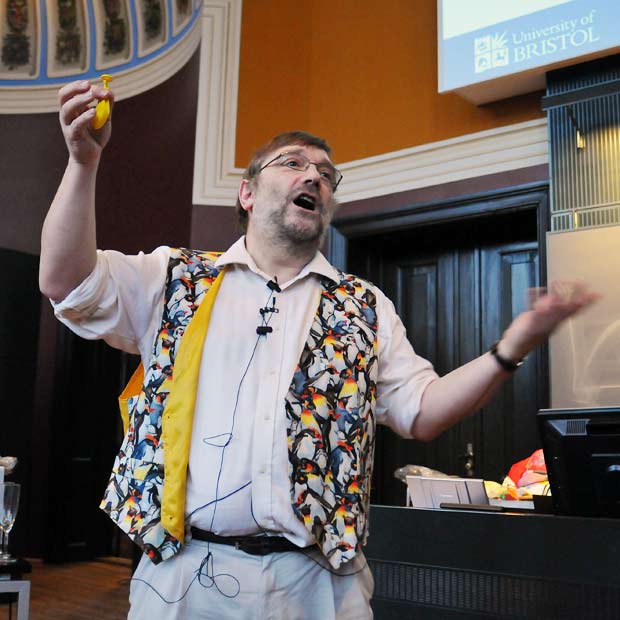
How much does air weigh? With a balloon and a microwave oven you can easily find out says Peter Barham.

Peter Barham’s presentation at the MG seminar in Copenhagen focused on how food can be used to make students interested in physics and chemistry (not a bad thing, especially since 2011 is the International Year of Chemistry) -Most people think science is boring and difficult, he said. But demos can help bring science to life, and believe it or not – experiments are much better when they go wrong. Using balloons, champagne, potatoes and liquid nitrogen Peter Barham proved his point. (more…)

Update: Texture version 2.3

Tuesday, May 4th, 2010

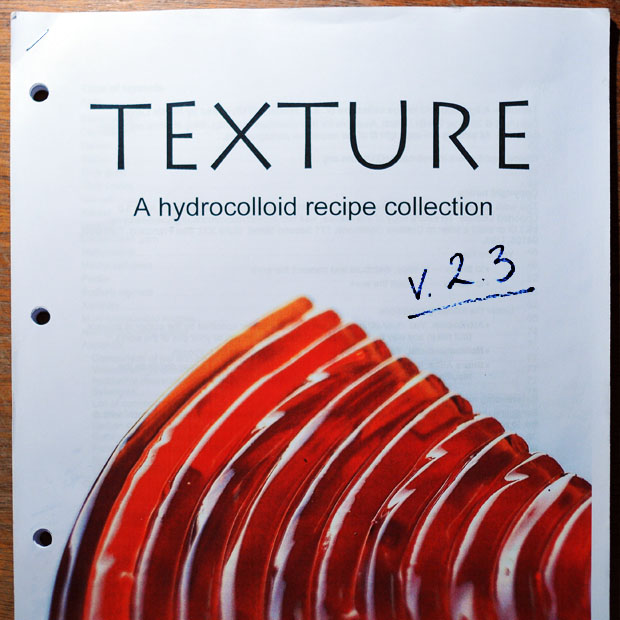
An updated version of “Texture – A hydrocolloid recipe collection” is now available for download (version 2.3). The longer I work on this, the more I realize that it will never really “finish” – there’s always more to add. And believe me – my todo list is still quite long (and I even have some feedback which I haven’t had time to incorporate yet). But I thought that since it’s more than a year since the last update, it was about time to share with you the things that have been changed. Major changes and updates include:

Pictures: This is the biggest visual change! Some recipes are now equipped with pictures which may give you an idea of the texture AND they indicate that the recipe has indeed been tested. But I need your help to add more pictures to the recipe collection (please follow the link to read more about how you can contribute pictures)! And of course - a big thanks to those of you who have already contributed your pictures!

Recipes: Recipes have been added and the total number is about 310 now. I’m getting a little more picky now with regards to which recipes I add. Ideally each new recipe added now should illustrate something new.

I should mention that I’m very grateful for feedback from readers and users of this recipe collection. Thank you very much with helping me improve the document! If you find typos, wish to comment on something or have suggestions on how to improve the collection, please do not hesitate to write me an email at webmaster (at) khymos (.) org or just write a comment in the field below.

Please head over to the download page for the links.

Sourdough work in progress (part I)

Thursday, May 21st, 2009

apricot-starter
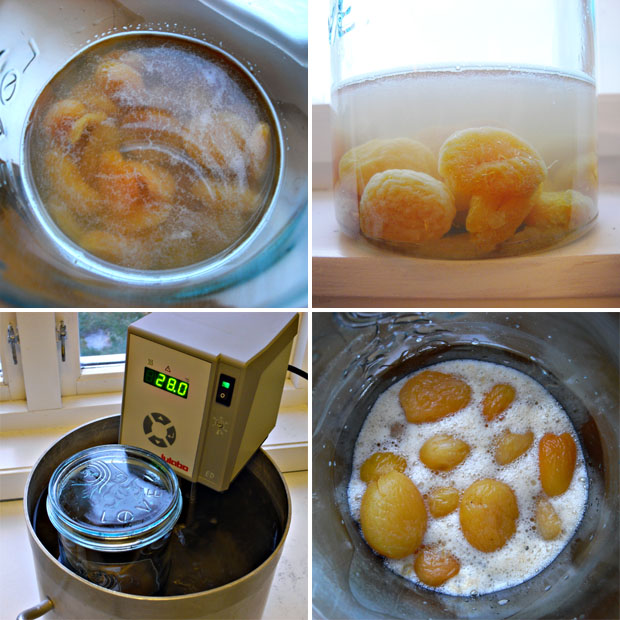
Attempt to make a sourdough starter using dried apricots, using my immersion circulator for temperature control. I got some bubbling yeast activity, but the final bread dough never rose properly.

Inspired by the Swedish bread blog Pain de Martin which I recently discovered I decided it was time to have a go at sourdough breads! Although one of my favorite types of bread it’s a long time since I gave it a try and even longer since I actually succeeded. Leaving apple peel covered with water for two weeks in a cool place (15 °C) I got a light apple cider which I used to make a starter some years ago. I followed a recipe from the Norwegian artisan bakery Åpent bakeri and it gave a marvelous bread. But since then I’ve tried to repeat this twice without success. No wonder that even Rose Levy Beranbaum in her book “The Bread Bible” writes that she didn’t intend to include a chapter on sourdough at all. There’s no doubt that sourdoughs are tricky, but I was a litte surprised and disappointed that someone who sets of to write a 600+ page book on bread even considered to skip sourdough… Luckily she changed her mind and the introduction has a fascinating nice-to-know fact: 1 g flour contains about 320 lactic acid bacteria and 13000 yeast cells!

I believe one the reasons why sourdoughs seem to live their own lifes sometimes is that they need to be kept in a warm place. My kitchen isn’t that warm so I figured it was time to use my immersion circulator and give sourdough another chance (who says you can only use immersion circulators for sous vide anyway? – I think my next project will be to make yoghurt!). With a thermostated water bath keeping a sourdough starter at constant temperature is as easy as 1-2-3. But surprisingly I haven’t seen any blogposts yet from people using their sous vide water baths for sourdough starters (although some have built their own water baths for this purpose using aquarium equipment).
(more…)

Hydrocolloid recipe collection v.2.2

Friday, December 19th, 2008

An updated version of “Texture – A hydrocolloid recipe collection” is now available for download (version 2.2). There are two file sizes available: screen resolution (~1 MB) and high resolution for printing (~5 MB). Some recipes have been added bringing the total number up to about 270 recipes. Apart from this the version includes corrections of typos and updates of indexes and the supplier list. There is a new index for alcoholic preparations plus a small glossary. Again I should mention that I’m very grateful for feedback from readers and users of this recipe collection. Thank you very much with helping me improve the document! If you find typos, wish to comment on something or have suggestions on how to improve the collection, please do not hesitate to write me an email at webmaster (at) khymos (.) org or just write a comment in the field below.

Wonders of extraction: Espresso (part I)

Tuesday, November 11th, 2008

I have recently come to know Miss Silvia. She’s from Italy, weighs a good 14 kg and even my wife welcomed her in our kitchen! As home brew espresso afficionados will know by know, I’ve become the proud owner of an espresso machine from Rancilio! She’s been around for a number of years, and is one of the most popular among prosumer espresso machines available before you take the step up to double boiler machines that allow simultaneous brewing and steaming. Every place that is (proud of) serving espresso uses these machines, but their price is well beyond most coffee lovers budget. The good news however is that even single boiler machines can produce excellent espresso!

The first time I offered the science of espresso any thought was when reading Jeffry Steingarten’s accounts of his espresso adventure (in “It must’ve been something I ate”) which brought him all the way to Italy and Illy and then back again to Manhatten where he set up 14 home espresso machines in his kitchen. This is also where I first was made aware of the fact that 7 g of coffee should be used for a single espresso (which is considerably more than the 5-6 grams found in the Nespresso capsules).

Since I decided to buy an espresso machine I have been devouring sites written by and for coffee enthusiasts: CoffeeGeek, Home Barista and Espresso! My Espresso! to mention a few. You’ll be surprised how much one can possibly write about espresso!
(more…)

Hydrocolloid recipe collection v.2.1

Wednesday, June 25th, 2008

An updated version of “Texture – A hydrocolloid recipe collection” is now available for download (version 2.1). The version includes corrections of typos, minor additions to the property tables plus an important update in the gelatin section and a recipe for agar filtration. Read on for details!

I’m grateful for feedback from several readers pointing out that the size of gelatin sheets is made to compensate for different bloom strengths. In other words, one gelatin sheet will gel a given amount of water, regardless of the size of the gelatin sheet. To the best of my knowledge, this convention seems to have been adopted by most gelatin producers.

All gelatin based recipes have been updated to reflect this and most of them now give the amount of gelatin both in grams (for a platinum type, 240 bloom gelatin) and in number of sheets. I’ve also included a formula for conversion between different bloom strengths. This formula differs from what has been published earlier (no square root), but by testing the formula for given gelatin sheet bloom strengths and weights I got better results by simply multiplying the mass by the ratio of the bloom strengths. If you know more about these formulas, please leave a comment or email me.

Checking the gelatin recipes I discovered that the recipe “Strawberry spheres” originally called for “Sosa vegetable gelatin” which is not gelatin but a mixture of carrageenan and locust bean gum which are dispersed with maltodextrin. Since the exact amount of carrageenan and locust bean gum are not known I’ve deleted the recipe (but I’m sure you could achieve the same coating effect with plain gelatin, perhaps a 3-4% solution to render it viscous so it will cling the the spheres).

Thanks to feedback from a reader there is also recipe now for agar filtration (based on a Spanish forum post). This works just like gelatin filtration, but is much faster. Apparently you get more or less the same results with regard to clarity, flavor and color.

If printing the collection, make sure the hydrocolloid properties table is rotated so it prints correctly. This table is presented in landscape format. The right most column of the first page is gelatin – if you don’t see it, try printing these pages again. The pages are optimized for printing on A4. If printing on Letter sized paper, make sure you check the “resize” or “fit to paper” option in your pdf reader.

Thank you for comments, corrections, recipes and other feedback! As always, I can be reached at webmaster a t khymos d o t org.

Soda fountain science explained

Thursday, June 19th, 2008


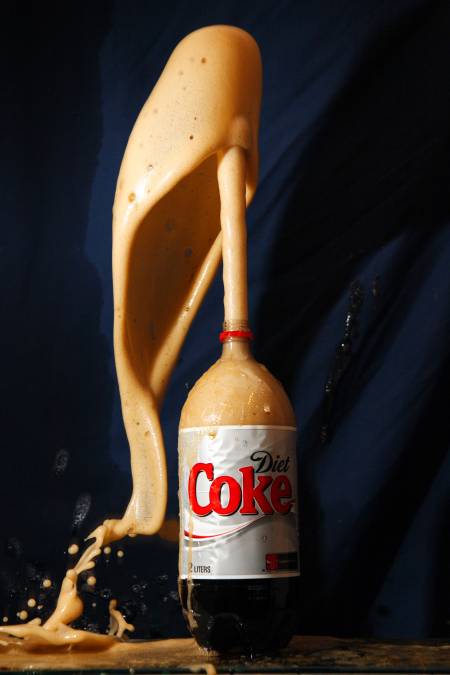
Picture by Michael Murphy (CC-BY-SA)

The soda fountain (Diet Coke + Mentos) has been around the net for quite a while with some spectacular videos available, and it has even made it into a news paper cartoon. People go crazy about this and the largest number of simultaneous fountains is steadily increasing.

Despite the interest, only now did a scientific paper appear on the subject. Many have speculated about what causes the reaction between Mentos and Diet Coke, and some have focused on possible acid-base reactions taking place. Mythbusters investigated this in 2006 (watch episode) and came up with the following factors that contribute to the bubble formation:

Diet coke

  • carbon dioxide is what makes the bubbles form in the first place
  • in synthetic mixtures aspartam, caffeine and potassium benzoate where shown give better fountains

Mentos

  • the most important property is the rough surface which provides plenty of nucleation sites for bubble formation
  • the density makes them sink which is ideal as the bubbles formed at the bottom of the bottle help expel much more soda
  • mentos contains gelatin and gum arabic which could also reduce surface tension

In the paper “Diet Coke and Mentos: What is really behind this physical reaction?” by Tonya Shea Coffey the findings of the Mythbuster teams are largely confirmed.

By measuring contact angles it was shown that aspartame and potassium benzoate reduce the surface tension of water. Aspartame is a winner, and as an extra benefit clean up is much easier with Diet Coke than sugared Coke. The amount of caffeine however is too low to have any effect. The roughness of the Mentos surface was studied with special microscopes (see picture below). Fruit Mentos have smooth patches, but the coating is not uniform and contrary to the Mythbuster experiment normal Mentos and Fruit Mentos performed equally well with regards to foam formation. The roughness of the Mentos surface was inbetween that of rock salt and the Life savers which suggests that roughness is not a single factor determining the reaction. The Mentos surface is covered with gum arabic which reduces surface tension, and experiments showed that even without Mentos, gum arabic could cause a reaction to occur. It is the combined effects of reduced surface tension (due to ingredients in Diet Coke and Mentos) and the rough surface of Mentos which is the key to understand the reaction.

As expected, the article also confirms that the reaction is more vigours at higher temperatures (i.e. solubility of carbon dioxide deacreases with increasing temperature). It was also shown that Mentos sink faster to the bottom of a 2 L bottle compared with rock salt, Wint-O-Green Life savers and sand (this is a function of size and density, not only density). When bubbles are formed at the bottom of the bottle the bubble has more time to grow as it rises. This causes a more explosive reaction and more soda is expelled from the bottle.


The picture shows scanning electron microscopy images of Mint Mentos (a) and (c) and Fruit Mentos with a candy coating (b) and (d). The scale bars in each image represent the lengths (a) 200 μm, (b) 100 μm, (c) 20 μm, and (d) 20 μm. Fruit Mentos has smooth patches, but the coating is not uniform. (Reprinted with permission from Coffey, T. S, American Journal of Physics, Vol. 76, Issue 6, pp. 551-557, 2008. Copyright 2008, American Association of Physics Teachers)

The question which lingers on my mind is whether Diet Coke and Mentos represent the optimal combination of ingredients to create a soda fountain. With regard to convenience, I guess the answer is yes. But perhaps it’s possible to create an even more powerful reaction? Since lowering the surface tension of water is important, I’m wondering if it would be possible to find a surfactant that could be added without setting the reaction off? Mentos would of course still be needed for the rough surface to provide nucleation sites. In the above mentioned study addition of diluted dish washing liquid was enough to give a pretty good reaction, so this is not an option. But perhaps a couple of drops right on the Mentos surface would work? I definitely need to try this some time.

Hydrocolloid recipe collection v.2

Wednesday, May 21st, 2008

Texture – A hydrocolloid recipe collection
It’s a pleasure for me to announce that an updated version of the hydrocolloid recipe collection is available for free download as a pdf file (73 pages, 1.8 Mb).

What’s new?
Several new recipes have been added (now counting more than 220 in total), including recipes with cornstarch, guar gum, gum arabic, konjac and locust bean gum. All in all 14 different hydrocolloids are included (plus lecithin which technically isn’t a hydrocolloid). In each section recipes are now sorted according to the amount of hydrocolloid used. The appendix has been updated with tables for comparison of hydrocolloid properties, hydrocolloid densities and synergies. The perhaps biggest change is that all recipes have been indexed according both to the texture/appearance of the resulting dish and according to the hydrocolloid used. Let’s say you want to make spheres, this index will show you which hydrocolloids can be used (that’s right – there are other possiblities than sodium alginate) and list the example recipes.

Foreword
A hydrocolloid can simply be defined as a substance that forms a gel in contact with water. Such substances include both polysaccharides and proteins which are capable of one or more of the following: thickening and gelling aqueous solutions, stabilizing foams, emulsions and dispersions and preventing crystallization of saturated water or sugar solutions.

In the recent years there has been a tremendous interest in molecular gastronomy. Part of this interest has been directed towards the “new” hydrocolloids. The term “new” includes hydrocolloids such as gellan and xanthan which are a result of relatively recent research, but also hydrocolloids such as agar which has been unknown in western cooking, but used in Asia for decades. One fortunate consequence of the increased interest in molecular gastronomy and hydrocolloids is that hydrocolloids that were previously only available to the food industry have become available in small quantities at a reasonable price. A less fortunate consequence however is that many have come to regard molecular gastronomy as synonymous with the use of hydrocolloids to prepare foams and spheres. I should therefore emphasize that molecular gastronomy is not limited to the use of hydrocolloids and that it is not the intention of this collection of recipes to define molecular gastronomy.

Along with the increased interest in hydrocolloids for texture modification there is a growing scepticism to using “chemicals” in the kitchen. Many have come to view hydrocolloids as unnatural and even unhealthy ingredients. It should therefore be stressed that the hydrocolloids described in this collection are all of biological origin. All have been purified, some have been processed, but nevertheless the raw material used is of either marine, plant, animal or microbial origin. Furthermore hydrocolloids can contribute significantly to the public health as they allow the reduction of fat and/or sugar content without loosing the desired mouth feel. The hydrocolloids themselves have a low calorific value and are generally used at very low concentrations.

One major challenge (at least for an amateur cook) is to find recipes and directions to utilize the “new” hydrocolloids. When purchasing hydrocolloids, typically only a few recipes are included. Personally I like to browse several recipes to get an idea of the different possibilities when cooking. Therefore I have collected a number of recipes which utilize hydrocolloids ranging from agar to xanthan. In addition to these some recipes with lecithin (not technically a hydrocolloid) have been included. Recipes for foams that do not call for addition of hydrocolloids have also been included for completeness. Some cornstarch recipes have been included to illustrate it’s properties at different consentrations. Recipes where flour is the only hydrocolloid do not fall within the scope of this collection as these are sufficiently covered by other cook books.

All recipes have been changed to SI units which are the ones preferred by the scientific community (and hopefully soon by the cooks as well). In doing so there is always uncertainty related to the conversion of volume to weight, especially powders. As far as possible, brand names have been replaced by generic names. Almost all recipes have been edited and some have been shortened significantly. To allow easy comparison of recipes the amount of hydrocolloid used is also shown as mass percentages and the recipes are ranked in an ascending order. In some recipes, obvious mistakes have been corrected. But unfortunately, the recipes have not been tested, so there is no guarantee that they actually work as intended and that the directions are complete, accurate and correct. It appears as if some of the recipes are not optimized with regard to proper dispersion and hydration of the hydrocolloids which again will influence the amount of hydrocolloid used. It is therefore advisable to always consult other similar recipes or the table with the hydrocolloid properties. The recipes have been collected from various printed and electronic sources and every attempt has been made to give the source of the recipes.

Since recipes can neither be patented nor copyrighted, every reader should feel free to download, print, use, modify, and further develop the recipes contained in this compilation. The latest version will be available for download from the static Khymos site and will also be announced here. I would like to thank readers for giving me feedback and suggestions on how to improve the collection. Feedback, comments, corrections and new recipes are always welcome at webmaster (a t) khymos ( dot ) org.

Kitchen gadgets

Thursday, October 11th, 2007

Popular science magazine has an amusing article on “The future of food” which portrays Dave Arnold, apparently the “man behind the curtain of today’s hottest movement in cooking”. I don’t buy all of this, but he’s no doubt had a central role in bringing lab equipment into the kitchens of North American chefs and teaching them a little science. You might also want to check out their gallery of kitchen gadgets. Some of my favorites include (click the pictures to lanuch the picture gallery at PopSci magazine):

kitchengadget_whipper.jpg
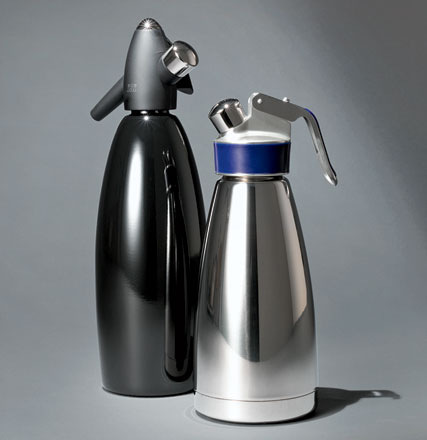
For the Pros: The Whipper. Adds a touch of air to every bite.

Within reach of the dedicated amateur chef, indispensible for the professional chef: a whipper which you can charge with either carbon dioxide (for instance to make carbonated fruit) or dinitrogen oxide (too make foams/espumas or simply whipped cream).

kitchengadget_circulator.jpg
For the Pros: The Sealer and Circulator. Cooks in a bag to lock in juiciness.

Sous vide cooking is perhaps one of the most fascinating examples of science inspired cooking. The picture shows a vacuum sealer and a thermostated water bath circulator. If this is too expensive, check out my post on a simple and easy DIY sous vide.

kitchengadget_chemicals.jpg
For the Pros: The New Spice Rack. Chemicals the experimental home chef shouldn’t be without.

Last but not least: the different chemicals which become more and more available. I’ve put together a collection of hydrocolloid recipes which will help you get started using these fascinating chemicals. If you have troubles getting hold of these, my list of suppliers might help you.

Of course I’d like to put my hands on a Pacojet, an Antigriddle or a Gastrovac as well, but for a home kitchen, this gets too exotic and far too expensive. But – the most surprising gadget was the vacuum meat tumbler from Reveo. Just like the extremely expensive Gastrovac, this little machine can be used for vacuum impregnation of meat and other foods (or at least this is something I assume from the description). IMHO vacuum impregnation is the most important feature of the Gastrovac – far more important than the heating capabilities. Perhaps someone owning a Reveo could report back?

kitchengadget_vacuummeattumbler.jpg
For the Home: Meat, Your Maker. This vacuum tumbler cuts marinating time by hours, first extracting air to expand the meat’s fibers and then spinning it so that every area is exposed to your sauce of choice. Probably doesn’t beat a good long soak, but perfect for when barbecue inspiration suddenly strikes.—Abby Seiff

But I was very dissapointed that my all-time favorite kitchen gadget didn’t make it into the gallery: a simple thermometer. As I have stated in one of my tips for practical molecular gastronomy, this is probably the single tool that can improve your cooking the most.

Practical molecular gastronomy, part 5

Tuesday, May 1st, 2007

5. Learn how to control taste and flavor.

apple-pear.jpg

When invited over to friends for dinner, even before eating, you judge the food by it’s aroma, handing out compliments such as “It really smells nice”! Thankfully, nature is on the cook’s side, because when we prepare food and heat it, volatile aroma compounds are released which trigger very sensitive receptors in our noses. It is generally said that 80% of “taste” is perceived by our nose (what we refer to as aroma), whereas only 20% is perceived by our tongue. How important smell is becomes clear if you catch a cold – suddenly all food tastes the same. Too illustrate the importance of smell, prepare equally sized pieces of apple and pear. Close your eyes, hold your nose and let a friend give you the pieces without telling which is which. Notice how difficult it is to tell them apart. In fact, with a good nose clip you wouldn’t even be able to tell the difference between an apple and an onion! Then, with a piece of either in your mouth, let go of your nose. Within a second you can tell whether it’s apple or pear!

Taste
Our tongue has approximately 10.000 taste buds and they are replaced every 1 to 3 weeks. Their sensitivity increases roughly in the following order: sweet < salt < sour < bitter. In addition to the four basic tastes there is umami, the savory, fifth taste. This taste is produced by monosodium glutamate (MSG), disodium 5’-inosine monophosphate (IMP) and disodium 5’-guanosine monophosphate (GMP). Pure MSG doesn’t taste of much, but can enhance the taste of other foods. There are also some claims of a sixth taste.

A number of taste synergies/enhancements exist. I’ve also included three examples of how flavours can influence taste:

  • MSG, IMP and GMP enhance each other
  • IMP and GMP enhance sweetness
  • MSG, IMP and GMP generally enhance saltiness and vice versa
  • Salt enhances MSG, so foods with a natural high level of MSG (tomatoes) taste more if a pinch of salt is added
  • Salt and acid at low/medium concentrations enhance each other
  • Salt at low concentrations enhances sweet taste
  • Black pepper reduces sweet taste
  • Vanilla enhances sweet taste
  • Cinnamon enhances sweet taste
  • The only general, over-all trend which can be found is that binary tastes enhance each other at low concentrations and suppress each other at higher concentrations (but there are several exceptions!). Do check out “An overview of binary taste–taste interactions” (DOI:10.1016/S0950-3293(02)00110-6) if you’re interested in more details on binary taste interactions. I’ve tried to visualize taste enhancements (green) and suppresions (red) in the following figure using arrows to indicate the direction. For example, salt suppresses sweetnes at high concentrations.

    binary-taste-interactions.jpg

    In addition to taste, our tongue also percieves texture, temperature and astringency. An interesting thing about the temperature receptors is that they can be triggered not only by temperature, but also by certain foods. The cold receptor is triggered by mint, spearmint, menthol and camphor. There is even a patented compound, monomenthyl succinate, that triggers the cold receptor, but without the taste of menthol. It’s marketed under the name Physcool by the flavour company Mane.

    Substances such as ethanol and capsaicin trigger the trigeminal nerve, causing a burning sensation. Capsaicin also triggers the high temperature receptors of the tongue, hence the term “hot food” which can refer both to spicy food and food which is very warm. For a general article about taste, check out “Taste Perception: Cracking the Code” (DOI:10.1371/journal.pbio.0020064, free download).

    Flavour
    Our nose has about 5-10 million receptors capable of detecting volatile compounds. There are about 1000 different smell receptors and they allow us to distinguish more than 10.000 different smells – perhaps as many as 100.000! In order for us to smell something, the molecule needs to enter our nose at a concentration sufficient for us to detect. Aroma compounds are typically small, non-polar molecules. The fact that they are small means they will have low boiling points – they are volatile and spread rapidly throughout a room. They are often referred to as essential oils and are very soluble in fat, oil and alcohol. These aroma compounds generally not soluble in water, but there are also water soluble aroma compounds; just think of a well prepared stock – no fat but lots of taste and aroma!

    A challenge with aroma molecules is that they should remain intact during storage and not be released until cooking (or even better, until consumption). A example would be to install a Liebieg condenser over your pot. Dylan Stiles has explored this in his column Bench Monkey by placing a bag of ice on top of the lid. He claims that his roommates prefereed the curry which has been cooked under “reflux conditions”. The study was performed in a double blind manner (which I will come back to in part 8 of this series).

    Because aroma compounds are volatile, spices should be obtained whole and stored in tight containers away from light. If possible, fresh herbs should be used. The flavour of herbs and spices can be extracted by chopping or grinding to increase the surface area. To speed up grinding in a mortar you can add a pinch of salt or sugar.

    grinding-saffron.jpg

    Heat can help extract flavour (just think of how we brew tea or coffee), but will also evaporate volatile compounds, so a general advice would be to add spices at the start and herbs towards the end of the cooking time. Some herbs can even be sprinkeled over the food just before serving. In Southeast Asia (and especially India) it is quite common heat spices in a dry pan or in oil. This matures flavours and allows reactions to occur (possibly Maillard reactions). Coarse spices should be added earlier than finely ground spices.

    In addition to adding flavour using spices, herbs and other foods, we can also use heat to create new flavours. When sugar is heated, caramel is formed. And if a reducing sugar is heated in the presence of an amino acid, they react and form a host of new flavour compounds in what is known as the Maillard reaction. Caramelisation and the Maillard reaction are known as non-enzymatic browning. Enzymatic browning on the other hand is detrimental to many fruits (such as apples and bananas), but there are a few exceptions. Enzymatic browning is essential in the production of tea (black, green, oolong), coffe, cocoa and vanilla, although this is rarely attempted in kitchen.

    Another source of flavour is fermentation. It refers to a process were sugar is converted to alcohol and carbon dioxide by the action of a yeast. In the process a number of flavour compounds are formed as well which is why this is of great interest also from a molecular gastronomy viewpoint. Some examples of fermented products include wine, beer, cider and bread. Fermentation also refers to the process where some bacteria produce lactic acid. Some examples of foods resulting from lactic acid fermentation are yoghurt, kimchi and pickled cucumbers.

    Flavour pairing
    Cookbooks and recipes throughout the world are the result of billions of experiments. As a result, some very good combinations of herbs and spices have been discovered. Some of these mixtures have even been given names of their own and it is fascinating how easily one can forget that curry for instance is a mixture of spices. Wikipedia has a wonderful overview of herb and spice mixtures from all over the world. I must admit I only new a fraction of these:

    Adjika | Advieh | Berbere | Bouquet garni | Buknu | Cajun King | Chaat masala | Chaunk | Chermoula | Chili powder | Curry powder | Djahe | Fines herbes | Five-spice powder | Garam masala | Garlic salt | Harissa | Herbes de Provence | Khmeli suneli | Lawry’s and Adolph’s | Masala | Masuman | Mixed spice | Niter kibbeh | Old Bay Seasoning | Panch phoron | Quatre épices | Ras el hanout | Recado rojo | Shake ‘N’ Bake | Sharena sol | Shichimi | Spice mix | Tajín | Tandoori masala | Tony Chachere’s | Za’atar

    A book which I’ve found to be very useful when combining flavours is “Culinary artistry” by Andrew Dornenburg and Karen Page. It is the most comprehensive book about flavour pairing that I’m aware of, and I would say it is indispensible for someone who likes to cook without a cookbook. It has lists of basic flavors contributed by various foods. For example a sweet taste is contributed by foods such as bananas, beets, carrots, coriander, corn, dates, figs, fruits, grapes, onions, poppy seeds, sesame and vanilla (plus sugars and syrups of course). It has lists of “flavor pals”, a term attributed to Jean-Georges Vongerichten. For example, the flavour pals of ginger are allspice, chiles, chives, cinnamon, cloves ,coriander, cumin, curry, fennel, garlic, mace, nutmeg, black pepper and saffron. By far the most extensive part of the book are listings of food matchings. An illustrative example is pork which combines well with (classic/widely used combinations in bold):

    apples, apricots, bay leaves, black beans, beer, brandy, cabbage, Calvados, dried sour cherries, clams, Cognac, coriander, cream, cumin, fennel, fruit, garlic, ginger, hoisin sauce, honey, juniper berries, lemon, lime, marsala, molasses, mustard, onions, orange, parsley, black pepper, pineapple, Chinese plum sauce, plums, prunes, quinces, rosemary, sage, sauerkraut, soy sauce, star anise, tarragon, thyme, vinegar, walnuts, whiskey, white wine

    Despite the abundance of combinations, I dare say that little is understood about the science behind these flavour pairings. Why do these combinations of herbs and spices go particularily well together? Is it all about getting used to the combinations, so that we learn to like them? What influence does the complexity of the flavour play? These are easy questions that probably have rather complex answers.

    Very recently a different approach to flavour pairing has emerged. If two foods share one or more key odorants, chances are that they will go well together. The first step towards finding new pairings would be to identify key odorants. More info on key odorants can be found in the article “Evaluation of the Key Odorants of Foods by Dilution Experiments, Aroma Models and Omission” (DOI: 10.1093/chemse/26.5.533, free download). I’ve initiated the food blogging event “They go really well together” (TGRWT) to explore new flavour pairings and develop new recipes. There are also several blogposts with interesting comments on about flavour pairing.

    *

    Check out my previous blogpost for an overview of the tips for practical molecular gastronomy. The collection of books (favorite, molecular gastronomy, aroma/taste, reference/technique, food chemistry) and links (webresources, people/chefs/blogs, institutions, articles, audio/video) at khymos.org might also be of interest.