Posts Tagged ‘carbon dioxide’

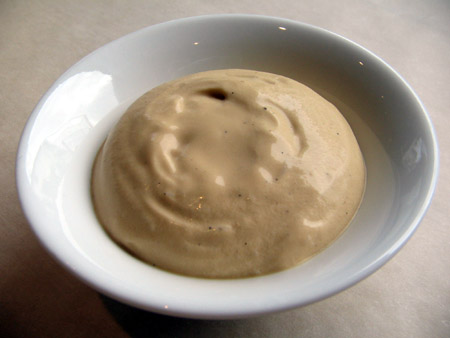
Coffee cream foam

Tuesday, April 10th, 2007

coffee-cream-foam.jpg

Based on some googling of espuma and foam recipes (including Ferran Adria’s coffee espuma), I figured that the following should work:

2 dL coffee
2 sheets of gelatine
3 dL heavy cream
sugar/vanilla sugar

Soak gelatine in cold water. Strain. Dissolve gelatin sheets in the hot coffee and stir in sugar while heating. Cool. Add heavy cream. Filter through a fine meshed sift (just in case there should be any undissolved sugar, gelatin or particles) into a 0.5 L iSi gourmet whipper. Screw on top and charge with a cream charger. Shake 2-3 times and leave in fridge for a couple of hours. Hold whipper upside down, shake once to displace mixture towards the nozzle in case it is stuck and dispense. Texture is soft and silky. Tastes delicious!

Some more chemistry: The cream chargers contain dinitrogen oxide (N2O) which is less polar than carbon dioxide (CO2), and hence more soluble in fat (such as heavy cream for instance). Another reason why carbon dioxide is not used in this recipe is probably that when it dissolves, some carbonic acid is formed which could curdle milk based products if pH drops to much and also influence taste (but carbonated milk has actually been marketed!). The idea of using dinitrogen oxide for soda/beer has also been explored.

Carbonated fruit the iSi way

Monday, April 9th, 2007

I blogged about carbonated strawberries some while ago. Those were made using dry ice which unfortunately is not always easy to get hold of. Last week however I bought a iSi Gourmet Whipper – one of those Ferran Adria uses to make foams/espumas. I plan to experiment with that as well, but the first thing I decided to prepare was carbonated fruit. In fact this is a safe way (the only?) to make carbonated fruit at home using a pressurized container.

isi-whipper.jpg

The instruction booklet which comes with the iSi Gourmet Whipper only mentions cream chargers (filled with N2O, dinitrogen oxide), whereas soda chargers (filled with CO2, carbon dioxide) are not mentioned (I guess the opposite is true for the iSi Siphons?). This is quite amazing actually! Luckily however the cream and soda chargers are exactly the same size and both hold 8 g of gas. So it should be possible to make carbonated fruit with any of the iSi whippers (cream, easy, gourmet, dessert, thermo) or siphons available.

Here’s how you proceed:

  1. Fill you iSi whipper (or siphon) with fruit, preferably fruit which has a cut, wet surface to allow the carbon dioxide to dissolve in the water/juice.
  2. Screw on top securly
  3. Charge with one soda charger (two if you have the 1 L whipper)
  4. Leave in fridge over night
  5. Release pressure with valve (Important!)
  6. Unscrew top and serve immediately!
  7. Enjoy!

carbonated-grapes.jpg
This is what carbonated grapes look like. As you see, I decided to cut the grapes in to halves.

carbonated-grapes-closeup.jpg
Notice how they sizzle!

A quick recap of the chemistry: cold water dissolves more CO2 than tempered water, that’s why we leave it in the fridge. Also, remember that it takes some time for the carbon dioxide to dissolve in water, therefore it’s better not to be in a hurry. A quick calculation of the pressures gives the following: Both gases have molecular weights of 44 g/mol, so 8 g of gas corresponds to 0.1818 moles or 4.1 L at 25 °C and 1 atm pressure. The volume of the chargers is 0.01 L which gives an initial pressure in the chargers of impressive 445 atm! With an approximate volume of 0.7 L this gives a pressure (in an empty whipper) of nearly 6 atm – the same as in a bottle of champagne. However once you add water, the equilibriums will change and the pressure in the head space will drop. Anyone who remembers how to calculate the head space pressure at equilibrium if the container is filled with 0.5 L of water and cooled to 4 °C?

I’ve done some googling and there is also some mention of making carbonated fruit with an iSi whipper over at Ideas in food.

(The word play in the title works better for those with a mother tongue where iSi would be pronounced just like “easy”!)

Happy New Year with the Science of Champagne!

Sunday, December 31st, 2006

Have you ever though about how far you can shoot a champagne cork? The swedish physicist Hans-Uno Bengtsson has actually done the necessary calculations in the wonderful Swedish book “Kring flaskor och fysik” (which translates to something like “Among bottles and physics”, it was written together with sommelier Mischa Billing). Assuming a bottle pressure of 6 atmospheres, a cork length of 25 mm (the part in contact with the bottle), a radius of 9 mm and a mass of 7.5 g, this gives an initial cork velocity of approximately 20 meters per second or 70 km/h! This translates into a maximum shot length of around 40 m (if we neglect air resistance). In case you prefer not to shoot the cork, you could of coarse turn to a saber or a heavy kitchen knife instead to open the bottle.

When opening a bottle of champagne, you might have noticed the cloud forming right above the bottle neck (see picture below). This is due to a significant temperature drop, caused by gas expansion when we open the bottle. Assuming an adiabatic expansion (meaning no heat exchange with the surroundings), Hans-Uno Bengtsson has calculated a temperature drop of 112 °C! No wonder the vapor around the bottle neck immediately freezes forming a small cloud.

cloud at neck of champagne bottle
(picture by polarunner at flickr.com)

If this doesn’t satisfy your craving for champagne science, there’s a whole book on the subject: “Uncorked – The Science of Champagne” by Gérard Liger-Belair. He’s an associate professor of physical sciences at the University of Reims Champagne-Ardenne and probably knows more about champagne bubbles than anyone else! In addition to many fascinating pictures of bubbles, the book has many interesting facts. Did you know that:

  • 0.1 liters of champagne (the contets of an average flute) contains approximately 0.7 liters of carbon dioxide which must escape to restore equillibrium – assuming an average bubble size of 500 micrometers in diameter this corresponds to 11 million bubbles!
  • Contrary to popular belief, nucleation sites for bubbles are not found on scratches or irregularities on the glass itself, but on impurites stuck on the glass wall. These impurities are typically fibres from paper or fabrics.
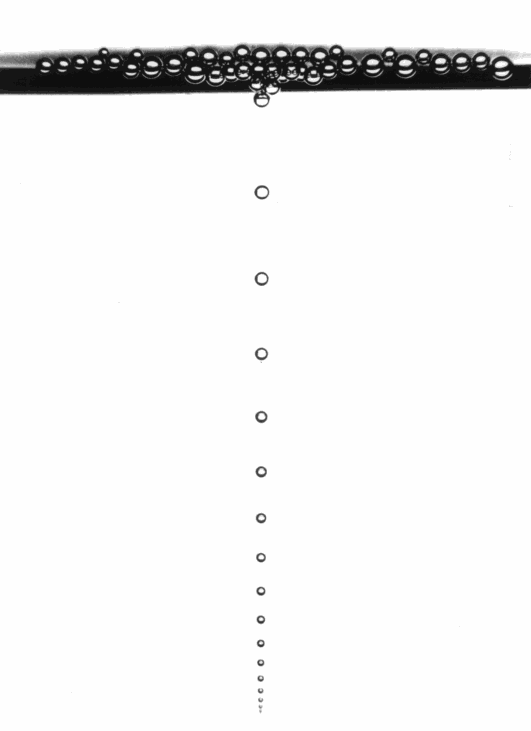
  • From the point when a bubble leaves the nucleation site till it reaches the surface, the volume increases by a factor of 1 million. This is due to diffusion of carbon dioxide from the solution and into the bubble.
  • Surfactant molecules in champagne form a protective shield around the rising bubbles. This stiffens the bubbles and significantly increases the drag on the bubble as it rises (which gives us more time to admire the trail of bubbles!).
  • The surfactant coating of the bubbles helps keeping them in line as they rise. In pure water, the bubbles would jostle around.
  • The bursting bubbles play an imporant role in flavor release as they collect and concentrate surface active molecules which are thrown against your nose once the bubble bursts, creating a cloud of droplets.
  • (these facts should be perfect conversation starters!)

    trail of champagne bubbles
    (photo by Gérard Liger-Belair)

    An interesting article by Gérard Liger-Belair, “Effervescence in a glass of champagne: A bubble story” is available from Europhysics news.

    Happy New Year!

    Carbonated strawberries

    Sunday, October 22nd, 2006

    Here’s some pictures of an experiment I did with strawberries and dry ice (solid carbon dioxide). Dry ice is frozen carbon dioxide which holds a temperature of -78 °C. What is fascinating is that dry ice does not melt – it sublimes, which means that it turns directly into carbon dioxide gas.

    The idea was to create a carbonated fruit which gives a sparkling sensation in the mouth. I have used strawberries, but any juicy fruit with a moist surface could be used. Water melons would be perfect!

    The chemistry explained in simple terms:

    co2.jpg

    A schematic drawing of the container:

    strawberry-dryice.jpg

    To prevent the plate from touching the dry ice (which would cause the strawberries to freeze), I put in a wooden triangle first.

    p7110004.JPG

    Put the plate with strawberry halves on top of the wooden triangle. Cover with a kitchen towel (do NOT cover with a tight fitting cover – remember that as CO2 sublimes, it expands, and this would create a huge pressure ultimately resulting in an explosion), and leave for 30 minutes.

    p7110005.JPG

    Eat and enjoy!

    Update: Carbonated fruit the iSi way!