Posts Tagged ‘chocolate’
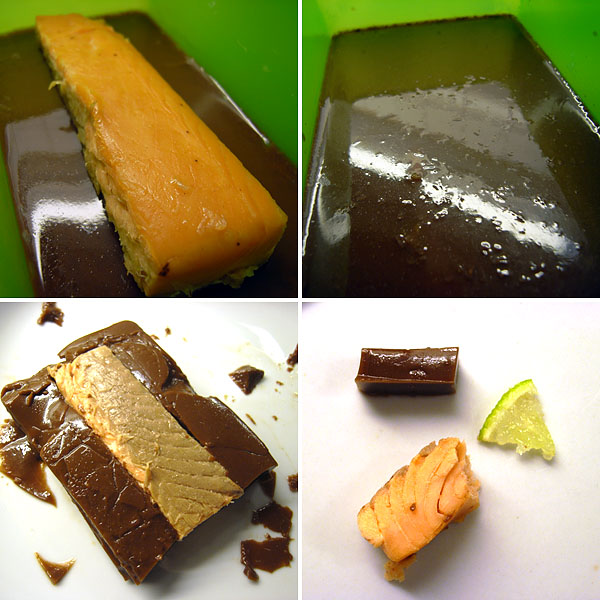
TGRWT #15: Dark chocolate and smoked salmon
Wednesday, February 4th, 2009
This month’s round of “They go really well together” (TGRWT #15) is hosted by Mexmix and foods to pair this time are dark chocolate and smoked salmon. As usual you can find instructions on how to participate in the announcement post. Don’t forget to check out Rob’s summary of the malt and soy sauce round.
The Flemish Primitives: Chocolate surprise (part 2)
Monday, January 12th, 2009
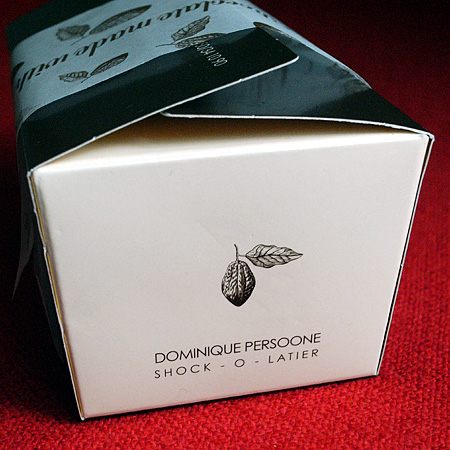
Chocolatier by profession, Shock-o-Latier by reputation! I bought this box the next day at Dominique’s shop “The Chocolate Line” to bring back home.
As I mentioned in part 1 of the travel report from Brugge, the highlight (for me at least) of The Flemish Primitives seminar was the surprise box presented to us by Dominique Persoone (owner of The Chocolate Line) and his team which included James Petrie (pastry chef at The Fat Duck), Tony Conigliaro (mixologist, bartender at Roka, blogger) and Bruce Bryan (medical doctor and inventor). As the box was distributed in the auditorium (more than 1000 present, mostly chefs) the instructions were kept very simple: DO NOT OPEN THE BOX! Makes you wonder of course what is inside.
(more…)
TGRWT #13: Caraway and chocolate
Saturday, December 6th, 2008
According to Google trends searches for chocolate peak every December (plus that special day in February), and I assume that consumption of chocolate follows the same pattern. For this month’s They go really well together event (TGRWT #13) Erik Fooladi over at Fooducation has chosen to pair chocolate with caraway. So if you plan to cook or bake with chocolate (or cocoa) in December – why not add some caraway and see how it turns out? It’s time to spice up your Christmas desserts! Surprise your guests and let us all know how it worked out.
If you can’t figure out what to make, try the chocolate sauerkraut cake I blogged about last year. It was quite successful and I figured out that one possible reason for the success was the fact that sauerkraut contains caraway which goes well with chocolate (and cognac).
More information about how to participate can be found in Erik’s announcement post of TGRWT #13.
TGRWT #9: Chocolate tagliatelle with parmesan cream
Monday, February 25th, 2008
Chocolate pasta suspended for drying.
For this round of TGRWT I decided to use the recipe (Chocolate Carbonara with Parmigiano Reggiano Cream and a Chocolate-Dipped Grissini Wrapped in Prosciutto di Parma) by Masaharu Morimoto which I’ve blogged about previously. I was quite intrigued by that recipe and wanted to try it! So here it is, converted to metric units with some small adjustments. The original recipe called for 4 eggs, but this rendered the pasta dough to hard. I added two of the whites which were left over from the sauce. BTW this is why one of should better weigh out eggs instead of count them (too bad I didn’t think about his from the beginning so I could have weighed the eggs I used). The original recipe called for bread sticks with chocolate and prosciutto di Parma which I skipped (but which nonetheless sounds like a good accompaniment – as you’re probably aware of meat and chocolate also go very well together!).
TGRWT #5: Grilled pork tenderloin with chocholate beef stock cream
Sunday, August 26th, 2007
This month’s TGRWT is hosted by Le Petite Boulanger, and the foods to pair are chocolate and meat. The recipe for the chocolate beef stock cream is inspired by the Iberian Ham Cream by Ferran Adrià/El Bulli (the recipe can be found on p. 21 in the hydrocolloid recipe collection). I used anis because it brings out the meatiness very well. After mixing in the olive oil I saw that the droplets were not properly dispersed. Addition of some lecithin which solved this problem.
Chocolate beef stock cream
100 g water
2 g beef stock powder
10 g chocolate (70%)
1/4 t anis, powdered
0.5 g xanthan
0.2 g lecithin
20 g olive oil
honey and chili oil to taste
Heat water to dilute beef stock and melt chocolate. Cool. Add xanthan and lecithin. Mix with immersion blender. Add olive oil. Mix until smooth texture. Sprinkle with chives.
Grilled pork tenderloin
pork tenderloin, cut in 3 cm thick pieces
oil
powdered anis
crushed garlic
Marinate meat with oil, garlic and anis mixture. Grill. Serve together with the chocolate meat broth cream.

Verdict: The chocolate beef stock cream has very meaty and almost nutty flavour. Honey is important to round of the otherwise slightly bitter taste of the chocolate. Chili oil gives it a bite, but can be omitted.
You can get an impression of the texture from this video:
TGRWT #1 roundup – coffee, chocolate, garlic
Wednesday, May 2nd, 2007It’s time to sum up the contributions to the food blogging event They go really well together (TGRWT). There were five seven contributions plus a number of suggestions in the comments to the announcement post and I would like to thank you all very much indeed for taking time to experiment in your kitchens! Here are the results (in no particular order):
Lamiacucina: Candied, chocolate coated Garlic. Garlic cloves were heated in a strong sugar-coffee solution. Cloves were then dried and coated with chocolate. Succession of taste and aroma: strong, unpleasant character of garlic. Bloggers verdict: disappointing!
Blog & White: Chocolate-Coffee Mayonnaise with Garlic. Adapted from Hervé This’ chocolate mayonnaise with added coffee and garlic. Succession of taste and aroma: chocolate aroma is followed by taste of garlic and sweetness of chocolate, coffee aftertaste. Bloggers verdict: Interesting (but wife hates it!).
Should you eat that: Mocha Tofu Mousse with Garlic. Roasted garlic cloves were added to an adapted version of Scharfenberger’s mocha tofu mousse. Succession of taste and aroma: coffee followed by chocolate, then a subtle, sweet, roasted garlic aftertaste. Bloggers verdict: I would definately make it again!
M’s blog: Mocca garlic creme brulee. As the name suggests a creme brulee with espresso, chocolate and a garlic clove. Bloggers verdict: Tasted like mocca creme brulee.
Khymos: Coffee espuma with garlic and chocolate. Coffee and cream espuma with added chocolate and roasted garlic. Succession of taste and aroma: coffee with sweet taste, then a faint chocolate aroma followed by a garlicky aftertaste. My verdict: Aromas blend well together. Would use less garlic for dessert version.
Entries added after first posting:
GrapeThinking: Roasted garlic dipped in melted chocolate with coffee beans. Succession of taste and aroma: Roast garlic doesn’t have much of a smell. Chocolate and coffee always smell good. Bloggers verdict: Good aroma. Taste was good in the beginning; slightly funky aftertaste. Texture of garlic was good.
Kompottsurfer: Espresso-risotto with bitter chocolate, tomatoe and mozzarella (posting in German). Bloggers verdict: Color was a disaster, and difficult to get relative proportions right. But aroma worked out prette nice.
From the different comments it seems that garlic is a difficult beast to tame, especially when used raw. A major challenge is finding the right balance between the aromas. Garlic was either too strong or almost absent. Chocolate and coffee however seem to go very well together (and my preliminary search for odor activity values confirm this – more on this soon!).
I also find it interesting that ratios of chocolate, coffee and garlic used influence the succession of aroma and taste (“>” meaning “followed by”):
Is it a coincidence that coffee is the first aroma noticed in the two “foamy” preparations or is this simply a result of the different ratios used?
I should mention that I also tried to make a chicken mole using the three ingredients. Based on a couple of recipes from the net and some tinkering I ended up with a chicken mole that had a little too much chocolate… It tasted … eh … strange, so I decided to add balsamic vinegar which helped a lot! The coffee blended in very well however, so this is how I would make it the next time using less chocolate:
Chocolate coffee chicken mole
800 g canned, crushed tomatoes
750 g chicken breast,
1 red chili, chopped
2 t chili paste
2 onions, chopped
6 cloves of garlic, chopped
3 dL coffee
150 g pistacchio nuts, chopped
1 t ground cumin
30-50 g dark chocolate
2 T sugar
1-2 T balsamico vinegarBrown onions. Add the rest and simmer. Season to taste with chocolate, balsamico vinegar and sugar. Serve with rice. Sprinkle with coriander/cilantro or ruccola/rocket salad.
There were also a number of recipe suggestions in the comments to the three posts on the coffee/chocolate/garlic theme.
Coffee espuma with garlic and chocolate (TGRWT #1)
Sunday, April 22nd, 2007
For the food blogging event They Go Really Well Together (TGRWT #1) I decided to used baked garlic. Baking gives garlic a slightly sweet, mellow taste and I figured this might work well with the soft texture of an espuma. Just make sure you get fresh garlic without green sprouts – they will give a bitter taste.
4 cloves of baked garlic (baked whole, 30 min @ 150 °C)
3.5 dL strong coffee
30 g sugar
40 g chocolate (70% cocoa)
ground cardamom
3.4 g gelatin (= 2 sheets)
1.5 dL heavy cream (38% fat)
1 iSi cream charger
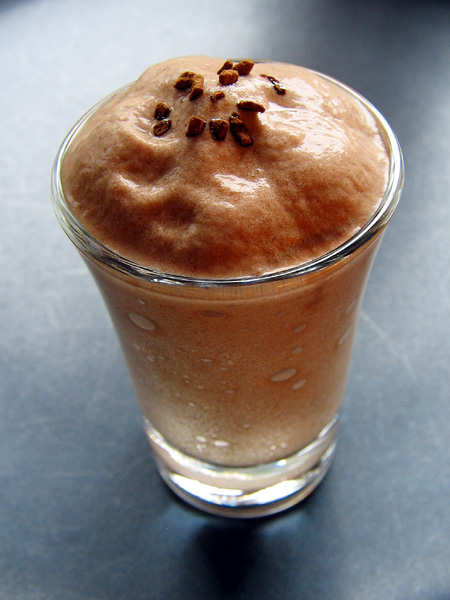
Mix garlic cloves and coffee with blender or hand-held mixer. Add chocolate, a pinch of cardamom and heat while dissolving sugar. Stir in pre-soaked gelatin. Cool, add heavy cream, sift through fine mesh to remove remaining pieces of garlic and fill 0.5 L iSi gourmet whipper. Charge with 1 cream charger and leave in fridge over night. Serve with a drizzle of instant coffee.
How it tastes? In the finished espuma served cold, the first aroma noticed is coffee accompanied by a sweet taste on the tongue. This is followed by a faint chocolate aroma which then gives way for an aftertaste dominated by garlic. It’s quite surprising and the aromas blend well together. I used 30 g of chocolate, but I’ve increased it to 40 g in the recipe since the cocolate aroma was a little weak. As for uses, I think it would go well with a steak for instance. If used as a dessert I would perhaps reduce the amount of garlic to 2 or 3 cloves so as not to overwhelm the guests (unless they frequent the restaurant Garlic & shots in Soho, London where even the beer is served with garlic!).

TGRWT #1: Garlic, coffe and chocolate
Tuesday, April 17th, 2007Reading the comments on how to prepare a dish using garlic, coffee and chocolate, I figured it could actually be a good idea to make this into a food blogging event. Inspired by Is My Blog Burning (IMBB), Sugar High Friday (SHF) and the like, I hereby launch a new food blogging event called They Go Really Well Together (TGRWT).
The name refers to flavour pairing of ingredients based on their content of volatile aroma compounds. The idea behind flavour pairing is that if two (or more) foods have one or more volatile compounds in common, chances are good that they might taste well together. Click for a list of other flavour pairings and to read previous blog posts on the topic. The molecule shown in the logo is of 2-methylfuran-3-thiol, a very potent aroma chemical found in coffee, chicken, meat, fish and popcorn – to mention a few.

Many flavour pairings seem strange at first, especially when the combination is not found in any recipes. To illustrate the flavour pairing one can always just eat the two ingredients together. But it would be so much nicer to actually make a proper dish out of it. Therefore I’m quite excited to see what the creative minds of all the food loving bloggers can come up with!
This is how the first round of the blogging event works (hereafter referred to as TGRWT #1):
- Prepare a dish that combines garlic, coffee and chocolate. You can either use an existing recipe (if there is any) or come up with your own.
- Write a entry in your blog by May 1st with TGRWT #1 in the subject and make sure to include a link to the header of this post for trackback links. Readers will probably be particularily interested in how the flavour pairing worked out, so make an attempt at describing it.
- Deadline for submissions is May 1st. A round-up will be posted by me here some days later with pictures.
- Please send me an email at webmaster (at) khymos (dot) org with the following details: Your name, URL of blog and URL of the TGRWT #1 post and a picture for your entry in the round-up.
- If you don’t have a blog, email me your recipe, name and location and I’ll be glad to include it in the final round-up.
- In due time I will ask one of the participants to host the next round on their blog (and provide an updated logo).
Triple flavour pairing: garlic, coffee and chocolate
Monday, April 16th, 2007Preparing for a presentation on flavour pairing, Bernard Lahousse at Food for design visited François Benzi at Firmenich, a large supplier of aroma chemicals and perfume ingredients. Bernard plans to launch a website dedicated to flavour pairing soon, and in the mean time he posts about it on his blog, including this interesting expansion of the flavour pairing concept:
…you can also use foodpairing to pair food that doesn’t match. Like chocolate and garlic. The trick then is to search for a third food product that has something in common with chocolate and with garlic. An example is coffee. Coffee has flavour components in common with garlic: Dimethyl disulfide and with chocolate: Methyl pyrazine.

My challenge to you all is to come up with recipes that include garlic, chocolate and coffee. Any suggestions?
TGIF: Molecular chocolate
Thursday, March 1st, 2007
When eating this chocolate, you eat a molecular model of what you are eating (well, at least one of it’s components) – theobromine!
It’s the brainchild of two Belgians, chocolatier Pierre Marcolini and furniture designer Dirk Meylaerts. More info on the Belgian and US website.
The taste scheme used for the different elements does not seem to be quite consistent (i.e. each element represented by a unique color):

[Via Inkling Magazine]
Scientific chocolate tasting kits
Monday, February 19th, 2007Dominique & Cindy Duby, chocolatiers based in Canada, have put together two “scientific chocolate tasting kits” (one, two). Some of the science behind is explained in their “tasting notes” (copy the text into a wordprocessor to read it). For a review of the first kit, check out Rob and Rachel’s blogpost over at Hungry in Hogtown.
The kits illustrate the use of various hydrocolloids to produce foams, gels, dispersions, emulsions and pearls. The principle of flavor pairing is illustrated and binary taste interactions are explored. They also include experiments to explore crunchy vs. soft textures. Each kit comes with four different experiments and enough ingredients to make 8 servings. Furthermore they let you serve every experiment at two different tempereatures. This is neat because is allows you to explore the great influence temperature has on texture and aroma. Each kit sells for $125 – expensive yes, but from the presentation it seems like a good bundle.
Science tasting kit no. 1

The following is illustrated in kit no. 1:
-
Experiment 1: foaming of pectin and gelatin gels, spherification of a fruit juice/chocolate emulsion (there’s no info on this, but I guess the spherification is alginate based)
-
Experiment 2: explore how temperature influences sweet and bitter tastes, make a chocolate emulsion (with cream, strawberry juice, wine, cocoa butter and oil) and serve it at two different temperatures
-
Experiment 3: explore the fact that “taste” is 80% smell, illustrate how salt can suppress bitterness, use a special powder made from an aromatic liquid and maltodextrin which is then dried under vacuum with microwaves (sort of like freeze drying, only this uses microwaves in stead)
-
Experiment 4: Hervé This’ double dispersion chocolate “cake” made with chocolate and egg white foam which is set in a microwave oven (described in his Angewante Chemie article on molecular gastronomy), short lived crunchy texture, flavor pairing is illustrated by combining cumin and coffe with chocolate
Science tasting kit no. 2

Kit no. 2 starts of by exploring culinary “equations” which are remarkably similar to (yet somewhat less comprehensive than) the CDS formalism described by Hervé This elsewhere. The following is illustrated in the second kit:
-
Experiment no. 1: a “whisky” is constructed from ethanol lignin, aromatic aldehydes, sugars, acetic acid, oak flavor, vanilin, malt etc.
-
Experiment no. 2: ice cream is made without churning using foamed egg whites to incorporate air (is this what Italians refer to as a frozen parfait?)
-
Experiment no. 3: Hervé This’ chocolate chantilly
-
Experiment no. 4: meringues floating on a pool of custard sauce drizzled with caramel
If you’d rather reverse engineer the dishes, my list of hydrocolloid suppliers might come handy. The “tasting notes” also gives you some hints if you want to have a go on your own.
Chocolate with pepper, rosemary, juniper and cured meat
Thursday, January 25th, 2007As a followup to the previous posts on chocolate pairings (chocolate sauerkraut cake and chocolate + caraway and other pairings), here’s a picture of an exotic chocolate I got for Christmas. It’s from Schloss Bückeburg in Germany, but a label on the back says it’s made in Austria (possibly by Johannes Bachhalm, one of Austria’s most famous chocolatiers).

Sprinkled on top the chocolate you see green and pink peppercorns! Furthermore it’s flavoured with vanilla, rosemary, juniper and cured red deer meat. What it tastes like? The pepper certainly goes well with the chocolate. Rosemary and juniper add some freshness. The taste of cured meat was more difficult to identify, but I guess it did add som saltiness. All in all very tasty!
Chocolate + caraway and other pairings
Thursday, January 18th, 2007I have been pondering on the chocolate sauerkraut cake I wrote about, and considering the fact that caraway is a spice used in sauerkraut I did some googling… And voilá – I found a page on different chocolate and cognac pairings! In October 2006 a tasting sessions was held for sommeliers – it was hosted by John Campbell (author of “Formulas for flavour”) and sponsored by Hennesy. Here are the chocolate and cognac pairings that were offered:
“Another interesting flavour to arise was the peanut and Merlot vinegar chocolates. Whilst trialing the combination of a merlot vinegar flavoured chocolate and the Hennessy Paradis Extra Cognac we noticed an unexpected third flavour element, present only when the two were combined: peanut. We underscored this unusual taste discovery by adding salted and roasted peanuts. The result is amazing”
“The long tradition of savouring cognac together with a suitably matched, high-quality cigar led us to the logical conclusion that both of these products must contain taste elements that matched or complemented each other. Once we blended various tobaccos and oak it resulted in a smooth underscore of the tobacco taste that is present when smoking a fine cigar. This coupled with Richard Hennessey makes the experience unique. On further experimentation the Ganache itself delivers the aromas slowly, you therefore savour the chocolate as you would a fine cigar.”
Any cooks out there who can come up with recipe suggestions for the different chocolate dishes? I have added theses pairings to the list of other known pairings.
Chocolate sauerkraut cake
Sunday, January 14th, 2007After giving a presentation about molecular gastronomy I was asked if I had ever heard about a chocolate cake baked with sauerkraut. I admitted that this was new for me, but that I would be very interested in the recipe. Could it be that this is a new flavor/flavour pairing? Remember, the hypothesis is: if the major volatile molecules of two foods are the same, they might taste (and smell) nice when eaten together. Perhaps there’s some one out there with access to a headspace gas chromatographer that could check this out? Or perhaps someone who has access to the Volatile Compounds in Foods database could do a quick search? If you’re unfamilier with such flavor pairings, another nice pairing with chocolate is the one with caramelized cauliflower and chocolate jelly.
I did get the recipe and it turned out that it was from a cookbook called “Food that really schmecks” by Edna Staebler. The book is a collection of recipes from the Mennonite community in Ontario. Many Mennonites came from Germany, hence the word “schmecks” in the title which is German (zu schmecken = to taste). According to the cookbook, leftover sauerkraut makes the cake moist and delicious – which I can certainly confirm! And the strange things is you can’t really taste the sauerkraut. Here is the recipe (the way I made it):
Sauerkraut chocolate cake
170 g butter (ca. 3/4 cup)
300 g white sugar – less than the 1 1/2 cups in the original recipe
3 large eggs
1 teaspoon vanilla (either essence or vanilla flavored sugar)
2.5 dL water (= 1 cup)
6 dL flour (= 2 1/2 cup)
1.3 dL unsweetened cocoa (= 1/2 cup)
1 teaspoon baking powder
1 teaspoon soda (sauerkraut is sour, therefore the recipe calls for soda!)
1/2 teaspoon salt
330 g drained sauerkraut (1 1/2 cup) – more than in the original recipe
Mix butter and sugar. Add eggs, water and dry ingredients. Stir in the sauerkraut and pour batter into greased pan. Bake at 350 F/180 C for 30-50 minutes.

The cake was a little too moist in the center when I made it and could have needed a couple more minutes in the oven. Make sure you check if it’s all set by inserting a wooden match or a knitting pin in the center of the cake!
Interestingly, the cookbook “Food that really schmecks” was recently presented in the blog Cream Puffs in Venice, with the following statement attached: “There is no haute cuisine or molecular gastronomy to be found here”. But chocolate and sauerkraut might turn out to be another flavor pairing based on sound chemical reasoning.
Update: Read the followup on this post with more about chocolate and caraway (the main spice in sauerkraut)