
Making sense about science
Tuesday, June 5th, 2007
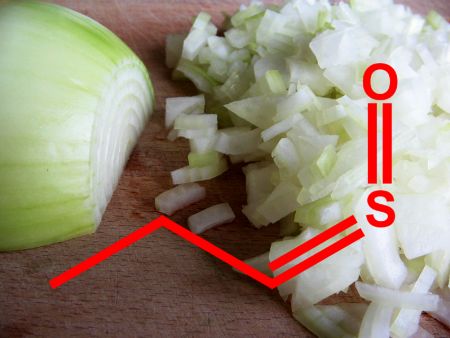
When chopping onions, propanethial-S-oxide is liberated. If this compound is not a chemical, what is it then?
There are many misconceptions about chemicals, and one of the most common ones is that food should be “free” of chemicals. For example, in the article “The future of cuisine?” the journalist writes:
“… the ingredients used in molecular cooking are natural, free of chemicals…”
Most of the hydrocolloids used in molecular gastronomy are certainly of natural origin, I don’t disagree about that. But “free of chemicals” is ridiculous… All ingredients used in the kitchen are chemicals (in a broad sense), albeit some very complex and not always very pure onces!
One of my motivations for being involved with molecular gastronomy and popular food science is to promote the understanding that all food is made up of atoms and molecules. Therefore I would like to present to you the organisation Sense about science which tries to combat common chemical misconceptions. According to their site which is well worth a visit they “promote good science and evidence for the public”. As a chemist I found the section Making sense of chemical stories particularily interesting. I think the report Misconceptions about chemicals (downloadable pdf) should be downloaded and read by every journalist writing a story about molecular gastronomy (or any other everyday science topic for that sake). And I think it should be quite interesting for the readers of this blog as well. Here’s a short summary:
You can lead a chemical-free life
The chemical reality is that you cannot lead a chemical-free life, because everything is made of chemicals. Chemicals are substances and chemistry is the science of substances – their structure, their properties and the reactions which change them into other substances. Claims that products are “chemical free” are untrue. There are no alternatives to chemicals, just choices about which chemicals to use and how they are made.Man-made chemicals are inherently dangerous
The chemical reality is that whether a substance is manufactured by people, copied from nature, or extracted directly from nature, tells us nothing much at all about its properties. In terms of chemical safety, “industrial”, “synthetic”, “artificial” and “man-made” do not necessarily mean damaging and “natural” does not necessarily mean better.Synthetic chemicals are causing many cancers and other diseases
The chemical reality is that many of the claims about chemicals being ‘linked’ to diseases simply tell us that that a chemical was present when an effect occurred, rather than showing that the chemical causes the effect. Caution is needed in reporting apparent correlations: it is in the nature of scientific experiments that many disappear when a further test is done or they turn out to be explained in other ways.Our exposure to a cocktail of chemicals is a ticking time-bomb
The chemical reality is that, although the language of “cocktails” and “time bombs” is alarming, neither the presence of chemicals nor the bioaccumulation of them, in themselves, mean that harm is being done. We have always been exposed to many different substances, because nature is a “cocktail of chemicals”. Modern technology enables us to detect miniscule amounts of substances, but the presence of such a small amount of a specific substance does not mean that it is having any discernible effect on us or on future generations.It is beneficial to avoid man-made chemicals
The chemical reality is that, insofar as there is a ‘need’ for anything, synthesised and man-made chemicals have given societies choices beyond measure about what they are exposed to and the problems they can solve.We are subjects in an unregulated, uncontrolled experiment
The chemical reality is that there is an extensive regulatory system that strictly controls what chemicals can be introduced: what experiments can take place, what can be used, for which purpose and how they should be transported, used and disposed of.
Apart from the “free of chemicals” misconception there is the whole natural/organic vs. synthetic/conventional food debate. But I think I’ll leave that for a separate post.
Update: Several commenters below have pointed out that Sense about science is funded by various lobby groups. An article by George Monbiot explores this in great detail. It’s OK to be aware of this, but I still feel their statements regarding “Misconceptions about chemicals” are very much to the point and well worth reading.
["Sense about science" was found via The Sceptical Chymist. Thanks!]