Posts Tagged ‘egg’
Saturday, October 24th, 2009

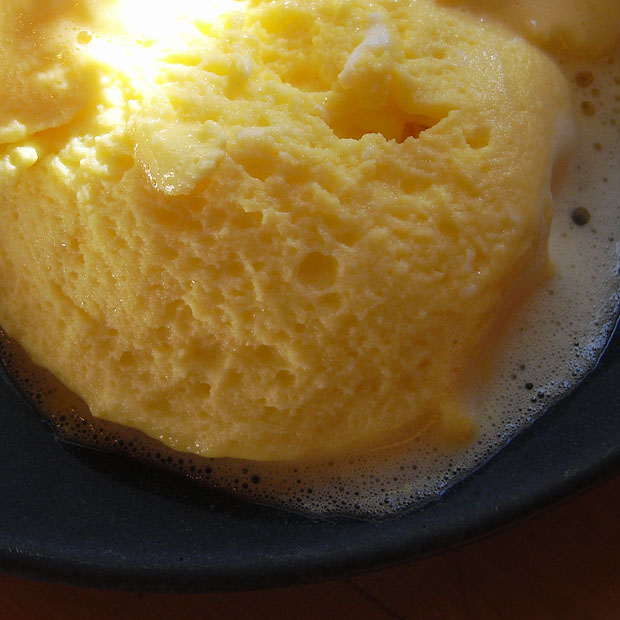
Miss Silvia is full of surprises! She’s been around the house for a year, but only now did she reveal one of her hidden capabilities. Did you know that you can make scrambled eggs with the steam wand of your espresso machine? Me neither. It’s a brilliant idea and one can wonder why no one has done this before. I mean, espresso machines have been around for a while. And as it turns out – according to Kelly’s comment below this was done in San Francisco back in the 90′s. It seems as if the credits for rediscovering these scrambled eggs should go to Chef Jody Williams (and thanks to Jessica at FoodMayhem for posting this). I’ve tried it several times and it works very well. I’d even say that this gives you another reason to purchase an espresso machine with a proper steam wand! Many other reasons can be found in my first post about Miss Silvia. (more…)
Tags: aeration, custard, egg, espresso machine, Miss Silvia, Ranciliio, sabayon, scrambled eggs, steam, steam wand, video, zabaglione
Posted in equipment, experiments, molecular gastronomy, recipe, tips & tricks | 23 Comments »
Tuesday, April 14th, 2009

One of the more curious cookbooks I own is a German one entitled “Kochen und Backen nach Grundrezepten”
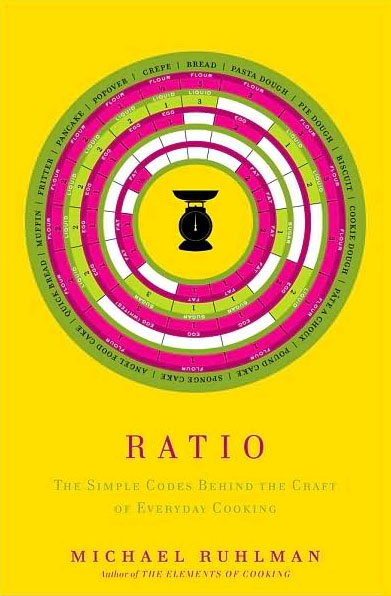
(Cooking and Baking with Base recipes). It was first written in 1932 and has been updated regularily ever since. Each section typically has a standard recipe which indicates the ratios to use followed by suggested variations (just like The improvisational cook). It also has nice summaries of dos and don’ts (just like BakeWise and CookWise), and what really makes the book stand out is that is so compact yet still comprehensive. It’s one of those books I actually use when cooking. Many other books have a little too much text – you have to read a lot to pick up the key points. Anyway – the reason I mention this is that as I read about the new “Ratio” book by Michael Ruhlman (MR books, MR blog), the German cookbook was the first book that came to my mind.
(more…)
Tags: Baker's percentage, baking, book, bread, cooking, cooking without a cookbook, egg, eggs, improvisation, luise haarer, michael ruhlman, molecular gastronomy, proportions, ratio, ratios, without recipe
Posted in books, molecular gastronomy, tips & tricks | 12 Comments »
Thursday, April 9th, 2009

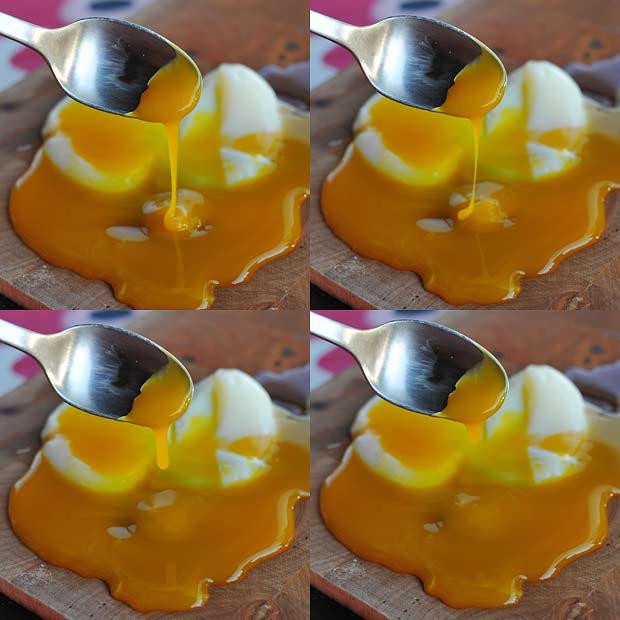
Many cookbooks suggest the following for boiling eggs: 3-6 min for a soft yolk, 6-8 min for a medium soft yolk and 8-10 min for a hard yolk. If you are satisfied with this, there is no need for you to continue reading. But if you’ve ever wondered whether the size of an egg has any impact on the cooking time you should read on. And if you search the ultimate soft boiled egg we share a common goal! From a scientific view point, a cooking time of approximately 3-8 minutes to obtain a soft yolk is not very precise. A number of important parameters remain unanswered: What size are the eggs? Are they taken from the fridge or are they room tempered? Are they put into cold or boiling water? And if using cold water – when should the timer be started? When the heat is turned on or when the water boils? And would the size of the pan, the amount of water and the power of the stove top matter?
(more…)
Tags: boiling eggs, Charles Williams, chemistry, cocotte, cooking, easter, egg, eggs, everyday science, formula, hard boiled, Jules Verne, maekbanseok gyeran, molecular gastronomy, onsen tamago, perfect eggs, Peter Barham, popular science, Robuchon, sauna, soft boiled, sous vide
Posted in experiments, molecular gastronomy | 45 Comments »
Sunday, December 14th, 2008
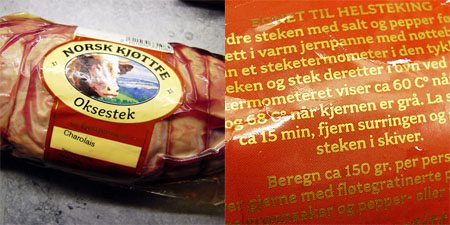
Having received a real kitchen gadget before the weekend, I certainly had to do some sous-vide experiments. While shopping I looked specifically for meat that was already vacuum packed in plastic bags as I do not have a food saver. There is actually a decent selection available and I got a 1.5 kg roast beef and a chicken breast (a particularily nice one, bred according to the Label Rouge principles). The nice thing about the meat I got was that the packaging had temperature suggestions. Even though I have books and tables and access to the internet it’s always nice to have this information available exactly when and where you need it. And as I dropped the meat into the water bath it occured to me that this was so simple (not that I shun complex recipes), so clean (I’m not afraid of a messy kitchen) and so convenient (I’m not at all a fan of fast food) that given the expected end result this is probably how very many people will prepare their meat in a not to distant future! So to all farmers, butchers and producers of immersion circulators – I hope you read this and act accordingly

(more…)
Tags: beef, chicken, egg, egg white, egg yolk, eggs, immersion circulator, molecular gastronomy, steak, techniques, temperature, texture
Posted in experiments, molecular gastronomy, sous vide, tips & tricks | 23 Comments »
Friday, September 26th, 2008

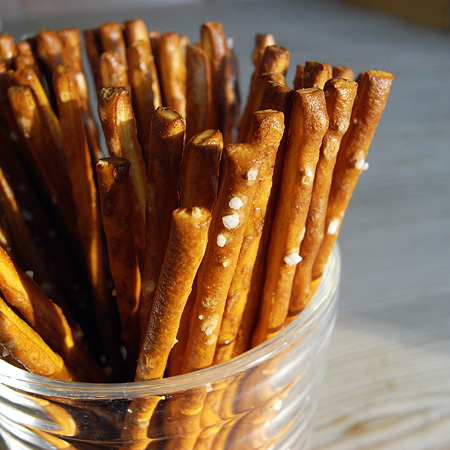
Ever thought about how pretzels and salt sticks get their nice brown color?
The products of the Maillard reaction provide tastes, smells and colors that are much desired and lend their charachteristics to a variety of foods. In this post I will focus on the factors that influence how fast the Maillard reaction proceeds. And more specifically I’ll give examples on how the Maillard reaction can be speeded up. This is not about fast food, nor is it about saving time. It’s more about controlling the browning reaction by speeding it up or slowing it down in order to get a desired end result.
The Maillard reaction is, to put it simple, a reaction between an amino acid and a sugar (there’s more on the chemistry at the end of the post). To speed it up you can do one or more of the following:
(more…)
Tags: acid, amino acid, baking soda, base, egg, eggs, everyday science, fructose, glucose, lactose, lye, maillard, Maillard reaction, milk, pH, protein, reducing sugar, temperature, video
Posted in experiments, molecular gastronomy | 29 Comments »
Tuesday, May 13th, 2008

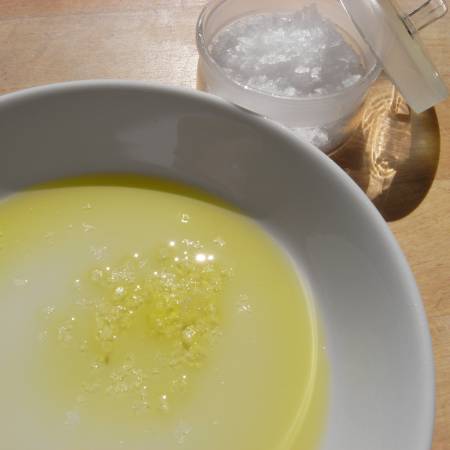
Salt in oil. According to Pierre Gagnaire, this is Hervé This’ main discovery. It allows him to sprinkle salt on dishes without the salt dissolving in water from the dish. Thereby the “crunch” of the salt is retained.
Rob Mifsud, perhaps best know for his Hungry in Hogtown blog has interviewed Hervé This. At the end of the interview Hervé lists 10 elements of basic kitchen knowledge. Some may seem obvious, but they are not, according to Hervé. Here’s the list so you can judge by yourselves:
- Salt dissolves in water.
- Salt does not dissolve in oil.
- Oil does not dissolve in water.
- Water boils at 100 °C (212 °F).
- Generally foods contain mostly water (or another fluid).
- Foods without water or fluid are tough.
- Some proteins (in eggs, meat, fish) coagulate.
- Collagen dissolves in water at temperatures higher than 55 °C (131 °F).
- Dishes are dispersed systems (combinations of gas, liquid or solid ingredients transformed by cooking).
- Some chemical processes – such as the Maillard Reaction (browning or caramelizing) – generate new flavours.
Tags: egg, eggs, Hervé This, kitchen physics, kitchen science, oil, pierre gagnaire, salt
Posted in molecular gastronomy, news articles, science, tips & tricks | 10 Comments »
Monday, February 25th, 2008

Chocolate pasta suspended for drying.
For this round of TGRWT I decided to use the recipe (Chocolate Carbonara with Parmigiano Reggiano Cream and a Chocolate-Dipped Grissini Wrapped in Prosciutto di Parma) by Masaharu Morimoto which I’ve blogged about previously. I was quite intrigued by that recipe and wanted to try it! So here it is, converted to metric units with some small adjustments. The original recipe called for 4 eggs, but this rendered the pasta dough to hard. I added two of the whites which were left over from the sauce. BTW this is why one of should better weigh out eggs instead of count them (too bad I didn’t think about his from the beginning so I could have weighed the eggs I used). The original recipe called for bread sticks with chocolate and prosciutto di Parma which I skipped (but which nonetheless sounds like a good accompaniment – as you’re probably aware of meat and chocolate also go very well together!).
(more…)
Tags: chocolate, egg, eggs, Masaharu Morimoto, parmesan, pasta, vanilla
Posted in TGRWT, flavor pairing, molecular gastronomy, recipe | 11 Comments »
Wednesday, January 30th, 2008

As a late (but just in time for the deadline) response to TGRWT #8 which was announced by Chadzilla in December last year – here is finally my write up on a recipe and a little on the background of this flavor combination which has become a classic in molecular gastronomy.
Heston Blumenthal introduced it around 2002 at The Fat Duck. It’s well worth reading what Heston wrote about this combination back then. He describes how salt can help bring out the flavor of many desserts. At one point he tried caviar and white chocolate – the effect was stunning. He then wanted to find out why this combination was so successful:
I gave some caviar and chocolate to François Benzi, who works for Firmenich, the flavourings and perfumes company based in Geneva. He was so surprised at the way that the caviar and chocolate melded together that he excused himself for half an hour while he tried to discover the reason behind the success of this union.
When he returned, the response was that both the chocolate and caviar contain high levels of amines. These are a group of proteins that have broken down from their amino acid state but not so far as to become ammonia. Amines contribute to the desirable flavours that we find in cooked meats and cheeses, among other things.
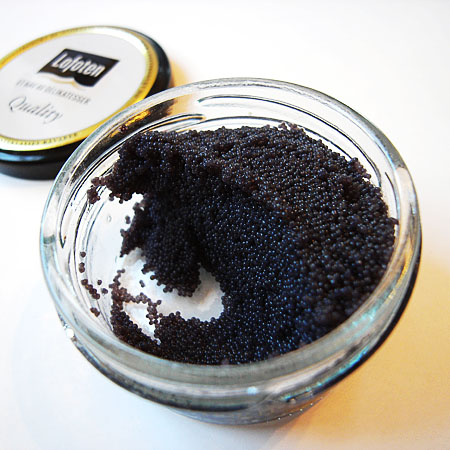
Some might object to using caviar but remember that there is no need to turn to sturgeon caviar as this species is endangered. I used caviar from Capelin which costs less than $4/€3 for a box of 50 g. As I have never tasted the “real” stuff I’m not the right person to judge about similarity or difference in aroma. And in case you also wondered about the terminology – roe is the fully ripe egg masses of fish whereas caviar refers to processed, salted roe. I decided to make a soufflé and based the recipe loosely on one of the soufflé recipes in my Larousse Gastronomique.

White chocolate soufflé with caviar
40 g white chocolate
30 g flour
1 dL milk
35 g caviar
3 eggs, separated
nutmeg
Melt chocolate on very low heat. Add 1/3 of the flour and stir, heating gently. Add a 1/3 of the milk and mix thoroughly. Add another 1/3 of the flour, then more milk and so on. Add finely ground nutmeg. Add 3 egg yolks and heat until right before the mixture sets (yeah – I admit – this is not very precise…). Then add the caviar. Beat egg whites stiff and fold them in. Pour into greased soufflé dish and bake at 220 °C for about 15 min.
Verdict: Aromas blend well together, but when eaten alone it’s perhaps a little bland. But I’m quite sure that it could be succesfully incorporated into a menu together with something acidic. The texture was nice, but the soufflé quickly falls together once it’s removed from the oven (I’ll have to post more on the chemistry of soufflés some other time – Hervé This has written a lot about this).
If you try to make this – note that white chocolate doesn’t behave excately like butter when you add the flour. It all got very thick, very fast – that’s why I started adding milk early. I also guess you have to be really careful when heating the whtie chocolate, but I didn’t do any stress tests here.

This is what the mix looks like before I folded in the egg whites.
For my first attempt at this recipe I used 20 g flour and 15 g caviar. The result was that the caviar sedimented before the soufflé had set, besides the fact that one could hardly taste the caviar at all. On my second attempt however, there was enough flour to keep the caviar suspended until the soufflé set. And one could actually also taste the caviar.

And now on to the chemistry behind:
I promised that I would come back with more information about the chemistry behind this pairing, but there isn’t very much information out there. There is one paper on aroma development in block-milk which used in the production of white chocolate. This paper lists a couple of volatiles, but only with their relative peak areas. Turning to caviar (or roe), there is a recent paper on flavor characterization of ripened cod roe, and this paper includes qualitative information about odor intensity.
Comparing the list of volatiles, the following volatiles which contribute substantially to the odor of ripened cod roe are also found in block milk (followed by odor thresholds in water, given in ppb, taken from this page):
2-butanone (50000 ppb)
2-methylbutanal (1 ppb)
3-methylbutanal (0.2-2 ppb)
pentanal (na)
Of these, the first has a high odor threshold, so it’s not likely to be an impact odorant in block-milk (and white chocolate). The methylbutanals however probably contribute to the overlapping aroma of roe and white chocolate. I didn’t find any threshold value for pentanal.
One group of compounds which was not mentioned in the paper on cod roe odor from 2004, but which was mentioned in a Russian paper from 1967 are amines (Golovnya: “Gas-chromatographic analysis of amines in volatile substances of salmon caviar”). Considering the fact that trimethylamine has a threshold in the range of 0.37-1.06 ppb, and that trimethylamine is found in block-milk suggests that it might contribute significantly to the odor of both white chocolate and roe. I guess the reason trimethylamine (and the whole range of other, closely related amines) is not found in the odor analysis in the 2004 paper has to do with the analytical method used.
The fact that amines are crucial is further supported by the Guardian article I quoted from in the beginning where Heston Blumenthal describes how he turned to François Benzi, a flavor chemist at Firmenich, to find out why white chocolate and caviar is such a good match. Benzi concludes that it is due to the presence of similar amines in white chocolate and caviar.
Tags: egg, eggs, Hervé This, Heston Blumenthal, impact odorants, OAV, odor activity value, techniques
Posted in TGRWT, flavor pairing, molecular gastronomy, recipe, tips & tricks | 6 Comments »
Monday, December 31st, 2007
Although I started blogging in August 2006, it wasn’t until 2007 that things got rollin’ so I thought I would post a “metapost” about my first whole year of blogging.

Most popular blogpost
The most popular post by far this year has been the post on how to achieve a “Perfect steak with DIY “sous vide” cooking”. This is also the post which was most commented, counting 42 comments so far. I really enjoy that this topic has become so popular. Low temperature cooking can make a huge difference in people’s cooking, yet it doesn’t require any sophisticated equipment apart from a thermometer. It’s perhaps the best example of a technical application of molecular gastronomy in a home kitchen.

Most popular static page
The khymos site got a jump start in January as the static page on “How to prepare the perfect boiled egg” made it all the way up to the front page of digg.com (many readers left comments here). It’s amazing how this can drive up the traffic on a site!

Most time consuming post
The single post which took the most time to research and prepare was without doubt the one were I presented the collection of hydrocolloid recipes. I spent quite some time searching for recipes and an equal amount of time formatting and converting them all to metric units and shortening down the text. Reception has been good, and since it was published in August, it has been downloaded more than 7000 times. I hope to publish a revised edition in 2008, and I am of course always eager to hear from you, especially if you have some recipes that you think should be included.
Most fun to write
I blog because I enjoy it. But if had to chose which posts were most fun to research and to write, I think the list would include “Perfect steak with DIY “sous vide” cooking”, “Two flavour pairing case studies”, “New perspectives on whisky and water” and “First experiments with sodium alginate”.

TGRWT
The first round of the food blogging event “They go really well together” was launched in April. Since then 7 rounds have been completed with almost 90 submissions in total! I’ve had a lot of fun both preparing dishes and browsing through the round-ups. The current round is on white chocolate and caviar, and since December has been a busy month for most people (including myself), the deadline has been extended to February 1st. So if you’ve never participated before – why not try out one of the “classic” flavor pairings of molecular gastronomy?

DMBLGiT
I admit that I am a passionate amateur photographer, and I have submitted a couple of pictures to the monthly “Does my blog look good in this” contest. But with around 100 contributions every month, and most of them of very high quality, I haven’t had great expectations of winning. Therefore it was a pleaseant surprise that my picture of cherries (used to illustrate “Ten tips for practical molecular gastronomy, part 6″) made it all the way to the top of the August 2007 round of DMBLGiT (click to view gallery).
2008 blog forecast
One of the first things I’ll do in 2008 is to complete the series of post with “10 tips for practical molecular gastronomy” which I started in January. Apart from this I have a number of unfinished projects that only need a little more research and experimentation – so let’s hope that I can find some time for this besides my full time job and my family!
A great thing about blogging is that it allows me to interact with the readers – you. So far there are 514 comments to my 112 posts – thank you very much for taking time to comment my posts! Some of you also contact my by email, and I try my best to answer all emails, but if you haven’t heard back from me – don’t hesitate sending me a reminder to webmaster (at) khymos (dot) org!
Because of all the spam comments (67,506 so far!) it’s difficult to say something about the number of people actually visiting the site, but there’s at least a couple of hundred unique visitors every day which is very nice and encouraging. So to all my readers I just want to say Happy New Year! (and in case you missed it, go back and read “Happy New Year with the Science of Champagne!” from last year).
Tags: 2007, blog posts, egg, eggs, highlights, khymos
Posted in molecular gastronomy | 10 Comments »
Sunday, September 30th, 2007

In the last minutes of the TGRWT #6 I decided to make a simple apple cake and add some lavender. The cake was nice, but I could clearly have used much more lavender. This makes me curious about what experiences the rest of you have made combining apple and lavender.
Apple cake (with too little lavender)
100 g butter
170 g sugar
rind of 1/2 lemon
4 eggs (~210 g)
275 g flour
1 t baking powder
1 dL milk (or cream)
ca. 20 lavender leaves
3-4 apples, thinly sliced
3-4 t sugar
Mix butter and sugar. Add eggs and lemon rind. Mix flour and baking powder and add to the rest. Stir in milk and add lavender. I used leaves for the batter and ca. 15 to decorate the top. Pour batter into greased pan. Insert apple slices. Sprinkle with sugar. Bake at 175 °C for 45-55 min until golden. Cool. Serve with whipped cream.
Tags: apple, egg, eggs, lavender
Posted in TGRWT, flavor pairing, molecular gastronomy, recipe | 5 Comments »
Saturday, May 5th, 2007
In previous posts and comments I have suggested that flavour pairings based on key odorants could be explored by looking at odor activity values (= ratio of volatile compound to it’s threshold). If two foods share one or more key odorants, chances are that they will go well together. It is also reasonable to assume that the more key odorants are shared, the more similar the flavours will be and the more likely it is that the foods will blend well and match each other.
Having initiated the TGRWT event I figured I should try to see if there was any OAV data available for coffee, chocolate and garlic. I was lucky to find OAVs for coffee (both arabica and robusta beans) and cocoa. To compare coffee and cocoa I sorted the flavour compounds in a descending order based on the OAV, keeping only the 20 first compounds. I turned out that 7 out of 20 key odorants in coffee and cocoa are shared, corresponding to 28/25% and 39% respectively of the total “odor activity” (= sum of OAV of top 20 odorants). Here’s the whole list:

(I hope the authors stuck to the IUPAC naming conventions as I did not take the time to check if synonyms were present in the compounds lists)
To compare this with a random pairing I search for more OAVs and found data for parmigiano reggiano and mango, so I repeated the excercise. Among the 20 odorants with the highest OAVs respectively for coffee and mango there was no overlap. A neglibile overlap was found between cocoa and mango: one odorant (linalool) was present in both with OAVs corresponding to 0.03% and 0.05% of the “odor activity” respectively. The fact that there is no overlap between coffee or cocoa and mango does not imply that they don’t go well together, only that their key odorants don’t match. Parmigiano reggiano and cocoa however had a lot in common, as seen from the table below. In fact 6 out of 20 key odorants, representing 36% and 89% of the “odor activity” for parmigiano reggiano and cocoa respectively.

The degree of overlap between parmesan and cocoa is in fact better than for coffee and chocolate when judging by the percentages (albeit with one less odorant), so this pairing will certainly be included in a future TGRWT event! A quick google search revealed that chef Masaharu Morimoto has come up with a recipe combining cocoa and parmesan:
Chocolate Carbonara with Parmigiano Reggiano Cream
Chocolate Pasta:
1 pound all-purpose flour
4 eggs
½ cup cocoa powder
1 Tablespoon olive oil
Pasta Sauce:
2 cups cream
4 egg yolks
½ cup sugar
½ cup Parmigiano Reggiano
For the Chocolate Pasta:
Sift flour and cocoa powder together and knead in the eggs and olive oil for 15 minutes. Rest for another fifteen minutes then roll and cut in a pasta machine. Heat up a pot of lightly salted water and boil pasta until al dente.
For the Pasta Sauce:
In a medium sauce pot scald the cream. In a separate bowl, whisk together egg yolks, Parmigiano Reggiano, and sugar. Temper this mixture into the hot cream and bring to a light simmer, whisking constantly to prevent curdling.
Unfortunately I couldn’t find any OAVs for garlic, so I haven’t been able to verify the triple pairing forming the basis for TGRWT #1. The claim was that coffee has dimethyl sulfide in common with garlic, and methyl pyrazine in common with chocolate. The table above confirms that coffee and chocolate have several methyl pyrazines in common, but dimethylsulfide is not among the 20 key odorants in coffee. This puzzles me, but there could of course be other volatile compounds that garlic shares with coffee. There should also be quite a difference between raw garlic (not to mention between whole, crushed and possibly even minced) and roasted garlic. If I overlooked something (or perhaps a paper with OAVs for garlic), please drop me an email about this. The OAVs of garlic could easily be calculated if data on volatile compounds in garlic and threshold concentrations are available.
I did a search on coffee, cocoa and garlic on The Good Scents Company website as described previously and found the following compounds either naturally occuring or used for recreating the aroma of coffee, cocoa and garlic:
5-methyl furfural (found naturally in all three, used for coffee and garlic)
benzothiazole (found naturally in cocoa, used in all three)
2-furfuryl mercaptan (found naturally in coffee, used in coffee, garlic cocoa)
isovaleraldehyde (found naturally in coffee and cocoa, used in all three)
ethyl methyl sulfide (found naturally in coffee and cocoa, used in coffee and garlic)
bis(2-methyl-3-furyl) disulfide (used in all three)
butyraldehyde (found naturally in all three)
S-(methyl thio) butyrate (used in all three)
isopropyl mercaptan (found naturally in garlic, used in coffee and cocoa)
So there are obviously similarities similarities between coffee, chocolate and garlic, but the question is whether these compounds are key odorants or not.
It’s only fair enough to add that the concept of odor activity values has it’s limitations. Some are related to matrix effects, because thresholds are not necessarily recorded in a matrix mimicking the food product. Possible synergies between flavour compounds are disregarded (examples are known where sub-threshold concentrations are detected in the presence of other volatile compounds). Also, the underlying assumption that the odor intensity increases linearily is not quite correct. The typical intensity vs. concentration curve is more ‘S’ shaped with an expansive, linear and compressive region as shown below. At low concentrations (expansive region) synergism (also known as hyperadditivity or mutual enhancement) is observed. At high concentrations (compressive region) antagonism (or subadditivity or mutual suppresion) is observed. This means that a high OAV overestimates and a low OAV underestimates the impact of the individual compounds. This also means that the odor activity percentages calculated for the pairings above should be take with a pinch of salt. In between these extremes normal additivities are observed.

Even though OAVs are not phsychophysical measures of the perceived odor intensity, they compare quite well with models that take different aspects of sensing into accout. The validity of the found OAV can also be tested by a recombination of the flavour compounds to see how good it imitates the original product studied. I can recommend the freely downloadable article “Evaluation of the Key Odorants of Foods by Dilution Experiments, Aroma Models and Omission” (DOI: 10.1093/chemse/26.5.533) for those interested in reading more about the science.
Despite the drawbacks and limitations I think OAVs can and will be helpful when studying the flavour pairing hypothesis.
Tips: You can read more about OAVs in books which are (partly) available through Google books.
Tags: arabica, chocolate carbonara, cocoa, coffee, egg, eggs, impact odorants, Masaharu Morimoto, OAV, odor activity value, parmesan, Parmigiano Reggiano, robusta
Posted in flavor pairing, molecular gastronomy, recipe | 17 Comments »
Thursday, April 5th, 2007
About.com has a nice guide on how to color eggs, and the list of colors is quite impressive (click for instructions):
Lavender
Small Quantity of Purple Grape Juice
Violet Blossoms plus 2 tsp Lemon Juice
Violet Blue
Violet Blossoms
Small Quantity of Red Onions Skins (boiled)
Blue
Canned Blueberries
Red Cabbage Leaves (boiled)
Purple Grape Juice
Green
Spinach Leaves (boiled)
Liquid Chlorophyll
Greenish Yellow
Yellow Delicious Apple Peels (boiled)
Yellow
Orange or Lemon Peels (boiled)
Carrot Tops (boiled)
Celery Seed (boiled)
Ground Cumin (boiled)
Ground Turmeric (boiled)
Brown
Strong Coffee
Instant Coffee
Black Walnut Shells (boiled)
Orange
Yellow Onion Skins (boiled)
Pink
Beets
Cranberries or Juice
Raspberries
Red Grape Juice
Juice from Pickled Beets
Red
Lots of Red Onions Skins (boiled)
More information about the chemistry behind can be found in the article “Chemistry in the dyeing of eggs” (Journal of Chemical Education, 1987, 291). The article discusses anionic dyes with sulfonate groups. These bond to the cuticle (protein) covering the egg shell forming salt linkages as shown (illustrated using FD&C yellow no. 6):

By lowering the pH (for example by adding vinegar), more amino groups in the proteins covering the egg shell are protonated and thus available for formation of the salt linkages with the anionic dyes.
Tags: anionic dyes, color, coloring, cuticle, dye, easter, egg, egg coloring, eggs
Posted in academic articles, fun with food, science, tips & tricks | 2 Comments »
Saturday, March 17th, 2007

(Photo by vintage_patrisha at flickr.com)
4. Learn how to control the texture of food
Taste and flavour normally get more attention when food is discussed, but the texture of food is equally important and our tongue is very sensitive, not only to taste and temperature, but also to the texture of food. The texture of food determines it’s mouthfeel and it is related to many physical properties of the food. Wikipedia lists the following aspects of mouthfeel (click to see the full description of each aspect) which can be useful when analyzing food:
Adhesiveness, Bounce/Springiness, Chewiness, Coarseness, Cohesiveness, Denseness, Dryness, Fracturability, Graininess, Gumminess, Hardness, Heaviness, Moisture absorption, Moisture release, Mouthcoating, Roughness, Slipperiness, Smoothness, Uniformity, Uniformity of chew, Uniformity of bite, Viscosity, Wetness
I will barely scratch the surface of how texture can be controlled by highlighting a couple of topics and point you to further resources. Hopefully it will spark your interest and give some new ideas for you to play with in the kitchen. Those interested in a comprehensive review of food texture are referred to the CRC handbooks on food texture (volume 1: semi-solid foods, volume 2: solid foods).
What determines the texture of food?
Put very simple, it’s the relative amounts of air, liquid and solids that determines the texture of food. This is complicated by the fact that liquids have different viscosities. Furthermore the air, liquid and solid ratio is not necessarily constant. A liquid can solidify or evaporate, solids can melt or dissolve, and air bubbles can escape during cooking or storage. An elegant but quite abstract way of describing the complicated mixtures of air, liquids and solids found in food, is to use the CDS formalism (CDS = complex disperse systems), introduced by Hervé This.

(Photo by Subspace at flickr.com)
How can texture be controlled and changed?
Texture can be controlled by temperature, pH, air/liquid/solid ratio, osmosis, hydrocolloids and emulsifiers – to mention a few. Here’s some examples:
Heating induces a change in the structure of proteins referred to as coagulation or denaturation. Typical examples are the boiling of eggs and the cooking of meat. When proteins denature they contract and become firmer. There are several helpful tables relating the doneness of different meats to temperature.
At around 70 °C (160 °F) collagen, the connective tissue in meat, turns into gelatin. As a result the meat becomes more tender, which is desireable in stews and other slow cooked meats.
Heat causes air/gas to expand and water to evaporate to give a foamy/airy texture. For example, experiments have shown that it is mainly the evaporation of water that causes a soufflé to rise.
Heat will cause certain hydrocolloids to solidify (for exaple methyl cellulose) whereas it will cause others to melt (such as gelatin).
Brining meat can greatly improve it’s texture and juicyness. This is done by immersing the meat in a 3-6% salt solution from anyhere between a few hours to two days before cooking.
Frozen water in the form of tiny ice crystals are important for the smooth texture of sorbets and ice cream. Ice cream that has been partly melted and frozen again will grow larger ice crystals that impart a coarser texture to the ice cream.
Acidic solutions (low pH) can cause proteins to denature. This allows fish to be cooked without the use of any heat. An example is the use of lime juice in ceviche.
Emulsifiers, thickeners and gelling agents have almost become synonymous with molecular gastronomy for many. They can greatly alter the texture of foods and typically only a very small amount is required. Where gelatin was the only gelling agent videly available to cooks in Europe and America only a decade ago, this has changed with the advent of many internet suppliers of speciality ingredients.
Cooking under vacuum can create new and exciting textures. First of all it’s a way of removing excess water without having to raise the temperature all the way up to 100 °C. When the water is removed, this will create pockets of air in the food, and when the pressure is released, the liquid surrounding the food that is prepared will rush in and fill these pockets. There is a commercially available vacuum cooker, but a DIY version can be made from a pressure cooker and a vacuum pump.

(Photo by Trinity at flickr.com)
Green leaf vegetables such as lettuce loose water upon storage. As the pressure inside the cells drops, the leaf becomes softer. By immersing the leaves in cold water for 15-30 min, thanks to osmosis, water will enter into the cells again. As the pressure increases, the leaves become crisper.
Air bubbles can greatly modify textures, and foams really are ubiquitious (which becomes obvious if you read the book “Universal foam – from cappuccino to the cosmos”). Ferran Adria’s espumas have become very popular, as has his recent invention, the Espesso. Air bubbles are also very important for the texture of ice cream, in fact ice cream is nearly 50% air (just consider the fact that ice cream is sold by volume, not by weight!).
A very recent addition to the modern kitchen pantry is the enzyme transglutaminase. The enzyme acts like a meat glue and Chadzilla has nice blog post on his transglutaminase experiments.
There are also enzymatic counterparts of transglutaminase available: proteolytic enzymes also known as proteases. You can find them in pineapple (bromelain/bromelin), papaya (papain), figs (ficin) and kiwi (actinidin) – and they are capable of degrading proteins and muscle tissue. Despite this, they have only found limited use in marinades, as their action can be difficult to control (as Nicholas Kurti experienced, look for the “But the crackling is superb” link).
When mixing flour and water, glutenin and gliadin react to form gluten which gives bread it’s elasticity and plasticity. Addition of 1-2% salt to bread tightens the gluten network and increases the volume of the finished loaf. Similarly, addition of 1% oil to the dough (after the first kneading) can further increase the volume. Larger amounts of fat added before kneading will interfere with the formation of long gluten strands, hence the name shortening.
The no-knead bread that recently hoovered around in the blogosphere challenges the conventional wisdom that bread needs kneading to get a good texture.
Once bread is baked, the staling process starts. Staling does not necessarily involve loss of water from the bread and is caused by crystallisation (or retrogradation) of starch. In this process water molecules are trapped. The process proceeds fastest at 14 °C, but is halted below -5 °C. This is the reason why bread should be stored at room temperature. The staling process can be slowed down by addition of an emulsifier such as lecithin which is abundant in egg yolk.
A way of turning high fat foods and oils into powders is by the use of tapioca maltodextrin. Hungry in Hogtown has shown how Nutella can be turned into a powder.
*
Check out my previous blogpost for an overview of the tips for practical molecular gastronomy. The collection of books (favorite, molecular gastronomy, aroma/taste, reference/technique, food chemistry) and links (webresources, people/chefs/blogs, institutions, articles, audio/video) at khymos.org might also be of interest.
Tags: 10 tips, Adhesiveness, brining, Chewiness, Coarseness, Cohesiveness, collagen, denaturation, Denseness, Dryness, egg, eggs, emulsifiers, espresso, Fracturability, gels, gluten, Graininess, Gumminess, Hardness, Heaviness, hydrocolloids, Moisture absorption, Moisture release, mouth feel, Mouthcoating, osmosis, proteolytic enzymes, roughness, Slipperiness, Smoothness, Springiness, techniques, temperature, texture, thickening agents, Uniformity, Uniformity of bite, Uniformity of chew, Viscosity, Wetness
Posted in academic articles, books, hydrocolloids, molecular gastronomy, tips & tricks, websites | 13 Comments »
Sunday, February 4th, 2007
By beating air into an egg white you can increase it’s volume by a factor of approximately 8. Hervé This has shown that water is the limiting component. By adding more water you can significantly increase the volume. Addition of sugar further stabilises the foam by increasing the viscosity of the water. A very simple dessert kan be made by whisking egg whites with sugar and berries of your choice. In Norway we refer to this as “Troll cream”. There’s more on this over at eriks-food-ucation.blogspot.com. An interesting question for you to ponder upon is in what order egg whites, berries and sugar should be mixed to maximize the volume!
But there is more to such a foam than trolls! For the following experiment, use one eggwhite and a berry syrup of your choice – I used a blueberry syrup (approximately 1,5 dL). Start by whisking the egg white. Add the syrup slowly over 5-10 min while constantly whisking. Observe how the volume increases dramatically. When I did the experiment I got roughly 2 L of foam (which corresponds to a 40-50 fold increase in volume). Make sure you use a clean bowl, preferably one of metal as fats and oil cling very well to plastic bowls.

Now comes the fun part: Put some of the egg white foam onto a plate and place it in a microwave oven to make the proteins set! Hervé This described this in a recent article and decided to name this dish “Vauquelin” after the french pharmacist and chemist Louis Nicolas Vauquelin. It does take some experimentation to find a proper combination of the power setting and the time needed for the Vauquelin to set. If you overdo it, the foam will just collapse. I used the 360W setting and 4 seconds for the Vaquelin in the picture below.

Cutting through the Vauquelin with a knife leaves a trace which does not refill.

Scooping out with a spoon also gives you an impression of the texture.

Instead of blueberry syrup you can try other liquids. Hervé This suggests orange juice or cranberry juice (both require addition of sugar). Liquours also work fine (although my experimentation suggests that the volume increases somewhat less), but remember to add sugar as this stabilises the foam and rounds of the taste.
Tags: denaturation, egg, egg white, foam, microwave, physics, protein, Vauquelin
Posted in experiments, molecular gastronomy, recipe | 19 Comments »
Sunday, January 14th, 2007
After giving a presentation about molecular gastronomy I was asked if I had ever heard about a chocolate cake baked with sauerkraut. I admitted that this was new for me, but that I would be very interested in the recipe. Could it be that this is a new flavor/flavour pairing? Remember, the hypothesis is: if the major volatile molecules of two foods are the same, they might taste (and smell) nice when eaten together. Perhaps there’s some one out there with access to a headspace gas chromatographer that could check this out? Or perhaps someone who has access to the Volatile Compounds in Foods database could do a quick search? If you’re unfamilier with such flavor pairings, another nice pairing with chocolate is the one with caramelized cauliflower and chocolate jelly.
I did get the recipe and it turned out that it was from a cookbook called “Food that really schmecks” by Edna Staebler. The book is a collection of recipes from the Mennonite community in Ontario. Many Mennonites came from Germany, hence the word “schmecks” in the title which is German (zu schmecken = to taste). According to the cookbook, leftover sauerkraut makes the cake moist and delicious – which I can certainly confirm! And the strange things is you can’t really taste the sauerkraut. Here is the recipe (the way I made it):
Sauerkraut chocolate cake
170 g butter (ca. 3/4 cup)
300 g white sugar – less than the 1 1/2 cups in the original recipe
3 large eggs
1 teaspoon vanilla (either essence or vanilla flavored sugar)
2.5 dL water (= 1 cup)
6 dL flour (= 2 1/2 cup)
1.3 dL unsweetened cocoa (= 1/2 cup)
1 teaspoon baking powder
1 teaspoon soda (sauerkraut is sour, therefore the recipe calls for soda!)
1/2 teaspoon salt
330 g drained sauerkraut (1 1/2 cup) – more than in the original recipe
Mix butter and sugar. Add eggs, water and dry ingredients. Stir in the sauerkraut and pour batter into greased pan. Bake at 350 F/180 C for 30-50 minutes.

The cake was a little too moist in the center when I made it and could have needed a couple more minutes in the oven. Make sure you check if it’s all set by inserting a wooden match or a knitting pin in the center of the cake!
Interestingly, the cookbook “Food that really schmecks” was recently presented in the blog Cream Puffs in Venice, with the following statement attached: “There is no haute cuisine or molecular gastronomy to be found here”. But chocolate and sauerkraut might turn out to be another flavor pairing based on sound chemical reasoning.
Update: Read the followup on this post with more about chocolate and caraway (the main spice in sauerkraut)
Tags: caraway, chocolate, egg, eggs, fermentation, fermented, flavor pairing, Mennonite, sauerkraut
Posted in flavor pairing, molecular gastronomy, recipe | 18 Comments »