Posts Tagged ‘flavor pairing’

The Flemish Primitives 2010 (part 1)

Tuesday, February 9th, 2010

Again I was lukcy that all the practical details worked out so I could attend this year’s Flemish Primitives in Brugge. For some one who’s not attended, it’s not so easy to grasp the concept and ideas behind The Flemish Primitives (TFP). And I admit, even though I’ve been there twice it’s not so easy to convey it in a short way. First of all the name is rather cryptic (unless you’re into art) as it refers to early Netherlandish painting. The link to food is described as follows by the organizers of the event (my highlights):

In the 15th and 16th century, ’The Flemish Primitives’ were masters in combining their talent with new techniques. Techniques they developed by interacting with other disciplines like manuscripting, sculpting, etc. This way of working changed the painting techniques in all of Western Europe forever. The event ‘The Flemish Primitives’ wants to continue in the same spirit. Respect for food products and beverages, the knowledge of the classic cooking techniques combined with a stimulation of new techniques and creativity. By promoting interaction between scientists, the world’s most famous chefs and artists, the event wants to deliver a creative boost for the food industry and gastronomy in Belgium and the world.

Considering last year’s sucess it was no big surprise that this year’s event was sold out (and the foyer of the Concertgebouw was equally full in the coffee breaks). And with the memories from last year I arrived in Brugge with great expectations. One main difference from previous years was that the scientific parts were much better integrated throughout the day. Scientists were on stage alongside the chefs, explaining their work. Also, contrary to last year’s back stage kitchen, they had now moved the kitchen onto the stage, flanked by a bar, some sofas and laboratory mezzanine. A good decision!
(more…)

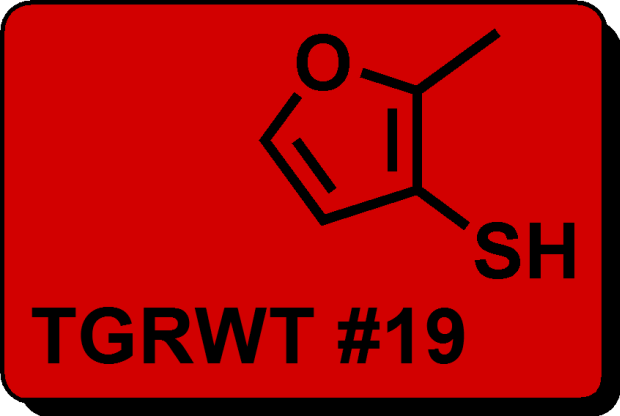
TGRWT #19: Tomato and black tea

Monday, September 7th, 2009

tgrwt-19

This month’s round of TGRWT is hosted by Pablo over at Medellitin, and the foods to pair this time are tomato and black tea. As always you can find instructions on how to participate in the announcement post. If you are new to TGRWT (which stands for They Go Really Well Together), check out the round-ups of the previous 18 rounds! And if you are chemically inclined, you may want to read on to learn more about the compounds behind this months pairing.
(more…)

French book on flavor pairing of food and wine

Wednesday, July 22nd, 2009

papilles_molecules

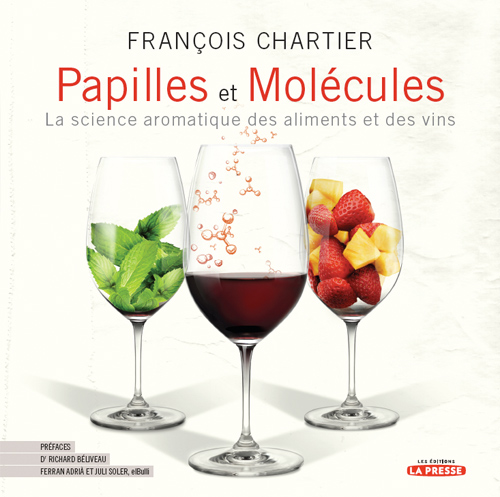
The Canadian sommerlier François Chartier (he has an extensive website featuring several blogs, including a section named Sommellerie moléculaire) is out with a new book on food and wine pairing. It’s not just another (superfluous) book on the subject. As the title Papilles et molécules (= Tastebuds and Molecules, unfortunately not available in English) suggests there is some science involved. It turns out in fact that he has applied the principles of flavor pairing to food and wine. With help from Richard Béliveau from Agriculture and Agri-Food Canada and Martin Loignon from PerkinElmer he has analyzed wines and food and comes up with the following suggestions for lamb, as described in the article “Chemistry-set wine pairing”:
(more…)

Ten tips for practical molecular gastronomy, part 8

Sunday, February 3rd, 2008

balancing-forks-tall.jpg
Read about the physics behind the balancing fork trick.

8. Experiment!

Dare to experiment and try new ingredients and procedures. Do control experiments so you can compare results. When evaluating the outcome, be aware that your own opinions will be biased. Have a friend help you perform a blind comparison, or even better a triangle test to evaluate the outcome of your experiments.

In a scientific context, an experiment is a set of actions and observations performed in the context of solving a particular problem, in order to support or falsify a research hypothesis. In a kitchen context, the problem to solve would typically be related to taste, aroma, texture or color. And the required actions and observations would be cooking and eating.

An essential part of the scientific method is that new knowledge is gained when, based previous knowledge, an assumption is made and tested. In the kitchen, this is exactly what you do when you taste your concoctions repeatedly as you cook. And it is also what makes you an experienced cook, because you remember and learn from your previous successes and mistakes. It might sound very complicated, but here’s how it goes:

1) Observation: soup lacks flavor
2) Hypothesis: adding something with flavor might help
3) Experiment: add more spices
4) New observation: soup tastes more (or less)
5) Hypothesis is either supported (or rejected)

Of these steps, I think observation is the easiest. Coming up with a hypothesis however can sometimes be difficult. If you have lumps in your custard or a sauce that’s separating, it isn’t always easy to think of what to do. This is where books on popular food science and molecular gastronomy might help you.

balancing-forks-1.jpg

Think outside the cook book! I mentioned in previous post that you should always question authorities and cook books. And even when you have a recipe that works, remember that it’s nothing more than a suggestion. For instance, it can be useful to know when to be sloppy and when to be accurate with measurements. The smaller amount you measure, the greater the precision should be. Let’s consider a hypothetical recipe that calls for 1000 g flour and 1 g of saffron. Whether you use 999 or 1001 g of flour makes no difference, but using 1 or 2 g of saffron will be quite noticable. A good rule of thumb is that you should measure to within +/- 10% of the given amount. But again, don’t follow this blindly. Experience will show when you can be even more sloppy.

Thinking of good experiments to do requires both creativity and experience, and there are many sources of inspiration. The molecular gastronomy movement has come up with a number of books and blogs which point towards new ingredients and procedures. There are several approaches to flavor pairing (i.e. a general one based on experience and a chemical one based on impact odorants). Further more there’s a lot of inspiration to get from regional cooking – also for molecular gastronomists! Lastly, I think considering not only the food but the whole atmosphere and the setting of the meal is important, because our senses are connected!

balancing-forks-2.jpg

The best way to judge the outcome of a new procedure or ingredient is to compare it with the original. I’ve previously termed this “parallel cooking”. In scientific contexts it’s very common to do control experiments and I can’t see why this shouldn’t be done in the kitchen routinely. Im convinced that this could have saved us from many kitchen myths!

Once you’ve done your parallel cooking, you have to taste it. If you did the cooking, you’ll probably have an opnion or expectation that the new dish is better or worse than the original. The big problem here is that due to confirmation bias, if you know what you are eating, this will influence your perception of it. Therefore it’s crucial to do a blind tasting (or a double-blind tasting). Have friend help you label each dish with random three digit numbers (to avoid thinking about ranking) and give them to you. If the dishes can easily be recognized due to color, it’s important that the lights are turned down or that you are blindfolded. State which dish you prefer and have your friend reveal the identity of the dishes tasted.

A slightly more sophisticated test is the triangle test which is commonly used in the food industry. The tester is presented with three samples of which two are identical and the task is to pick the odd one out. Using statistics, it’s possible to evaluate the outcome of repeated tests. The number of correct assignments in a number of triangle tests required for you to be 95% sure there is a difference are given in the table below. Read more about simple difference tests here.

Number of tests performed Number of correct assignments required
3 3
4 4
5 4
6 5
7 5
8 6
9 6
10 7

Bionomial distribution for a triangle test (p=1/3) at 0.05 probability level. A more extensive table can be found here.

It seems that this would be the ultimate way to determine whether or not there is a difference between pepsi and coke. It’s more than 50 years since the first experiments were conducted. The theory is simple, but in the real world things aren’t always that simple. Read the entertaining story about Fizzy logic.

balancing-forks-3.jpg

There are several examples of experimental cooking out on the net, and I thought I’d share some of them with you as this might illustrate my ideas on the subject.

Many cooks have strong opinions about how garlic should be treated. Should it be minced, crushed or microplaned? And does this really influence the taste and aroma? Or does it only affect the degree of extraction and hence the intensity of the flavor? Dominic of Skillet Doux had a excellent post on this subject in 2006, Deconstructing garlic. The task was formulated as follows:

The subject of this experiment is the effect that various methods of breaking down garlic have on its flavor when used to prepare a dish. The hypothesis is that not only does mincing garlic create a different flavor than crushing it, but also that mincing is the preferred method for pasta sauces. Furthermore, the experiment is intended to determine if microplaning garlic achieves a character different from mincing or crushing.

In his conclusion, Dominic writes ” I was surprised to discover that the difference between the minced and crushed garlic sauces was even more significant than I had previously thought”. Check out his post to find out which kind of garlic treatment he prefers for his pasta sauces. As a side comment it can be mentioned that a group of researchers in 2007 studied the effect of cooking on garlics ability to inhibit aggregation of blood platelets. They found that crushing could reduce the loss of activity upon heating. But unfortunately they didn’t report anything about the flavor.

Other food bloggers have also adopted experimental cooking with emphasis on systematic and thorough testing. Examples include Chad’s experiments with gellan, konjac and iota/kappa carrageenans, Michael Chu’s parallell cooking of bacon and his eggplant test and Papin’s comparison of orange juices – to mention but a few! And I shouldn’t forget Dylan Stiles either whom I mentioned in part 5 of this series:

A challenge with aroma molecules is that they should remain intact during storage and not be released until cooking (or even better, until consumption). A example would be to install a Liebieg condenser over your pot. Dylan Stiles has explored this in his column Bench Monkey by placing a bag of ice on top of the lid. He claims that his roommates preferred the curry which has been cooked under “reflux conditions”. The study was performed in a double blind manner (which I will come back to in part 8 of this series).

An extreme example of the application of the scientific method to cooking appeared in the news last spring when the recipe for the ultimate bacon buttie was revealed by scientists from Leeds University. Commissioned by Danish Bacon, the study evaluated more than 700 variations of a bacon buttie. They even came up with a “formula” for the perfect bacon buttie and quantified the required crispiness and crunchiness. The news story was picked up by many news agencies, so although it wasn’t necessarily ground breaking science, at least it was clever marketing.

*

Check out my previous blogpost for an overview of the 10 tips for practical molecular gastronomy series. The collection of books (favorite, molecular gastronomy, aroma/taste, reference/technique, food chemistry, presentation/photography) and links (webresources, people/chefs/blogs, institutions, articles, audio/video) at khymos.org might also be of interest.

Practical molecular gastronomy, part 5

Tuesday, May 1st, 2007

5. Learn how to control taste and flavor.

apple-pear.jpg

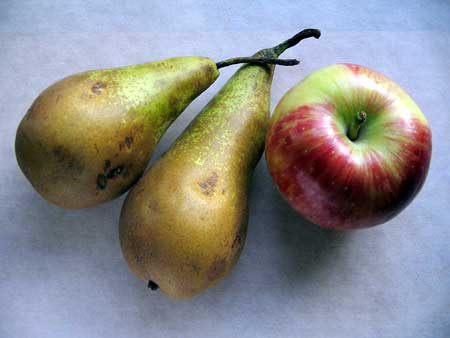
When invited over to friends for dinner, even before eating, you judge the food by it’s aroma, handing out compliments such as “It really smells nice”! Thankfully, nature is on the cook’s side, because when we prepare food and heat it, volatile aroma compounds are released which trigger very sensitive receptors in our noses. It is generally said that 80% of “taste” is perceived by our nose (what we refer to as aroma), whereas only 20% is perceived by our tongue. How important smell is becomes clear if you catch a cold – suddenly all food tastes the same. Too illustrate the importance of smell, prepare equally sized pieces of apple and pear. Close your eyes, hold your nose and let a friend give you the pieces without telling which is which. Notice how difficult it is to tell them apart. In fact, with a good nose clip you wouldn’t even be able to tell the difference between an apple and an onion! Then, with a piece of either in your mouth, let go of your nose. Within a second you can tell whether it’s apple or pear!

Taste
Our tongue has approximately 10.000 taste buds and they are replaced every 1 to 3 weeks. Their sensitivity increases roughly in the following order: sweet < salt < sour < bitter. In addition to the four basic tastes there is umami, the savory, fifth taste. This taste is produced by monosodium glutamate (MSG), disodium 5’-inosine monophosphate (IMP) and disodium 5’-guanosine monophosphate (GMP). Pure MSG doesn’t taste of much, but can enhance the taste of other foods. There are also some claims of a sixth taste.

A number of taste synergies/enhancements exist. I’ve also included three examples of how flavours can influence taste:

  • MSG, IMP and GMP enhance each other
  • IMP and GMP enhance sweetness
  • MSG, IMP and GMP generally enhance saltiness and vice versa
  • Salt enhances MSG, so foods with a natural high level of MSG (tomatoes) taste more if a pinch of salt is added
  • Salt and acid at low/medium concentrations enhance each other
  • Salt at low concentrations enhances sweet taste
  • Black pepper reduces sweet taste
  • Vanilla enhances sweet taste
  • Cinnamon enhances sweet taste
  • The only general, over-all trend which can be found is that binary tastes enhance each other at low concentrations and suppress each other at higher concentrations (but there are several exceptions!). Do check out “An overview of binary taste–taste interactions” (DOI:10.1016/S0950-3293(02)00110-6) if you’re interested in more details on binary taste interactions. I’ve tried to visualize taste enhancements (green) and suppresions (red) in the following figure using arrows to indicate the direction. For example, salt suppresses sweetnes at high concentrations.

    binary-taste-interactions.jpg

    In addition to taste, our tongue also percieves texture, temperature and astringency. An interesting thing about the temperature receptors is that they can be triggered not only by temperature, but also by certain foods. The cold receptor is triggered by mint, spearmint, menthol and camphor. There is even a patented compound, monomenthyl succinate, that triggers the cold receptor, but without the taste of menthol. It’s marketed under the name Physcool by the flavour company Mane.

    Substances such as ethanol and capsaicin trigger the trigeminal nerve, causing a burning sensation. Capsaicin also triggers the high temperature receptors of the tongue, hence the term “hot food” which can refer both to spicy food and food which is very warm. For a general article about taste, check out “Taste Perception: Cracking the Code” (DOI:10.1371/journal.pbio.0020064, free download).

    Flavour
    Our nose has about 5-10 million receptors capable of detecting volatile compounds. There are about 1000 different smell receptors and they allow us to distinguish more than 10.000 different smells – perhaps as many as 100.000! In order for us to smell something, the molecule needs to enter our nose at a concentration sufficient for us to detect. Aroma compounds are typically small, non-polar molecules. The fact that they are small means they will have low boiling points – they are volatile and spread rapidly throughout a room. They are often referred to as essential oils and are very soluble in fat, oil and alcohol. These aroma compounds generally not soluble in water, but there are also water soluble aroma compounds; just think of a well prepared stock – no fat but lots of taste and aroma!

    A challenge with aroma molecules is that they should remain intact during storage and not be released until cooking (or even better, until consumption). A example would be to install a Liebieg condenser over your pot. Dylan Stiles has explored this in his column Bench Monkey by placing a bag of ice on top of the lid. He claims that his roommates prefereed the curry which has been cooked under “reflux conditions”. The study was performed in a double blind manner (which I will come back to in part 8 of this series).

    Because aroma compounds are volatile, spices should be obtained whole and stored in tight containers away from light. If possible, fresh herbs should be used. The flavour of herbs and spices can be extracted by chopping or grinding to increase the surface area. To speed up grinding in a mortar you can add a pinch of salt or sugar.

    grinding-saffron.jpg

    Heat can help extract flavour (just think of how we brew tea or coffee), but will also evaporate volatile compounds, so a general advice would be to add spices at the start and herbs towards the end of the cooking time. Some herbs can even be sprinkeled over the food just before serving. In Southeast Asia (and especially India) it is quite common heat spices in a dry pan or in oil. This matures flavours and allows reactions to occur (possibly Maillard reactions). Coarse spices should be added earlier than finely ground spices.

    In addition to adding flavour using spices, herbs and other foods, we can also use heat to create new flavours. When sugar is heated, caramel is formed. And if a reducing sugar is heated in the presence of an amino acid, they react and form a host of new flavour compounds in what is known as the Maillard reaction. Caramelisation and the Maillard reaction are known as non-enzymatic browning. Enzymatic browning on the other hand is detrimental to many fruits (such as apples and bananas), but there are a few exceptions. Enzymatic browning is essential in the production of tea (black, green, oolong), coffe, cocoa and vanilla, although this is rarely attempted in kitchen.

    Another source of flavour is fermentation. It refers to a process were sugar is converted to alcohol and carbon dioxide by the action of a yeast. In the process a number of flavour compounds are formed as well which is why this is of great interest also from a molecular gastronomy viewpoint. Some examples of fermented products include wine, beer, cider and bread. Fermentation also refers to the process where some bacteria produce lactic acid. Some examples of foods resulting from lactic acid fermentation are yoghurt, kimchi and pickled cucumbers.

    Flavour pairing
    Cookbooks and recipes throughout the world are the result of billions of experiments. As a result, some very good combinations of herbs and spices have been discovered. Some of these mixtures have even been given names of their own and it is fascinating how easily one can forget that curry for instance is a mixture of spices. Wikipedia has a wonderful overview of herb and spice mixtures from all over the world. I must admit I only new a fraction of these:

    Adjika | Advieh | Berbere | Bouquet garni | Buknu | Cajun King | Chaat masala | Chaunk | Chermoula | Chili powder | Curry powder | Djahe | Fines herbes | Five-spice powder | Garam masala | Garlic salt | Harissa | Herbes de Provence | Khmeli suneli | Lawry’s and Adolph’s | Masala | Masuman | Mixed spice | Niter kibbeh | Old Bay Seasoning | Panch phoron | Quatre épices | Ras el hanout | Recado rojo | Shake ‘N’ Bake | Sharena sol | Shichimi | Spice mix | Tajín | Tandoori masala | Tony Chachere’s | Za’atar

    A book which I’ve found to be very useful when combining flavours is “Culinary artistry” by Andrew Dornenburg and Karen Page. It is the most comprehensive book about flavour pairing that I’m aware of, and I would say it is indispensible for someone who likes to cook without a cookbook. It has lists of basic flavors contributed by various foods. For example a sweet taste is contributed by foods such as bananas, beets, carrots, coriander, corn, dates, figs, fruits, grapes, onions, poppy seeds, sesame and vanilla (plus sugars and syrups of course). It has lists of “flavor pals”, a term attributed to Jean-Georges Vongerichten. For example, the flavour pals of ginger are allspice, chiles, chives, cinnamon, cloves ,coriander, cumin, curry, fennel, garlic, mace, nutmeg, black pepper and saffron. By far the most extensive part of the book are listings of food matchings. An illustrative example is pork which combines well with (classic/widely used combinations in bold):

    apples, apricots, bay leaves, black beans, beer, brandy, cabbage, Calvados, dried sour cherries, clams, Cognac, coriander, cream, cumin, fennel, fruit, garlic, ginger, hoisin sauce, honey, juniper berries, lemon, lime, marsala, molasses, mustard, onions, orange, parsley, black pepper, pineapple, Chinese plum sauce, plums, prunes, quinces, rosemary, sage, sauerkraut, soy sauce, star anise, tarragon, thyme, vinegar, walnuts, whiskey, white wine

    Despite the abundance of combinations, I dare say that little is understood about the science behind these flavour pairings. Why do these combinations of herbs and spices go particularily well together? Is it all about getting used to the combinations, so that we learn to like them? What influence does the complexity of the flavour play? These are easy questions that probably have rather complex answers.

    Very recently a different approach to flavour pairing has emerged. If two foods share one or more key odorants, chances are that they will go well together. The first step towards finding new pairings would be to identify key odorants. More info on key odorants can be found in the article “Evaluation of the Key Odorants of Foods by Dilution Experiments, Aroma Models and Omission” (DOI: 10.1093/chemse/26.5.533, free download). I’ve initiated the food blogging event “They go really well together” (TGRWT) to explore new flavour pairings and develop new recipes. There are also several blogposts with interesting comments on about flavour pairing.

    *

    Check out my previous blogpost for an overview of the tips for practical molecular gastronomy. The collection of books (favorite, molecular gastronomy, aroma/taste, reference/technique, food chemistry) and links (webresources, people/chefs/blogs, institutions, articles, audio/video) at khymos.org might also be of interest.

    Searching for flavour pairings

    Tuesday, April 17th, 2007

    Google can be of great help when exploring flavour pairings, especially for those of us who don’t have access to the commercial database VCF. The following tip has been mentioned in a comment to a previous blog post, but I thought it could be a good idea to bring it to everyones attention:

    The Good Scents company has en extensive range of aroma components, and the nice thing is that they list natural occurences and uses. The latter I guess, is based on the organoleptic properties of the aroma compounds. Using google, it’s possible to check if two or more foods have anything in common. Just type in the foods of interest and add site:http://www.thegoodscentscompany.com at the end. The triple combination in my last post for instance gives the following search string (click to perform the google search) and the top 5 hits are:

    furfuryl mercaptan * 98-02-2
    benzothiazole * 95-16-9
    isovaleraldehyde * 590-86-3
    bis(2-methyl-3-furyl) disulfide * 28588-75-2
    5-methyl furfural * 620-02-0

    The numbers following the name of the aroma compound are CAS registry numbers and indentify each compound uniquely. They are often more useful than the chemical name when searching the internet and databases.

    Unfortunately there is no way to distinguish whether the foods listed for each aroma compound occur under the “Natural occurences” or “Used in” labels.

    Triple flavour pairing: garlic, coffee and chocolate

    Monday, April 16th, 2007

    Preparing for a presentation on flavour pairing, Bernard Lahousse at Food for design visited François Benzi at Firmenich, a large supplier of aroma chemicals and perfume ingredients. Bernard plans to launch a website dedicated to flavour pairing soon, and in the mean time he posts about it on his blog, including this interesting expansion of the flavour pairing concept:

    …you can also use foodpairing to pair food that doesn’t match. Like chocolate and garlic. The trick then is to search for a third food product that has something in common with chocolate and with garlic. An example is coffee. Coffee has flavour components in common with garlic: Dimethyl disulfide and with chocolate: Methyl pyrazine.

    garlic-coffee-chocolate.jpg

    My challenge to you all is to come up with recipes that include garlic, chocolate and coffee. Any suggestions?

    DJ for your nose: Aroma jockey Odo7

    Friday, March 30th, 2007

    odo7.jpg

    Erich Berghammer, also known as Odo7 [homepage, myspace] is an aroma jockey or AJ for short. He blows scents over his audience with huge fans and has stocked up a pantry with exotic spices, roots, leafs, oils, extracts and herbs. The smells are vaporized using hot water. This video from Roskilde gives you an idea of the set up (but no smells unfortunately).

    From what I can see from his webpage Odo7 has been AJ’ing at clubs, parties, concerts, fashion shows, movie theaters and product presentations. But why hasn’t Odo7 been invited to a restaurant yet? Considering the fact that taste (as used in everyday terms) is 20% taste and 80% smell I could imagine some very interesting eating experiences with an AJ present. Think of it as a way of adding aroma to your food!

    I wonder what smells you would use with the different dishes? Perhaps recreate the smell of sea for the starters (seafood). Then the smell of pine, moss and wood for the main dish (wild boar, elk or reindeer) and finish up with orange blossom for the dessert (strawberries).

    The two last pairings are based on something I recall from the last International workshop on molecular gastronomy in Erice in 2004. Hervé This mentioned that strawberries combined with orange blossom extract, lemon and sugar are reminiscent of wild strawberries! At the same meeting Jack Lang suggested that branches of pine or juniper be placed around the rim of a large serving plate in front of each person. To speed up aroma extraction and vaporization one would pour hot water over the branches and then serve the food (dark meat/wild game) on a smaller plate placed between the branches. This brings us right back to the flavour pairing principle discussed earlier. But now – instead of combining two foods – we can combine a food ingredient or a dish with the appropriate aromas.

    Perhaps at a restaurant experience in the not to distant future you could expect not only a waiter and a sommelier to come to your table, but also an aroma jockey!

    I should also mention that the idea of using essential oils in cooking explored in great detail in the book “Aroma: The Magic of Essential Oils in Foods and Fragrance”. I justed received a copy and haven’t had much time to look at it. The fact that recipes for food and bath foam can be found on the same page might be disturbing for some, but I like the whole concept – simply because it takes the science of taste, eh.. aroma, seriously!

    Chocolate sauerkraut cake

    Sunday, January 14th, 2007

    After giving a presentation about molecular gastronomy I was asked if I had ever heard about a chocolate cake baked with sauerkraut. I admitted that this was new for me, but that I would be very interested in the recipe. Could it be that this is a new flavor/flavour pairing? Remember, the hypothesis is: if the major volatile molecules of two foods are the same, they might taste (and smell) nice when eaten together. Perhaps there’s some one out there with access to a headspace gas chromatographer that could check this out? Or perhaps someone who has access to the Volatile Compounds in Foods database could do a quick search? If you’re unfamilier with such flavor pairings, another nice pairing with chocolate is the one with caramelized cauliflower and chocolate jelly.

    I did get the recipe and it turned out that it was from a cookbook called “Food that really schmecks” by Edna Staebler. The book is a collection of recipes from the Mennonite community in Ontario. Many Mennonites came from Germany, hence the word “schmecks” in the title which is German (zu schmecken = to taste). According to the cookbook, leftover sauerkraut makes the cake moist and delicious – which I can certainly confirm! And the strange things is you can’t really taste the sauerkraut. Here is the recipe (the way I made it):

    Sauerkraut chocolate cake
    170 g butter (ca. 3/4 cup)
    300 g white sugar – less than the 1 1/2 cups in the original recipe
    3 large eggs
    1 teaspoon vanilla (either essence or vanilla flavored sugar)
    2.5 dL water (= 1 cup)
    6 dL flour (= 2 1/2 cup)
    1.3 dL unsweetened cocoa (= 1/2 cup)
    1 teaspoon baking powder
    1 teaspoon soda (sauerkraut is sour, therefore the recipe calls for soda!)
    1/2 teaspoon salt
    330 g drained  sauerkraut (1 1/2 cup) – more than in the original recipe

    Mix butter and sugar. Add eggs, water and dry ingredients. Stir in the sauerkraut and pour batter into greased pan. Bake at 350 F/180 C for 30-50 minutes.

    chocolate-sauerkraut-cake

    The cake was a little too moist in the center when I made it and could have needed a couple more minutes in the oven. Make sure you check if it’s all set by inserting a wooden match or a knitting pin in the center of the cake!

    Interestingly, the cookbook “Food that really schmecks” was recently presented in the blog Cream Puffs in Venice, with the following statement attached: “There is no haute cuisine or molecular gastronomy to be found here”. But chocolate and sauerkraut might turn out to be another flavor pairing based on sound chemical reasoning.

    Update: Read the followup on this post with more about chocolate and caraway (the main spice in sauerkraut)