Posts Tagged ‘Hervé This’

London Gastronomy Seminars

Thursday, November 12th, 2009

lgs

In New York the Experimental Cuisine Collective has been arranging regular seminars since 2007, in Paris Hervé This’ monthly seminar has been running for many years – and now finally the London Gastronomy Seminars are about to launch. To their upcoming event on November 30th they have invited Hervé This, Tony Conigliaro and John Forbes to speak about on Flavor extraction. You might remember that I’ve blogged about the wonders of extraction here previously (focusing on water, ethanol, oil and more specifically on espresso and walnut liqueur) – it’s a really fascinating topic and I wish I could take part in the seminar! If you’re in London or live nearby I would strongly recommend you to visit the seminar :)

(Too many?) New books

Friday, September 11th, 2009

books-2008

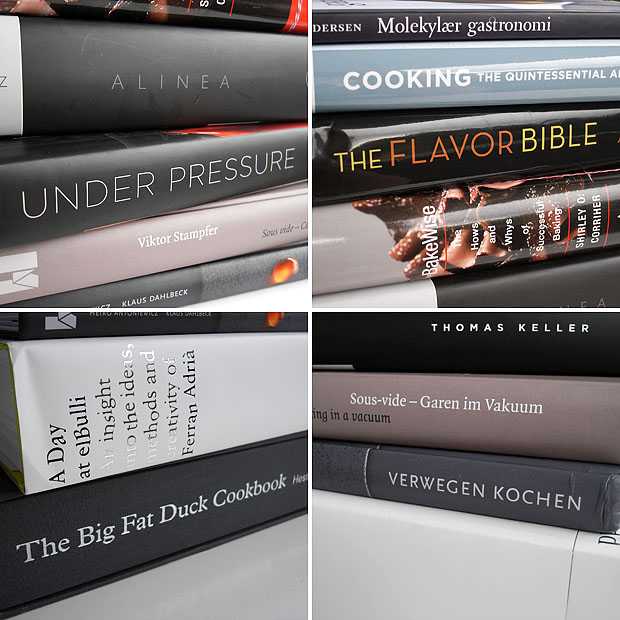
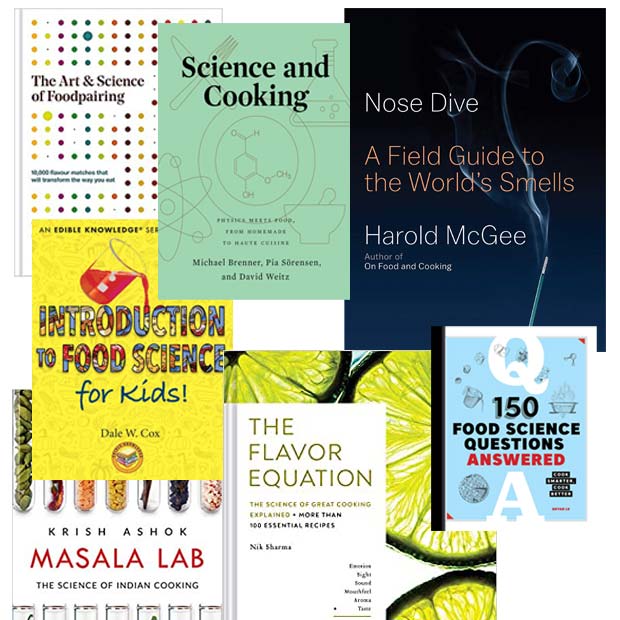
Last year’s book bonanza (Remember The Big Fat Duck Cookbook, Alinea and Under pressure right? Not to mention BakeWise, The Flavor Bible (not science, but I love their systematic approach), Cooking – The Quintessential Art, A day at el Bulli, the bilingual Sous-Vide, the German Verwegen Kochen and the Danish Molekylær gastronomi – did I miss any?) will be difficult to beat, but several interesting books will appear this fall as well. It’s as if this field is exploding with books now. When I first set up the webpages which later evolved into Khymos only a handful of books were available (you can travel back in time and view the single page from 2003 – only in Norwegian, sorry), but even I have a hard time now keeping track with all the books which cover the interesting intersection between cooking and science, aka molecular gastronomy. Sometimes I think – is this book really necessary? Do we need it? What does it add? But addicted as I am, I can’t help it – so I’ll probably get hold of most of these books as they become available :)

(more…)

New Hervé This website

Wednesday, March 25th, 2009

this-site

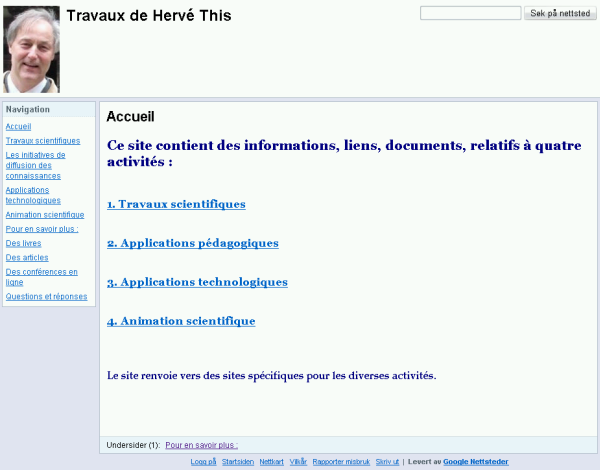
Hervé This has launched a new website: Travaux de Hervé This. As with his two blogs it’s difficult to follow unless you speak French. But at the same time it’s hard to get around Hervé since he’s a pioneer in the field! Machine translation of the French websites is available from Babelfish and Google, but the translations still leave a lot to be desired.

Building a meal

Friday, March 13th, 2009

bam_cover_this

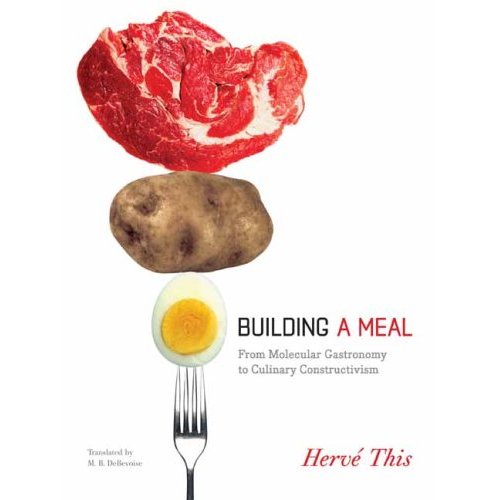
There’s a new book by Hervé This available in English: Building a meal – From Molecular Gastronomy to Culinary Constructivism. In the book he examines six bistro favorites — hard-boiled egg with mayonnaise, simple consommé, leg of lamb with green beans, steak with French fries, lemon meringue pie, and chocolate mousse — and discusses the chemistry of the preparation and the eating of these dishes. I haven’t seen the book yet, but it seems to be something like In search of perfection meets On food and cooking. I’ve also had troubles finding the original French title for this one. There is an excerpt chapter covering consommés available from the publisher website.

Has molecular gastronomy reached the plateau of productivity?

Monday, January 26th, 2009

pipa
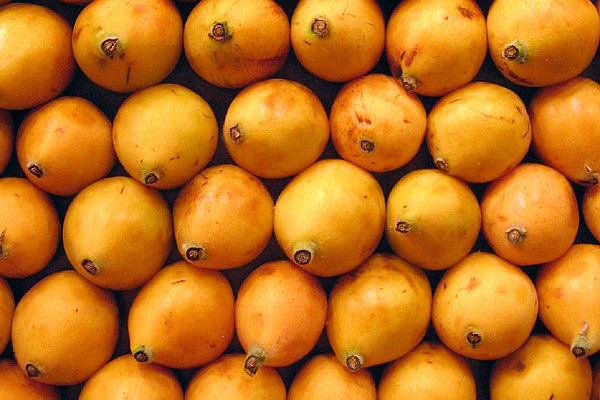
Loquat fruit (known as pipa in Chinese) piled up at Mercat St. Joseph in Barcelona.

Molecular gastronomy was recently chosen as word of the month (not quite sure exactly which month this was). They give the following definition:

the art and practice of cooking food using scientific methods to create new or unusual dishes

This is not the best definition I’ve seen, to be honest. Why should one limit it to new or unusual dishes? When taken to extremes this only results in gimmickery. Strangely enough there are no hits when I search for “molecular gastronomy” at www.askoxford.com, so one might wonder whether they changed their mind? Personally I feel that molecular gastronomy should strive to improve both home cooking and restaurant cooking. That’s also what I tried to convey with my 10-part series with tips for practical molecular gastronomy.

The Webster’s New Millennium dictionary has this definition:
(more…)

Hervé This is blogging

Saturday, January 17th, 2009

Hervé This

I just recently discovered that Hervé This has jumped on the blogging train as well now. Admittedly I normally don’t post about new blogs popping up, but after all it’s Hervé – I think it’s worth lending him an ear or two. There are two blogs, both in French, but as you all know automatic machine translation is really great (although it sometimes produces silly and strange translations):

http://hervethis.blogspot.com
(Translations: Google, Babelfish)

He started off in November with the words (translation by Google):

Some ideas that I want to share …
Confusion reigns: molecular cuisine, molecular gastronomy, science, technology, art, crafts, art …
Could we just evaporate the fog hanging over our intellectual world?

Let’s hope the machine translations won’t add more fog to the discussions ;)

http://gastronomie-moleculaire.blogspot.com
(Translations: Google, Babelfish)

Presently the second blog seems more like a copy-paste from a word document (which I’ve received by email earlier). It’s also poorly formatted – tables are a mess and URL’s are not clickable. There are however some interesting pieces of information here and there – for instance listings of restaurants, suppliers, books, websites etc.

A Christmas wish list

Tuesday, December 16th, 2008

The avalanche of books in the food/science intersection this fall has been truly amazing. Three books in particular have showcased special restaurants: el Bulli, Alinea and The Fat Duck.
(more…)

Recent academic articles

Saturday, November 8th, 2008

There are a couple of recent academic papers that have been published the last 2 years which I haven’t mentioned in blog posts, but they really deserve attention. Here’s the list (with quotes from the abstracts):

Molecular gastronomy: a food fad or science supporting innovative cuisine? Cesar Vega, Job Ubbink (Trends Food Sci Technol 2008, 19(7), 372-382)

The concepts, history and approaches of molecular gastronomy are discussed with an emphasis on the relation to food science and technology. A distinction is made between molecular gastronomy and science-based cooking (…) We discuss how chefs are dealing with the available systematic knowledge on food and cooking, and how molecular gastronomy can facilitate the cumbersome, but much needed discussions among food scientists and chefs.

Molecular Gastronomy: A Food Fad or an Interface for Science-based Cooking? Erik van der Linden, David Julian McClements and Job Ubbink (Food Biophysics, 2008, 3(2), 246-254)

A review is given over the field of molecular gastronomy and its relation to science and cooking. We begin with a brief history of the field of molecular gastronomy, the definition of the term itself, and the current controversy surrounding this term. (…) On the one hand, it can facilitate the implementation of new ideas and recipes in restaurants. On the other hand, it challenges scientists to apply their fundamental scientific understanding to the complexities of cooking, and it challenges them to expand the scientific understanding of many chemical and physical mechanisms beyond the common mass-produced food products.

The life of an anise-flavored alcoholic beverage: Does its stability cloud or confirm theory? Elke Scholten, Erik van der Linden, Hervé This (Langmuir 2008, 24(5), 1701-1706).

The well-known alcoholic beverage Pastis becomes turbid when mixed with water due to the poor solubility of trans-anethol, the anise-flavored component of Pastis in the water solution formed. This destabilization appears as the formation of micrometer-sized droplets that only very slowly grow in size, thus expanding the life of the anise-flavored beverage. (…) experiments on Ostwald ripening show an increase in stability with increasing ethanol concentration, the results based on our interfacial tension measurements in combination with the same Ostwald ripening model show a decrease in stability with an increase in ethanol concentration.

Formal descriptions for formulation, Hervé This (Int J Pharm 2007, 344(1-2), 4-8)

Two formalisms used to describe the physical microstructure and the organization of formulated products are given. The first, called “complex disperse systems formalism” (CDS formalism) is useful for the description of the physical nature of disperse matter. The second, called “non periodical organizational space formalism” (NPOS formalism) has the same operators as the CDS formalism, but different elements; it is useful to describe the arrangement of any objects in space. Both formalisms can be viewed as the same, applied to different orders of magnitude for spatial size.

Lavoisier and meat stock Hervé This, Robert Meric, Anne Cazor (Compt Rend Chim 2006, 9(11-12), 1510-1515).

Antoine-Laurent de Lavoisier published his results on meat stock’ preparations in 1783. Measuring density, he stated that food principles’ were better extracted using a large quantity of water. This result was checked.

New book by This and Gagnaire

Tuesday, August 5th, 2008

In the seemingly endless series of new books related to molecular gastronomy appearing this fall I just found out that Hervé This and Pierre Gagnaire also have a book due in October: “Cooking – The Quintessential Art”. The book is part of the California Studies in Food and Culture series which features interdisciplinary texts and has been characterized as “an intellectual exercise wholly removed from food-entertainment television”. The book is divided in five parts with the following titles which give further clues to the style of the book: The Beautiful Is the Good, Classical Ideas of Beauty, Beauty in the Middle Ages, Artistic Creativity Unbound, and The Present and Future of Cooking.

The book opens with the question “How can we reasonably judge a meal?”, signifying that this is not a cook book. According to the publisher:

This explores an astonishing variety of topics and elaborates a revolutionary method for judging the art of cooking. Many of the ideas he introduces in this culinary romance are illustrated by dishes created by Pierre Gagnaire, whose engaging commentaries provide rare insights into the creative inspiration of one of the world’s foremost chefs. The result is an enthralling, sophisticated, freewheeling dinner party of a book that also makes a powerful case for openness and change in the way we think about food.

Ten tips for practical molecular gastronomy, part 10

Wednesday, July 30th, 2008

Finally it’s time to round up my ten tips for moleceular gastronomy with the shortest of them all:

10. Have fun!

I sincerely believe that whatever you do, you do it better if you enjoy it. This isn’t a very scientific statement, but I’m sure there are bunches of scientific papers proving this, and my excuse is that I wouldn’t know where to start searching for them ;) (perhaps anyone can help?)

If you had fun preparing the food it’s definitely going to taste better when you eat it. And if you enjoy the company of good friends it’s going to taste even better (as pointed out by Hervé This previously). In his elaboration of what molecular gastronomy is (or should be), Hervé This emphasizes that the social phenomena linked to cooking and eating are among the topics that should be studied scientifically. In the first post summing up the 10 tips I mentioned the research done at Grythyttan in Sweden which has resulted in the “Five Aspects Meal Model” which captures a little of this. And I also stated that

average food eaten together with good friends while you’re sitting on a terrace with the sun setting in the ocean will taste superior to excellent food served on plastic plates and eaten alone in a room with mess all over the place

Perhaps this is what Paul Bocuse was touching upon as well when he was interviewed by a local newspaper in Stavanger where the Bocuse d’Or Europe final recently was held. Being questioned about what his greatest culinary experiences were he answered (my translation):

- I’ve travelled a lot and been lucky to taste delicacies from many different countries, but nothing compares to simple dishes were the pot is placed in front of you on the table and where you have the opportunity to help yourself several times until the food gets cold.

Hey – I’d be happy to invite him over for dinner. He sounds like an easy guest to please ;)

One of my intentions with the “10 tips” series has been to move the focus a little bit away from what too many have come to associate with molecular gastronomy – foam, alginate spheres and cooking with liquid nitrogen to mention a few. For me it has been a great oppurtunity to research a number of topics and I’m very thankful for all the feedback from readers! And in case it sounds as if I’m going to quit blogging I can let you know that the number of drafts for future blog posts is steadily increasing… So many interesting topics, so little time … But I’ll try to finish some of them soon.


Not only do I have fun cooking – blogging is also great fun! Here’s my blog as viewed on an OLPC (shown in tablet mode) obtained through the G1G1 program. Notice the screen which in the picture shown operates in a reflective, high-resolution black and white mode that is sunlight readable!

*

There is a summary of the “10 tips for practical molecular gastronomy” posts. The collection of books (favorite, molecular gastronomy, aroma/taste, reference/technique, food chemistry) and links (people/chefs/blogs, webresources, institutions, articles and audio/video) at khymos.org might also be of interest.

10 elements of basic kitchen knowledge

Tuesday, May 13th, 2008


Salt in oil. According to Pierre Gagnaire, this is Hervé This’ main discovery. It allows him to sprinkle salt on dishes without the salt dissolving in water from the dish. Thereby the “crunch” of the salt is retained.

Rob Mifsud, perhaps best know for his Hungry in Hogtown blog has interviewed Hervé This. At the end of the interview Hervé lists 10 elements of basic kitchen knowledge. Some may seem obvious, but they are not, according to Hervé. Here’s the list so you can judge by yourselves:

  1. Salt dissolves in water.
  2. Salt does not dissolve in oil.
  3. Oil does not dissolve in water.
  4. Water boils at 100 °C (212 °F).
  5. Generally foods contain mostly water (or another fluid).
  6. Foods without water or fluid are tough.
  7. Some proteins (in eggs, meat, fish) coagulate.
  8. Collagen dissolves in water at temperatures higher than 55 °C (131 °F).
  9. Dishes are dispersed systems (combinations of gas, liquid or solid ingredients transformed by cooking).
  10. Some chemical processes – such as the Maillard Reaction (browning or caramelizing) – generate new flavours.

It’s all about love

Tuesday, March 4th, 2008

Hervé This was touring California in February to promote his latest book. He flew in to San Francisco late at night and found most restaurants closed, so he and his wife dined at a randomly chosen Chinese restaurant. Hervé:

“Everything was in Chinese, there was no English. Don’t ask me what we ate because I have no idea, but I was there with my wife, fully in love, and so it was the best meal of my life.”

So true!

I’m tempted to say that this is Hervé in a nutshell. According to him a meal has three components – love, art and a technical component. Molecular gastronomy should investigate all three of them. More about how Hervé This defines and looks upon molecular gastronomy can be found here.

[quote via Times-Herald]

Look out for “The Gastronomer”

Wednesday, February 13th, 2008

viestad.jpg
(Photo: Mette Randem)

The Norwegian journalist, writer and food lover Andreas Viestad, known to many abroad for his books “Kitchen of light”, “Where Flavor Was Born: Recipes and Culinary Travels Along the Indian Ocean Spice Route” and two seasons of “New Scandinavian Cooking” on television (DVD of season one and two is available), has his debut today in The Washington Post with a new column dubbed “The Gastronomer”. Andreas has let me know that “It will be about food and science – as seen from the kitchen rather than the lab. It is an attempt to create a sort of maverick gastronomy, with recipes”.

The first column entitled “Like Water for Chocolate” is about chantilly butter and chocolate chantilly. Elaborations of Hervé This’ classic recipe in other words!

Andreas is not a scientist, but he has a remarkable capacity for absorbing the writings of Hervé This et al. and transform this into practical advice for the amateur home cook (and my guess is that many pro’s could learn a lot as well). So if you’re looking for extreme cooking á la Adrià, Andreas is not your kind of guy:

Spending hundreds of dollars on sous-vide equipment or ordering stuff weeks in advance and toiling for two days to make a “very interesting” side dish is for people in search of a hobby, not for people who want to make something nice for dinner.

A couple of years ago Andreas invited me to proof read one of his books from a chemical perspective. The book entitled “How to boil water” (only available in Norwegian) had a similar approach as his new column – it was about how the results of food science and molecular gastronomy could be applied to “normal” cooking at home. It was quite interesting, but also challenging, because as a scientist I’m used to a different level of precision when science is involved. But then on the other hand, what Andreas writes is much more readable and entertaining than what most scientists write!

Andreas has attended several of the Erice meetings (the International Workshop of Molecular Gastronomy) and he’s frequently in contact with Hervé This and Harold McGee from whom he gets a lot of inspiration. Although the chantilly is not exactly science, Hervé has told Andreas that:

From a scientific point of view it is nothing, a mere detail, but Pierre tells me it is one of the most useful things I have ever come up with.

In my opinion the chantilly is indeed a very good place to start! Hereby his new column is recommended! And if you have never made a chantilly, why not give the chocolate chantilly a try? I’ve posted a very short recipe previously, whereas Andreas has published a very comprehensive recipe in today’s column. Enjoy!

TGRWT #8: White chocolate soufflé with caviar

Wednesday, January 30th, 2008

white-chocolate-caviar-2.jpg

As a late (but just in time for the deadline) response to TGRWT #8 which was announced by Chadzilla in December last year – here is finally my write up on a recipe and a little on the background of this flavor combination which has become a classic in molecular gastronomy.

Heston Blumenthal introduced it around 2002 at The Fat Duck. It’s well worth reading what Heston wrote about this combination back then. He describes how salt can help bring out the flavor of many desserts. At one point he tried caviar and white chocolate – the effect was stunning. He then wanted to find out why this combination was so successful:

I gave some caviar and chocolate to François Benzi, who works for Firmenich, the flavourings and perfumes company based in Geneva. He was so surprised at the way that the caviar and chocolate melded together that he excused himself for half an hour while he tried to discover the reason behind the success of this union.

When he returned, the response was that both the chocolate and caviar contain high levels of amines. These are a group of proteins that have broken down from their amino acid state but not so far as to become ammonia. Amines contribute to the desirable flavours that we find in cooked meats and cheeses, among other things.

Some might object to using caviar but remember that there is no need to turn to sturgeon caviar as this species is endangered. I used caviar from Capelin which costs less than $4/€3 for a box of 50 g. As I have never tasted the “real” stuff I’m not the right person to judge about similarity or difference in aroma. And in case you also wondered about the terminology – roe is the fully ripe egg masses of fish whereas caviar refers to processed, salted roe. I decided to make a soufflé and based the recipe loosely on one of the soufflé recipes in my Larousse Gastronomique.

white-chocolate-caviar-3.jpg

White chocolate soufflé with caviar
40 g white chocolate
30 g flour
1 dL milk
35 g caviar
3 eggs, separated
nutmeg

Melt chocolate on very low heat. Add 1/3 of the flour and stir, heating gently. Add a 1/3 of the milk and mix thoroughly. Add another 1/3 of the flour, then more milk and so on. Add finely ground nutmeg. Add 3 egg yolks and heat until right before the mixture sets (yeah – I admit – this is not very precise…). Then add the caviar. Beat egg whites stiff and fold them in. Pour into greased soufflé dish and bake at 220 °C for about 15 min.

Verdict: Aromas blend well together, but when eaten alone it’s perhaps a little bland. But I’m quite sure that it could be succesfully incorporated into a menu together with something acidic. The texture was nice, but the soufflé quickly falls together once it’s removed from the oven (I’ll have to post more on the chemistry of soufflés some other time – Hervé This has written a lot about this).

If you try to make this – note that white chocolate doesn’t behave excately like butter when you add the flour. It all got very thick, very fast – that’s why I started adding milk early. I also guess you have to be really careful when heating the whtie chocolate, but I didn’t do any stress tests here.

white-chocolate-caviar-1.jpg
This is what the mix looks like before I folded in the egg whites.

For my first attempt at this recipe I used 20 g flour and 15 g caviar. The result was that the caviar sedimented before the soufflé had set, besides the fact that one could hardly taste the caviar at all. On my second attempt however, there was enough flour to keep the caviar suspended until the soufflé set. And one could actually also taste the caviar.

white-chocolate-caviar-4.jpg

And now on to the chemistry behind:
I promised that I would come back with more information about the chemistry behind this pairing, but there isn’t very much information out there. There is one paper on aroma development in block-milk which used in the production of white chocolate. This paper lists a couple of volatiles, but only with their relative peak areas. Turning to caviar (or roe), there is a recent paper on flavor characterization of ripened cod roe, and this paper includes qualitative information about odor intensity.

Comparing the list of volatiles, the following volatiles which contribute substantially to the odor of ripened cod roe are also found in block milk (followed by odor thresholds in water, given in ppb, taken from this page):

2-butanone (50000 ppb)
2-methylbutanal (1 ppb)
3-methylbutanal (0.2-2 ppb)
pentanal (na)

Of these, the first has a high odor threshold, so it’s not likely to be an impact odorant in block-milk (and white chocolate). The methylbutanals however probably contribute to the overlapping aroma of roe and white chocolate. I didn’t find any threshold value for pentanal.

One group of compounds which was not mentioned in the paper on cod roe odor from 2004, but which was mentioned in a Russian paper from 1967 are amines (Golovnya: “Gas-chromatographic analysis of amines in volatile substances of salmon caviar”). Considering the fact that trimethylamine has a threshold in the range of 0.37-1.06 ppb, and that trimethylamine is found in block-milk suggests that it might contribute significantly to the odor of both white chocolate and roe. I guess the reason trimethylamine (and the whole range of other, closely related amines) is not found in the odor analysis in the 2004 paper has to do with the analytical method used.

The fact that amines are crucial is further supported by the Guardian article I quoted from in the beginning where Heston Blumenthal describes how he turned to François Benzi, a flavor chemist at Firmenich, to find out why white chocolate and caviar is such a good match. Benzi concludes that it is due to the presence of similar amines in white chocolate and caviar.

Finally in English: Kitchen mysteries

Thursday, September 6th, 2007

this_kitchen-mysteries.jpg

Following the success of the English translation of Molecular gastronomy – Exploring the Science of Flavor (original title: Casseroles et éprouvettes), Hervé This book Kitchen mysteries (original title: Les secrets de la casserole) will appear in October 2007, and is already available for pre-order. As far as I know this book has already appeared in German as Rätsel der Kochkunst (and I guess in Spanish with the title La Cocina y Sus Misterios). As you can see from the list of foreign language books on molecular gastronomy, there’s still a whole number of books to be translated. Exciting times to come!