Posts Tagged ‘maillard’

Speeding up the Maillard reaction

Friday, September 26th, 2008


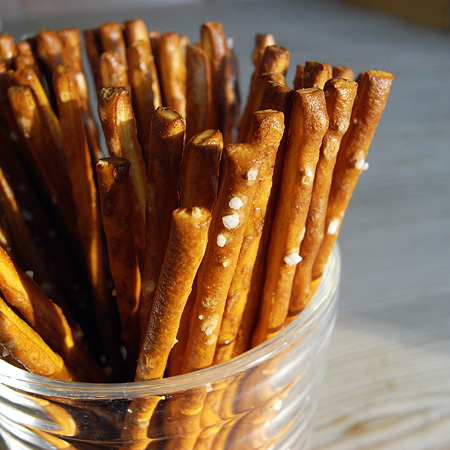
Ever thought about how pretzels and salt sticks get their nice brown color?

The products of the Maillard reaction provide tastes, smells and colors that are much desired and lend their charachteristics to a variety of foods. In this post I will focus on the factors that influence how fast the Maillard reaction proceeds. And more specifically I’ll give examples on how the Maillard reaction can be speeded up. This is not about fast food, nor is it about saving time. It’s more about controlling the browning reaction by speeding it up or slowing it down in order to get a desired end result.

The Maillard reaction is, to put it simple, a reaction between an amino acid and a sugar (there’s more on the chemistry at the end of the post). To speed it up you can do one or more of the following:

add protein (egg, milk)
reducing sugar (glucose, fructose or lactose)
remove water
increase temperature
pH

Chances are you have already utilized this in the kitchen without knowing. When eggs or milk are used for glazing, they act as a protein source for the Maillard reaction, giving a nice brown color. Milk also provides lactose which is a reducing sugar. You’ve probably also observed that temperature does influence browning. Water content is indirectly related to temperature - as long as there is water present, temperature will stay below 100 °C. But once the bread crust dries out the conditions are just right to get the Maillard reaction running.

The same principles are applied to microwaveable pies. The microwaves primarily interact with water and hence only bring the temperature up to the boiling point of water. In order to get sufficient Maillard productcs at these temperatures reducing sugars and amino acids are added to the crust (as exemplified in this patent where dextrose and whey solids are used). Not so surprisingly there is also a patent on how to avoid excessive browning in cookies which calls for addition of a polycarboxylic acid ester to lower pH and hence slow down the Maillard reaction.

Pretzels are an extreme example of how the Maillard reaction can be tweaked. Before baking the pretzels are brushed with lye, a dilute solution of sodium hydroxide, which is very basic. The high pH speeds up the bottleneck of the Maillard reaction (see end of post for details).


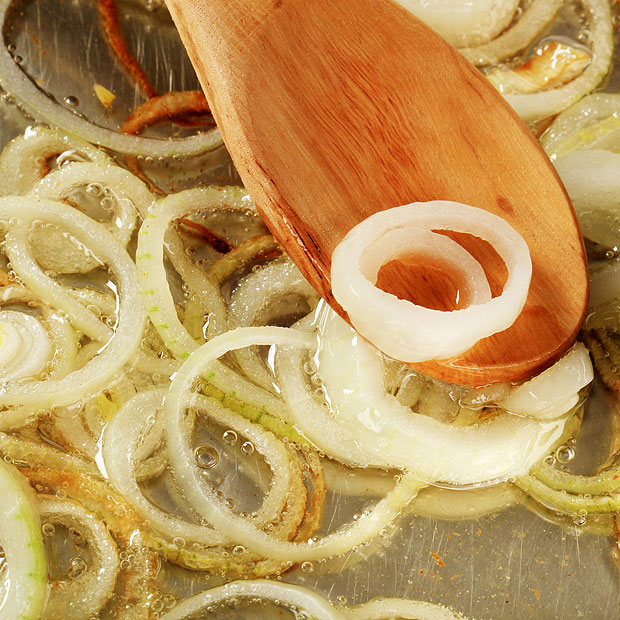
A pinch of baking soda can bring out a new taste dimension when browning onions

Another basic ingredient found in most kitchens is baking soda (sodium bicarbonate, NaHCO3). It’s used as a leavning agent which requires addition of an acid to function. Since it is a weak base, it can be used to increase the pH and hence the speed of the Maillard reaction, for instance when browning onions. This basic task, which isn’t always so easy after all, benefits greatly from a pinch of baking soda (and surprisingly it seems that this hasn’t been done before!). To illustrate this I’ve made a time lapse video of chopped onions being fried with and without baking soda. The frying took 11 min, but things are speeded up about 10x.

Samples taken throughout the experiment are shown in the picture below. Even after 4 min there is a visible difference. After 11 min, the small addition of baking soda has yielded onions which taste remarkably sweet with strong caramel notes, compared to the control which tastes like fried onions.

Another example of how baking soda is used to speed up the Maillard reaction is dulce de leche, a popular sauce/caramel candy in Latin America. It’s made by slowly boiling sweetened milk. Baking soda is not a required ingredient, but is often included. The baking soda gives dulce de leche a darker color and also contributes to the flavor.


Photo by audinou from flickr.com.

It should perhaps be added that baking soda is frequently used in Chinese cooking, for instance in tempura batters and marinades. Once there, the baking soda will certainly speed up the Maillard reaction, but it also affects the texture of meat - I’ll have to return to that topic later.

To round of this post I will briefly touch upon one of the reasons why pH influences the Maillard reaction. The first step involves a reaction between a reducing sugar (depicted as R(C=O)H) and an amino acid (depicted as R’NH2) followed by loss of water to yield a Schiff base. The Schiff base rearranges to the Amadori product (not shown). Of these first steps the formation of the Schiff base is the bottleneck (rate limiting step). The reactivity of the amino acid is influenced by the pH. A simplified reasoning goes like this: At low pH the amino group is protonated, yielding it less nucleophilic. At higher pH, the nitrogen becomes more nucleophilic and at very high pH the amino group can even be deprotonated. It should be noted that the fate of the Amadori product is also in large determined by pH and hence pH will affect more than just the rate, but this is far beyond the scope of this blog post.

The science of BBQ

Friday, April 4th, 2008

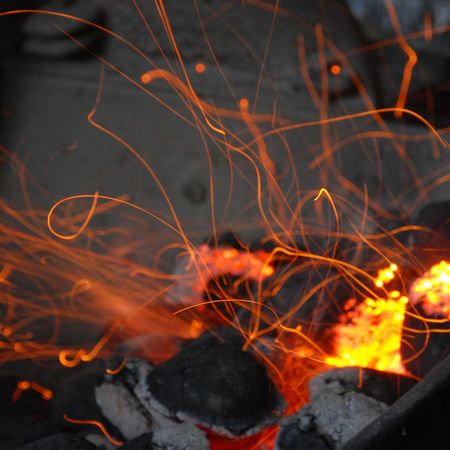
bbq-hot-air.jpg
Photo by spielzimmer via flickr.com (CC).

Eric Devlin over at Home of BBQ interviewed me via email about BBQ and molecular gastronomy. The topic should be of interest to the readers of Khymos as well, so I post the questions and answers in extenso here for your benefit.

Q. Martin, thank you for taking the time to discuss the science of BBQ. Before we get into ‘low and slow’ cooking, can you tell us a bit about your background and your interest in food?
mail
I have a PhD in chemistry and currently I’m working as a research scientist. When I first became interested in the connection between food and chemistry in the late 90’s, I searched the Internet without finding much information. I did however find some very interesting books in the faculty library, including Harold McGee’s “On Food and Cooking - The Science and Lore of the Kitchen”. Having found books about the subject, I soon started to give popular science presentations. In 2004 I was invited to attend the “International Workshop on Molecular Gastronomy” in Erice, Sicily. This was a great experience and I enjoyed meeting many of the scientists, writers and chefs involved with molecular gastronomy. The website I’ve put up, Khymos, is in many ways what I would have liked to find at the time I became interested in the subject.

Q. Over the past few years we have been hearing quite a bit about how food cooked over a hot flame can have increased carcinogens. Would food that is cooked for a longer period of time over a lower heat be safer?

The carcinogens are formed when meat gets burnt, so although you’d like to use high heat to get the Maillard reaction going (which gives you both flavor and color) you don’t want to overdo it. But even if the meat gets a little burnt, it is a good thing that for the carcinogens, as for all other substances, the poison is in the dose. So if you eat grilled meat every day you should be concerned about this, but for most people I think overeating poses a much greater risk!

Q. Serious BBQ cooks like to produce a ‘bark’ when preparing pork for their pulled pork dishes. Usually the natural ‘bark’ of the meat is enhanced by the sugar found in the dry rubs that are applied. Is there any other method that could be used to achieve or increase those results? Maybe an egg wash prior to cooking?

There are several processes which contribute to the flavor formation. First you have the sugars which caramelize. As you correctly state, this is enhanced by adding sugar to the rubs. Furthermore you have the Maillard reaction were sugars react with amino acids to form a host of compounds which contribute both flavor and color. Even though the Maillard reaction can take place at low temperature (such as in vintage champagne), things really speed up when temperature rises above 110-120 °C. Obviously to reach this temperature you’ll have to get rid of the water first. So using a dry rub makes sense. Apart from that it’s mostly about being patient. Use fresh spices, and where possible whole spices that you ground prior to use. The heat of the grill will toast the spices, thereby intensifying the flavor even more.

I must admit that I have never made nor tasted meat which was prepared with a “bark”, so I don’t dare to go into further details concerning how to improve it. The best thing would be to cook two pieces of meat in parallel, for instance with and without an egg wash to see which one comes out best.

Q. BBQ sauces vary greatly depending on region. Carolina sauces are often thin, while Kansas City and Texas sauces have greater viscosity. If a cook is making a sauce that comes out too thin, what recommendations would you have to thicken it?

You either have to take out some of the water by letting it boil over low heat in a large, wide pot, or you can add a thickening agent such as corn starch. If you use onions, these will help thicken your sauce if you let it boil for a while.

Q. In competitions, some BBQ pit-masters utilize a flavor enhancer called FAB B, which contains msg. The thought behind this additive is that after a judge has consumed numerous samples of the same category of meat, the additive will stimulate the taste buds and help to separate that entry from the rest. Can you recommend any other method of ‘waking the taste buds’ without detracting from the taste?

The problem with this explanation is that if everyone uses FAB, will there be any effect at all? If the idea is to rinse the mouth you would want something acidic which stimulates saliva production, some tannic compounds to bind proteins and perhaps some alcohol to help solubilize fats. Heston Blumentahl at the Fat Duck made a “Green tea sour mousse” from these guidelines.

But even so adaption and habituation occurs in all tasting. I’ve discussed this extensively in a blog post, and the easy answer is variation. Or more scientifically: increased sensing by contrast amplification. Eat something which is as far from meat as you can come, something which is cold, crisp, fresh and acidic (did someone mention a tasty salad?). This will make the next piece of meat taste much better!

Q. FAB contains the following: Hydrolyzed soy protein, vegetable oil (soybean and or corn, cottonseed), sodium phosphates, mono sodium glutamate, autolyzed yeast extract, disodium inosinate and guanylate, xanthan gum. They claim that it enhances natural meat flavors, makes your BBQ juicier, improves texture for better slicing and taste and increases yields. Would you believe that these claims are accurate? Would you recommend other methods to achieve the same results?

I would like to emphasize that MSG’s bad reputation is somewhat undeserved. MSG is the salt of a naturally occurring amino acids and is found in many foods. Parmesan and tomatoes contain lots of it (ever wondered why the Italians sprinkle so much parmesan on their food?). Protein and yeast are excellent sources for MSG and the related compounds listed, so I absolutely believe the claim that FAB will enhance the meaty flavors. When FAB is used in a marinade, the phosphates enhance juiciness and improve texture (more on this later). This is well documented. But even so, every chef should remember that FAB or other products can only make good meat better. Therefore you should pay close attention to the quality of the meat you use.

Q. What is a smoke ring and how is it created? What is the best method of producing a significant smoke ring?

When wood or coal burns, small amounts of nitrogen dioxide is formed which dissolves in the surface of the meat, thereby creating nitrous acid. The acid diffuses further into the meat, and when converted to nitric oxide it reacts with myoglobin to form a stable pink colored molecule.

Q. Is there a point of delineating returns, where a piece of meat will no longer absorb the flavor of the wood that it is cooked with? Are you wasting your time by adding more wood for flavor after a certain point?

Frankly, I don’t know. I think this question should be answered by a chef!

Q. How effective is brining and marinating such as pork shoulder or brisket? How much penetration can you reasonably expect? As competitors often work with a short time frame, is there a way to speed up the results of a marinade? And if alcohol burns off, what’s the advantage of using wine instead of juice? Does the alcohol “do” something before it burns off?

Marinades penetrate meat very slowly, so it should primarily be regarded as a way of adding taste to the surface of the meat (which it does very well). An exception here is chicken and fish which are more easily penetrated by marinades. To speed up marination, use water based, concentrated marinades and leave the meat at room temperature. Piercing the meat with a jaccard will allow the marinade to work from the “inside” as well.

It is perfectly fine to use wine in a marinade. The alcohol will dissolve some fat which can speed up penetration. Wine also contains organic acids which can have a tenderizing effect. Phenolic compounds (tannins) will react with meat proteins to form insoluble complexes which in turn makes meat more juicy and tender (even though the exact reason for this is not understood). Experiments have shown that red wine works better than white in marinades.

An interesting thing with marinades is that to maximize the water retaining capacity of beef, your marinade should not contain both acids and salt as this will in fact lower the water holding capacity! If you go for acids, you can easily add salt later on.

Brining, which is immersing meat in water with about 5% salt, does make sense as the salt helps untangle protein strands. This allows spices to penetrate the meat more easily, and it renders meat juicier. Furthermore it lowers the temperature at which the proteins become “cooked”.

Q. Would searing a piece of meat help to ‘seal’ the juices and allow for a more moist cut?

No. As Harold McGee pointed out, “searing is not sealing”. The only reason to sear meat is to get the Maillard reaction going.

Q. What recommendations would you give to someone that is cooking over wood in a smoker if they wanted to achieve a crisp skin on chicken?

In a smoker the low heat will only be enough to evaporate the water, but only very slowly turn the tough collagen into tender gelatin. To achieve this you’ll need a higher temperature, preferably temperatures around 80-90 °C. But even in a smoker there are a couple of things you can do to improve the crispiness. Use a chicken which has been dry-processed. Alternatively, let the chicken dry uncovered in the fridge for a day. Oiling the skin will improve the heat transfer. You can also pierce the skin to let the juices evaporate.

Q. Barbecuing is often seen as the art of taking a piece of meat that is tough and/or stringy and producing a tender, mouthwatering meal from it. What is it that occurs that renders a tough cut like brisket into a soft, enjoyable meat? Is there anything that can be done to enhance those efforts?

The muscle fibers themselves are tender, but they are held together by connective tissue of which collagen is most abundant. Collagen is tough, but when heated it slowly dissolves and forms gelatin which is very tender. Collagen in young animals dissolves more easily than that of older animals. Collagen starts do dissolve around 70 °C and at 90 °C it dissolves rapidly. But before the temperature get this high enzymes which are present in the meat will help tenderize it. These enzymes lose their activity between 40 and 50 °C, but when you barbecue at low heat the meat will spend quite some time below 40-50 °C.

Q. Why do some meats, after reaching optimal tenderness, seem to get even more tender the longer you cook, while others tend to get tougher if you cook past ideal time?

Preparing meat is more about temperature than time. If you like your beef medium rare you would aim for the center to be 55 °C. Continued heating will cause more proteins to denature and as the contract, water is expelled leaving the dry and rubbery. Unless you have prepared your meat at a temperature very close to the desired temperature of the center, there will be a temperature gradient. So even if you remove the meat from your heating source when the center reaches the desired temperature, the warmer outside of the meat will continue to cook the center as it rests, bringing it outside your desired temperature range. It takes experience to know exactly when to remove the meat from the heat.

Q. What’s happening to the meat during “resting”? Why is this recommended prior to cutting and serving?

Apart from the leveling out of the temperature gradient discussed in the previous question it is a very good idea let meat rest before serving, as this improves the water holding capacity of the meat. This in turn reduces the amount of juice you loose when you carve or slice the meat.