Posts Tagged ‘molecular gastronomy’
Thursday, December 8th, 2011

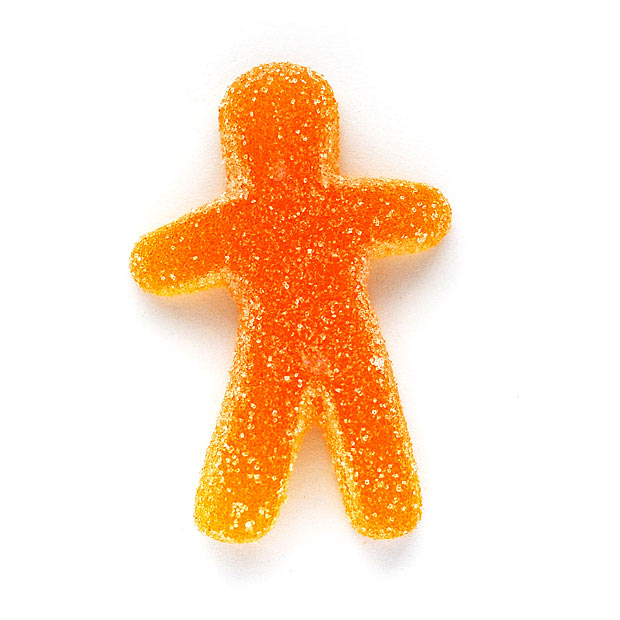
Flavor pairing is a controversial* topic which I’ve blogged about many times in the past. In my last post I suggested that predicted aroma similarity may be a more precise term, and below is an attempt to illustrate predicted aroma similarity (of type 2d according to this classification) by using a color analogy. Let me explain a little first: The letters describe different foods and colors are used to illustrate the sum of the key odorants. The normal situation is that foods A and K (which are perceived as different because they are far apart in the alphabet) also have different colors meaning that they share few or no key odorants. A and B however are close in the alphabet and have similar colors, hence they share key odorants. In some cases foods that we think are very different (A and Z) may turn out to share several key odorants (i.e. have similar colors). The “flavor pairing hypothesis” is a way of finding the “Z” based on predict aroma similarity. I think one reason why we cannot always find the “Z” is that (more…)
Tags: flavor pairing, food pairing, key odorant, molecular gastronomy, predicted aroma similarity
Posted in aroma similarity, flavor pairing, molecular gastronomy, TGRWT | 3 Comments »
Wednesday, December 22nd, 2010

Update: I’ve written up a short post about no-knead bread in Norwegian – Brød uten å kna – to accompany my appearance in the popular science program Schrödingers katt.
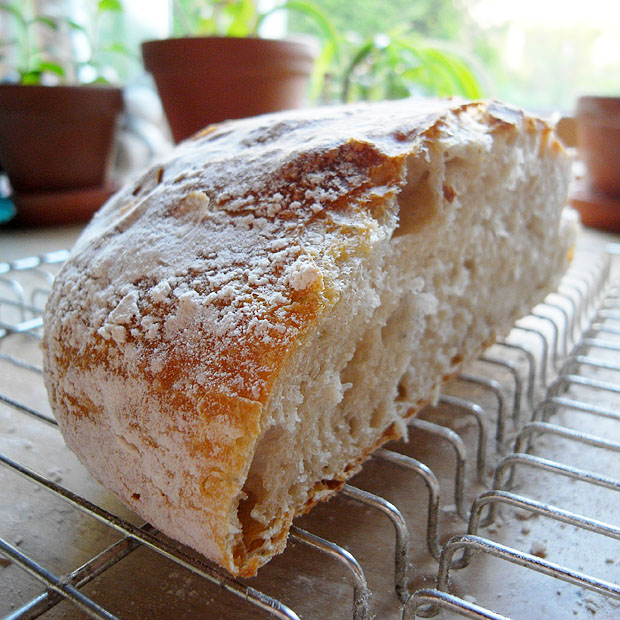
I know – since the NY Times article about Jim Lahey in 2006 the no-knead breads have been all over the internet, newspapers and now even appear in numerous books – this is really old news. But the no-knead breads are really tasty as well, so I hope you’ll forgive me! When I give popular science talks about chemistry in the kitchen the one thing I’m always asked about is the no-knead recipe I show, so I thought it was about time to publish a recipe. Surely, everyone can google it – but regrettably many (if not most?) recipes are given in non-metric, volume based units – even Jim Lahey’s original recipe. And for baking this is really a drawback because the density of flour depends so much on how tight you pack it. Oh yeah, and I will also try to explain why and how the no-knead bread works.
(more…)
Tags: Baker's percentage, baker's yeast, baking, bread, cast iron, Dutch oven, flour, hydration, Jim Lahey, molecular gastronomy, no-knead, Saccharomyces cerevisiae, volume measurement, weight measurement, yeast, yeast viability
Posted in equipment, molecular gastronomy, news articles, recipe, science | 26 Comments »
Tuesday, May 4th, 2010

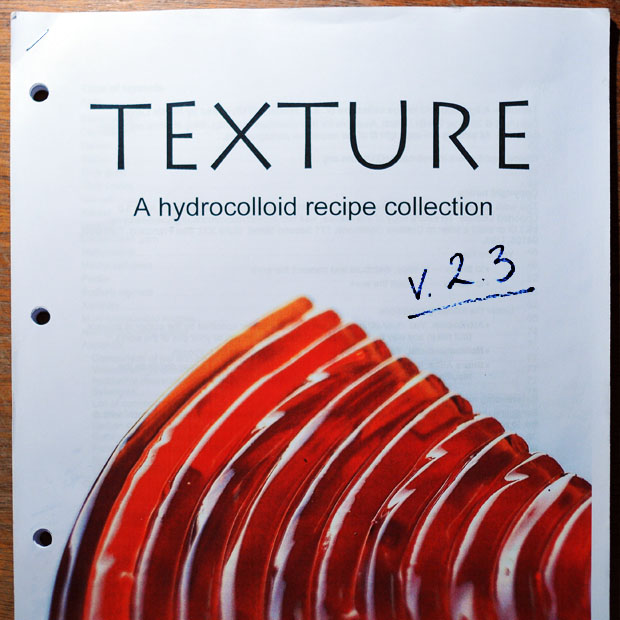
An updated version of “Texture – A hydrocolloid recipe collection” is now available for download (version 2.3). The longer I work on this, the more I realize that it will never really “finish” – there’s always more to add. And believe me – my todo list is still quite long (and I even have some feedback which I haven’t had time to incorporate yet). But I thought that since it’s more than a year since the last update, it was about time to share with you the things that have been changed. Major changes and updates include:
Pictures: This is the biggest visual change! Some recipes are now equipped with pictures which may give you an idea of the texture AND they indicate that the recipe has indeed been tested. But I need your help to add more pictures to the recipe collection (please follow the link to read more about how you can contribute pictures)! And of course - a big thanks to those of you who have already contributed your pictures!
Recipes: Recipes have been added and the total number is about 310 now. I’m getting a little more picky now with regards to which recipes I add. Ideally each new recipe added now should illustrate something new.
I should mention that I’m very grateful for feedback from readers and users of this recipe collection. Thank you very much with helping me improve the document! If you find typos, wish to comment on something or have suggestions on how to improve the collection, please do not hesitate to write me an email at webmaster (at) khymos (.) org or just write a comment in the field below.
Please head over to the download page for the links.
Tags: agar, alginate, bloom, bloom strength, bloom strength conversion, blue book, book, calcium chloride, calcium gluconate, calcium lactate, carbon dioxide, carob, carrageenan, cornstarch, directions, ebook, formula, gel, gelatin, gelatin filtration, gellan, gelling agents, guar gum, gum arabic, hydrocolloid, hydrocolloid recipe collection, ingredients, iSi, jelly, konjac, lecithin, locust bean gum, maltodextrin, methyl cellulose, mixology recipe, molecular cooking, molecular cuisine, molecular gastronomy, molecular mixology, molecular recipe, nitrous oxide, pdf, pectin, recipe, siphon, spherification, techniques, texture, thicken, thickener, update, whipper, xanthan
Posted in hydrocolloids, molecular gastronomy, recipe, tips & tricks | 6 Comments »
Monday, February 22nd, 2010

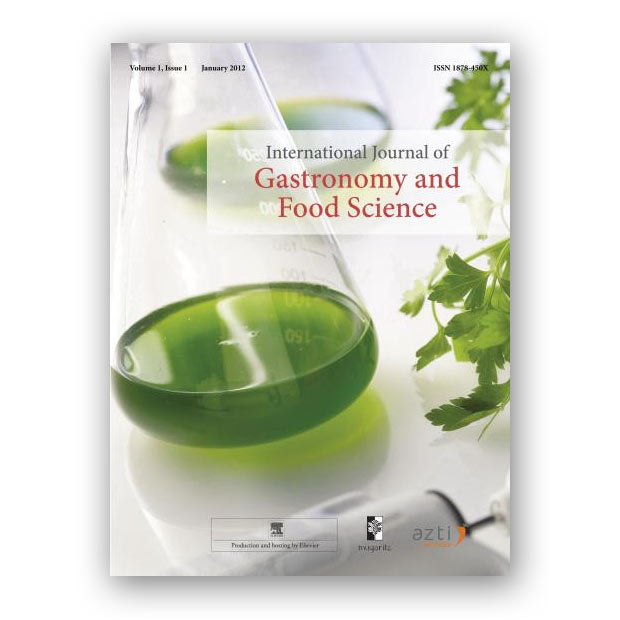
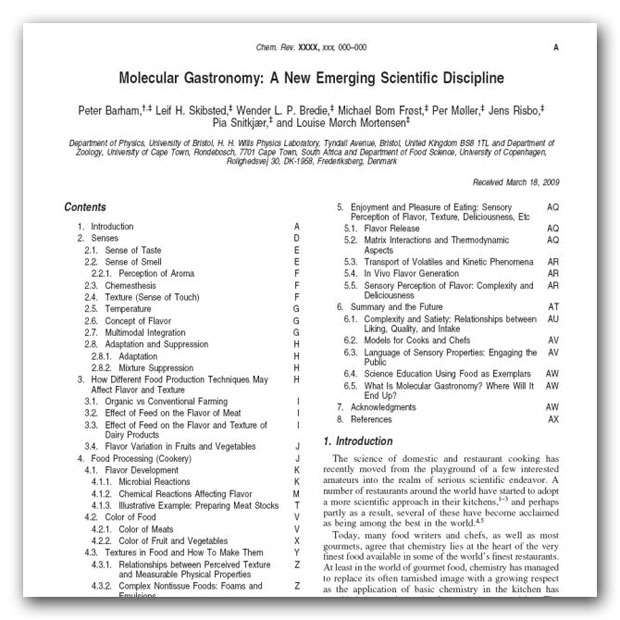
I just received an alert today about a major review article on molecular gastronomy: Molecular Gastronomy: A New Emerging Scientific Discipline (DOI: 10.1021/cr900105w) is a British-Danish joint publication by Peter Barham, Leif H. Skibsted, Wender L. P. Bredie, Michael Bom Frøst, Per Møller, Jens Risbo, Pia Snitkjær, and Louise Mørch Mortensen. Peter Barham is a professor in polymer physics at the University of Bristol, author of The science of cooking and probably doesn’t need further introduction. The Danes are all associated with the Department of Food Science at the University of Copenhagen and have a varied background in chemistry, food science, sensory science and psychology background. Check out the links to their individual profiles more info on projects and publications. Leif H. Skibsted and Michael Bom Frøst head several molecular gastronomy related projects. The Danish scientists also work closely together with Claus Meyer, chef at Meyers madhus and visiting professor at Copenhagen University, and Torsten Vildgaard, assistant head chef at Denmark’s gastronomic shining star Noma (which Claus Meyer started together with René Redzepi in 2004 – they were ranked 3rd in Restaurant magazines top 50 list for 2009, only surpassed by el Bulli and The Fat Duck).
Considering the impact factor of Chemical Reviews (ranked as a clear no. 1 among chemistry journals), this review will likely remain the review on molecular gastronomy for years to come – so you can just as well go ahead and read it. It’s got a whopping 53 pages and more than 350 references, and will be very useful for further studies and research. Oh, and the authors have opted for sponsored access, meaning that you can download the whole review for free!
–
(more…)
Tags: Claus Meyer, Leif Skibsted, molecular gastronomy, Noma, Peter Barham, review
Posted in academic articles, molecular gastronomy, science | 6 Comments »
Tuesday, November 10th, 2009
The University of Copenhagen wishes to appoint a professor with special responsibilities in Culinary Chemistry from 1 June 2010 or as soon as possible thereafter. As you may remember, Thorvald Pedersen was appointed professor of “Molecular gastronomy” some years ago for a limited time. One of the tasks then was to establish molecular gastronomy as a field of study at Copenhagen University (then KVL). As a result prof. Leif Horsfelt Skibsted and colleagues initiated several projects related to molecular gastronomy (only Danish text on site). Today Peter Barham is one of several affiliated professors at the Food Science department in Copenhagen, and over the last couple of years he’s been involved in activities which ultimately have lead to the creation of this new post.
I quote the following from the job description:
(more…)
Tags: Copenhagen, culinary chemistry, molecular gastronomy, Peter Barham, Thorvald Pedersen
Posted in molecular gastronomy | 1 Comment »
Tuesday, April 14th, 2009

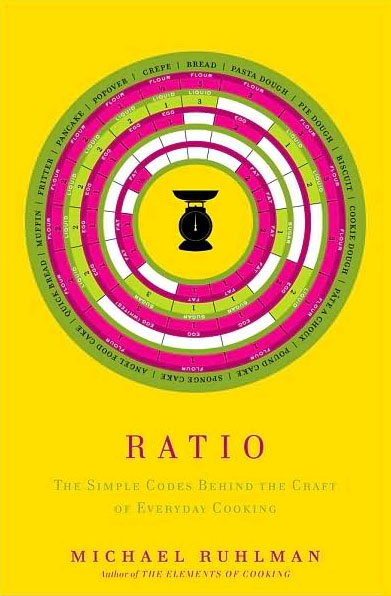
One of the more curious cookbooks I own is a German one entitled “Kochen und Backen nach Grundrezepten”
(Cooking and Baking with Base recipes). It was first written in 1932 and has been updated regularily ever since. Each section typically has a standard recipe which indicates the ratios to use followed by suggested variations (just like The improvisational cook). It also has nice summaries of dos and don’ts (just like BakeWise and CookWise), and what really makes the book stand out is that is so compact yet still comprehensive. It’s one of those books I actually use when cooking. Many other books have a little too much text – you have to read a lot to pick up the key points. Anyway – the reason I mention this is that as I read about the new “Ratio” book by Michael Ruhlman (MR books, MR blog), the German cookbook was the first book that came to my mind.
(more…)
Tags: Baker's percentage, baking, book, bread, cooking, cooking without a cookbook, egg, eggs, improvisation, luise haarer, michael ruhlman, molecular gastronomy, proportions, ratio, ratios, without recipe
Posted in books, molecular gastronomy, tips & tricks | 12 Comments »
Thursday, April 9th, 2009

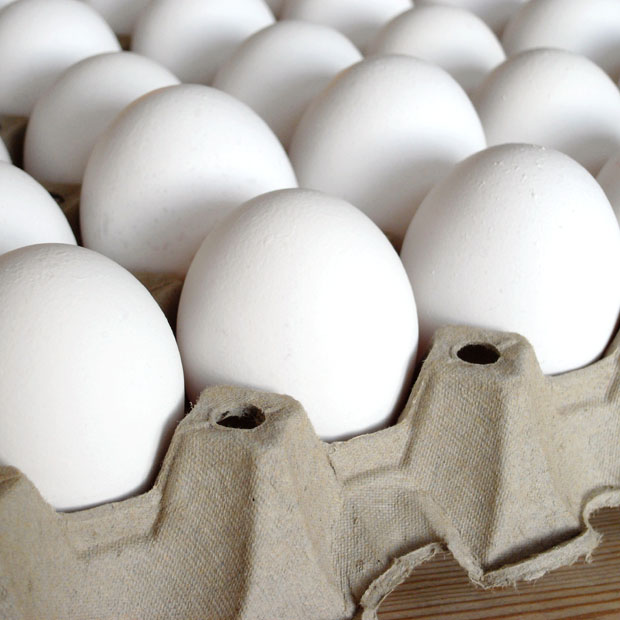
Many cookbooks suggest the following for boiling eggs: 3-6 min for a soft yolk, 6-8 min for a medium soft yolk and 8-10 min for a hard yolk. If you are satisfied with this, there is no need for you to continue reading. But if you’ve ever wondered whether the size of an egg has any impact on the cooking time you should read on. And if you search the ultimate soft boiled egg we share a common goal! From a scientific view point, a cooking time of approximately 3-8 minutes to obtain a soft yolk is not very precise. A number of important parameters remain unanswered: What size are the eggs? Are they taken from the fridge or are they room tempered? Are they put into cold or boiling water? And if using cold water – when should the timer be started? When the heat is turned on or when the water boils? And would the size of the pan, the amount of water and the power of the stove top matter?
(more…)
Tags: boiling eggs, Charles Williams, chemistry, cocotte, cooking, easter, egg, eggs, everyday science, formula, hard boiled, Jules Verne, maekbanseok gyeran, molecular gastronomy, onsen tamago, perfect eggs, Peter Barham, popular science, Robuchon, sauna, soft boiled, sous vide
Posted in experiments, molecular gastronomy | 48 Comments »
Friday, April 3rd, 2009

It’s time for a new round of “They go really well together”. For TGRWT #17 the challenge is to pair apple with rose, in particular Cox Orange or Elstar apples in combination with Damask (Rosa × damascena). The hosts this time are Malin and
Lisa, and Malin explains explains a litte about the chemistry behind the pairing both in English and Swedish. The deadline is May 8th so you get a little extra time for this round. By coincidence rose appears in TGRWT twice in a row, but I can assure you that the hosts of the March and April round did not know about each others choices when they were made. If you bought a bottle of rose water for last round I’m sure there’s a little left. You might even be lucky to get hold of fresh rose leaves now that summer is approaching. For inspiration on how rose combines with chicken, do check out the round up of TGRWT #16 over at Supernova Condensate.
Tags: apple, cox orange, damascena, damask, elstar, molecular gastronomy, rose
Posted in flavor pairing, molecular gastronomy, TGRWT | 4 Comments »
Thursday, April 2nd, 2009

I just discovered that The Atlantic features a blog by Grant Achatz of Alinea. Under the title “Back of the house” we get a peek “Inside the restlessly creative mind and kitchen of Grant Achatz” according to The Atlantic. Grant has so far reported from the Madrid Fusion in January (four posts) and in the latest post he describes how a visit to Japan has inspired him to explore manipulation of the environment at Alinea. Comments are allowed and Grant is actively involved in the discussions. Recommended reading!
Tags: alinea, blog, Grant Achatz, molecular gastronomy
Posted in molecular gastronomy, websites | 2 Comments »
Wednesday, April 1st, 2009

For a true multi modal experience I can imagine that restaurants and chefs who are into ORGASMIC, a new proposed acronym for science enabled cooking, will serve desserts accompanied by the orgasmatron (picture via BoingBoing).
The definition and use of the term molecular gastronomy has been a recurring topic here at Khymos. In my opinion no better name has been deviced, but that may actually change now. I just received an email which let me know that:
A group of influential international chefs have sequestered since yesterday in Alicia, Spain. Their mission has been to find a more palatable term for the dreaded “Molecular Gastronomy”. The consensus seems to be leaning towards ORGASMIC, an acronym for ORganoleptics, Gastronomy, Art, & Science Meet In Cuisine. A final vote on the proposed name change is scheduled for tomorrow morning, followed by the unveiling at a press conference.
Unfortunately information about which chefs have been invited to the event is scarce, so it’s difficult to judge about what impact this will have. Nevertheless, since the acronym includes so many of the different aspects related to molecular gastronomy I likely that the new name will eventually replace the term molecular gastronomy. I’ll update once I have more details!
Update: Fellow blogger Aiden Brooks is currently living in Barcelona and has many more details on this. It seems that there will actually be a new Erice meeting and that the current “secret session” is a run up to the next International Workshop on Molecular and Physical Gastronomy.
Tags: April's fool, definition, molecular gastronomy, science enabled cooking
Posted in fun with food, molecular gastronomy | 13 Comments »