Posts Tagged ‘pH’

Speeding up the Maillard reaction

Friday, September 26th, 2008


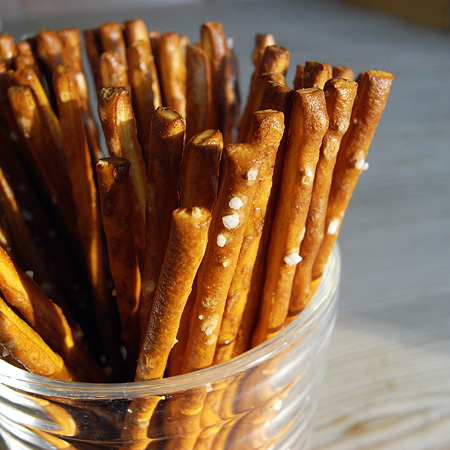
Ever thought about how pretzels and salt sticks get their nice brown color?

The products of the Maillard reaction provide tastes, smells and colors that are much desired and lend their charachteristics to a variety of foods. In this post I will focus on the factors that influence how fast the Maillard reaction proceeds. And more specifically I’ll give examples on how the Maillard reaction can be speeded up. This is not about fast food, nor is it about saving time. It’s more about controlling the browning reaction by speeding it up or slowing it down in order to get a desired end result.

The Maillard reaction is, to put it simple, a reaction between an amino acid and a sugar (there’s more on the chemistry at the end of the post). To speed it up you can do one or more of the following:

add protein (egg, milk)
reducing sugar (glucose, fructose or lactose)
remove water
increase temperature
pH

Chances are you have already utilized this in the kitchen without knowing. When eggs or milk are used for glazing, they act as a protein source for the Maillard reaction, giving a nice brown color. Milk also provides lactose which is a reducing sugar. You’ve probably also observed that temperature does influence browning. Water content is indirectly related to temperature - as long as there is water present, temperature will stay below 100 °C. But once the bread crust dries out the conditions are just right to get the Maillard reaction running.

The same principles are applied to microwaveable pies. The microwaves primarily interact with water and hence only bring the temperature up to the boiling point of water. In order to get sufficient Maillard productcs at these temperatures reducing sugars and amino acids are added to the crust (as exemplified in this patent where dextrose and whey solids are used). Not so surprisingly there is also a patent on how to avoid excessive browning in cookies which calls for addition of a polycarboxylic acid ester to lower pH and hence slow down the Maillard reaction.

Pretzels are an extreme example of how the Maillard reaction can be tweaked. Before baking the pretzels are brushed with lye, a dilute solution of sodium hydroxide, which is very basic. The high pH speeds up the bottleneck of the Maillard reaction (see end of post for details).


A pinch of baking soda can bring out a new taste dimension when browning onions

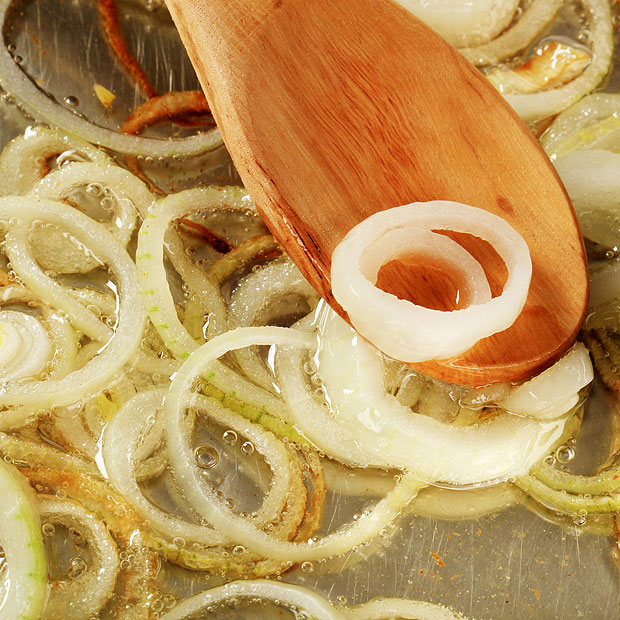
Another basic ingredient found in most kitchens is baking soda (sodium bicarbonate, NaHCO3). It’s used as a leavning agent which requires addition of an acid to function. Since it is a weak base, it can be used to increase the pH and hence the speed of the Maillard reaction, for instance when browning onions. This basic task, which isn’t always so easy after all, benefits greatly from a pinch of baking soda (and surprisingly it seems that this hasn’t been done before!). To illustrate this I’ve made a time lapse video of chopped onions being fried with and without baking soda. The frying took 11 min, but things are speeded up about 10x.

Samples taken throughout the experiment are shown in the picture below. Even after 4 min there is a visible difference. After 11 min, the small addition of baking soda has yielded onions which taste remarkably sweet with strong caramel notes, compared to the control which tastes like fried onions.

Another example of how baking soda is used to speed up the Maillard reaction is dulce de leche, a popular sauce/caramel candy in Latin America. It’s made by slowly boiling sweetened milk. Baking soda is not a required ingredient, but is often included. The baking soda gives dulce de leche a darker color and also contributes to the flavor.


Photo by audinou from flickr.com.

It should perhaps be added that baking soda is frequently used in Chinese cooking, for instance in tempura batters and marinades. Once there, the baking soda will certainly speed up the Maillard reaction, but it also affects the texture of meat - I’ll have to return to that topic later.

To round of this post I will briefly touch upon one of the reasons why pH influences the Maillard reaction. The first step involves a reaction between a reducing sugar (depicted as R(C=O)H) and an amino acid (depicted as R’NH2) followed by loss of water to yield a Schiff base. The Schiff base rearranges to the Amadori product (not shown). Of these first steps the formation of the Schiff base is the bottleneck (rate limiting step). The reactivity of the amino acid is influenced by the pH. A simplified reasoning goes like this: At low pH the amino group is protonated, yielding it less nucleophilic. At higher pH, the nitrogen becomes more nucleophilic and at very high pH the amino group can even be deprotonated. It should be noted that the fate of the Amadori product is also in large determined by pH and hence pH will affect more than just the rate, but this is far beyond the scope of this blog post.

Cherry jams with a twist

Sunday, August 3rd, 2008

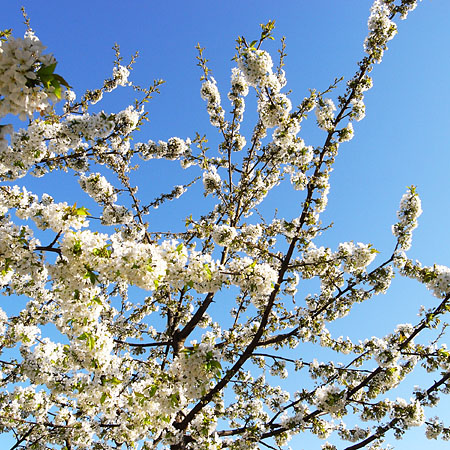
We have a small garden with a single tree. It’s a sweet cherry tree and this year must have been one of the best ever. In May it was overthrown with flowers. Last year I made some jam which came out OK, but the drawback with sweet cherries is that their taste doesn’t really compare with that of sour cherries. They’re good to eat, but not as good for cooking and jam as their sour cousins. The summer last year was quite wet and cold which could explain the fad taste, but this year however has been quite hot and the cherries grew darker and sweeter as summer proceeded.

I decided to give cherry jam another try. To improve the flavor even further, I was pondering on adding spices. My mom has previously added cloves and cinnamon to plums when making jam. The first place I looked was under cherries in the book “Culinary artistry”. Among the numerous suggestions for flavor pairings it was black pepper and lemon that caught my attention. Who would have thought? I made a small test batch and was quite pleased by the “bite” provided by pepper so I proceeded with a full batch. I used a pre-mixed gelling sugar from Danisco sugar (which contained sugar, pectin, a preservative and an acid), but you could use whatever pectin you have at hand. Just follow the instructions on the pack (more on the science further down).

Having added pepper and a little of the sugar to get an idea of how it would turn out, it almost felt as if ginger was already there so I added a little more to accentuate that. The other spices were added to round everything off. The pepper taste is quite noticeable if you eat the jam by itself, but on buttered bread or toast it’s really nice. I also suggest that you try it with different semi-soft and hard cheeses such as Emmentaler, Jarlsberg, Prästost, Parmesan or Pecorino. My wife thinks it’s a little to much pepper, but for me it’s just perfect. In German this jam would be known as a Herrenmarmelade (a gentleman’s jam). If you’re not very fond of pepper however it’s a good idea to start with half the amount of pepper.

Spicy cherry jam with pepper
3.7 kg depitted sweet cherries
7.0 g black pepper, ground
0.8 g cloves, ground
0.7 g ginger, ground
1.3 g anis seeds, ground
0.8 g star anis, ground
zest and juice from 1/2 lemon
2.2 kg gelling sugar (with pectin and preservative)

Place enough jars in a cold oven and heat to 120-130 °C to sterilize them (this is more convenient than in boiling water). Depit cherries (conveniently done with a cherry stoner) and cut in four (helps you discover those stones that eluded the cherry stoner). Add spices and bring to boil. Remove any remaining pits that float up to the surface. Pureé with immersion blender (hopefully you will not hear the sound of cherry pits being crushed at this stage). Add gelling sugar. Let boil and skim of foam. Fill the hot jars immediately. And remember - as all chemists know - hot glass looks just like cold glass! Use a canning funnel to avoid spilling jam on the sealing surface of the jars. Leave to cool for 10-15 minutes and then screw on lids. I usually wipe the inside of the lids with 40-60% alcohol and then screw them on tightly before the alcohol has evaporated. There’s more at the end regarding the procedure for closing the jars.

This way of canning is very convenient and the jam will keep for several years in closed jars if kept in a cool, dark and dry place. This is due to the high sugar concentration (sugar binds water, and unless water is available, molds won’t grow), the low pH and - if added - the presence of preservatives. A more tedious way is to sterilize the jars after filling by boiling in water. This is no doubt the best way to sterilize the jars, but for jams with a high sugar content and a low pH it’s a little overkill. The National Center for Home Food Preservation in the US has more information about this (but notice that there are different traditions - I wonder if there is a divide between Europe and North America?). There are also many books about this and good place to start would be the “Ball Blue Book of Preserving”, better known as BBB among home canners. If you chose this method you should probably use a little more pectin as the additional heating at low pH will degrade some of the pectin making the jam more runny.

Using black pepper in a jam worked really well so I googled this and found Clotilde’s recipe for a strawberry jam with pepper and peppermint. She got it from Christine Ferber, author of “Mes confitures: The Jams and Jellies of Christine Ferber” which has recipes organized according to season. As mint was also mentioned as a good flavor pairing for cherries in “Culinary artistry” I thought I’d give pepper and peppermint a try.

Cherry jam with pepper and peppermint
2.2 kg depitted sweet cherries
1.3 kg sugar
2.4 g fresh peppermint leaves
2.8 g black pepper, ground
zest and juice of 1/2 lemon
1 pack of Certo fruit pectin*

Depit cherries and cut in four. Add pepper and peppermint and bring to boil. Remove any remaining pits that float up to the surface. Pureé with immersion blender. Add pectin and stir until dissolved. Add sugar. Let boil and skim off foam. Sterilize and fill jars as in the previous recipe.

[ * The Certo pack weighs 70 g and contains sugar (for easier dispersion of the pectin), citrus pectin, citric acid to get the right pH for gelling and a preservative (ascorbic acid). ]

This jam was dominated by peppermint and the pepper could barely be noticed. I found it very refreshing and there is a surprise element as the red color does not suggest the presence of peppermint. Apart from the obvious use as a bread spread, I can imagine that this jam would be very nice with roasted meat, especially lamb, reindeer, elk and perhaps also wild game.

Having experimented with different spices and peppermint, my wife asked me to also make a batch of plain cherry jam which I happily did. But next year I would like to try making cherry jam with red wine!

As you can imagine, I couldn’t do all this without offering the chemistry behind some thoughts. Pectin chemistry is quite complicated though and there are several types available (low methoxyl, high methoxyl and amidated - so far I’ve only included the two first in “Texture - A hydrocolloid recipe collection”). Commercial packs of pectin for home use do normally not specify which type of pectin they contain, but I assume that it is the high methoxyl which gels in the presence of sugar and at low pH (as opposed to the low methoxyl which requires calcium ions to gel). The easiest is probably to follow the instructions that come with the pack you chose. Always add pectin before you add sugar (unless you premix them). The reason for this is that the gelling of high methoxyl pectins is promoted by sugar. If you add sugar before pectin, it will be very diffult to get the pectin properly dispersed and dissolved (it can be done with an immersion blender though - I’ve tried that once). Ready to use pectin is often pre-mixed with an acid to get the pH below 3.5 which promotes gelling. Citric acid is often used, and plain lemon juice will also do the job. Lowering the pH is especially important when using ripe or over ripe fruit as these can be less acidic and also contain less pectin if we are talking about pectin containing fruit. After the pectin and sugar have been added, the jam shouldn’t boil for more than a couple of minutes as pectin is not very heat stable.

There are also a couple of claims found in jam recipes which I have been wondering about:

Skimming: Almost all recipes I have seen for jams call for rapid skimming of the foam which formes when the jam mixture boils. One explanation I’ve seen is that this is done to prevent growth of mold, as these apparently grow more easily in the foam. There are certainly airborn molds, but the bubbles in the foam come from the jam as it boils, so it’s been very hot and presumably sterilized. So I’m simply wondering if the whole skimming is about esthetics - which is is still a good enough reason to me (but then I wish the recipes could state that!).

Turning jars upside-down: One thing that has puzzled me for a time is why recipes recommend that the jars should be turned upside-down. I’ve googled and checked several books and have come up with a couple of explanations (but most recipes only state that it should or shouldn’t (!) be done, without giving any reason). The fun thing is that the suggested time for how long the jars should remain turned upside-down varies from 2 minutes to several hours when the jam is cool and has set.

  • One site claims it is done to prevent larger pieces of fruit from settling to the bottom. This does make sense, and in that case there is no reason to do it if the fruit has been puréed.
  • A blogpost commenter suggests that turning the jars upside-down for 5 minutes makes sure the inside of the lid gets sterilized too. The temperature of the jam at this time is probably somewhere around 95 °C, so it does seem reasonable that it might kill some molds residing on the lid. I’d give this a thumbs up. Any microbiologist who could confirm this?
  • Personally I have speculated whether turning the jars upside-down would allow water (or jam to be precise) to be drawn into the seal by capillary action and that this helps to make a perfect seal, but several sites emphasize that this should not be done to prevent the seal from being broken (these sites assume that a canner has been used - i.e. sterilizing the filled jars with lids in boiling water for 5 to 10 min). I’m not sure, but I wonder if there is a difference here between screw caps and glass lids with rubber bands?
  • A last reason to turn jars upside down would be to prevent the water evaporating from the hot jam to condensate on the lid. If the jars are left to cool upside-down for 10-15 minutes, but turned back before the jam sets this will prevent water to condense on the lid and drip back to the surface of the jam. This water could potentially mean better conditions for growth of molds. This theory is also supported by the suggestion found in old cookbooks where the jars are left to cool completely without lids to let the surface dry and form a skin, and then covered with a filter paper dipped in alcohol before tying them up with pergament paper and string.

The conclusion so far regarding turning the jars upside-down can be summed up as follows. You should chose of the three methods:

  • Cover with lid immediately and turn upside-down until cool enough to handle (~40-50 °C). Then return to upright position. This will prevent condensation of water on the lid, it might help create a better seal and it could possibly knock out some molds on the lid. The jam however will most likely not have set yet.
  • As above, with the only difference that you leave the jars upside-down until cool and set. This means that the air pocket will not be below the lid but at the bottom of the glass when turned back to the upright position.
  • Allow the jam too cool without lids until a skin has formed and the jars are cool enough to handle. This prevents condensation of water on the lid. Wipe the inside of the lids with the highest percentage alcohol available (but do NOT use denatured alcohol!) - typically it would be 40% or 60% - and screw on the lid before the alcohol evaporates. The skin formed will be less suceptible to growth of mold because there is less water present and because of the presence of alcohol.