
Posts Tagged ‘science’

The Flemish Primitives 2010 (part 1)

Tuesday, February 9th, 2010

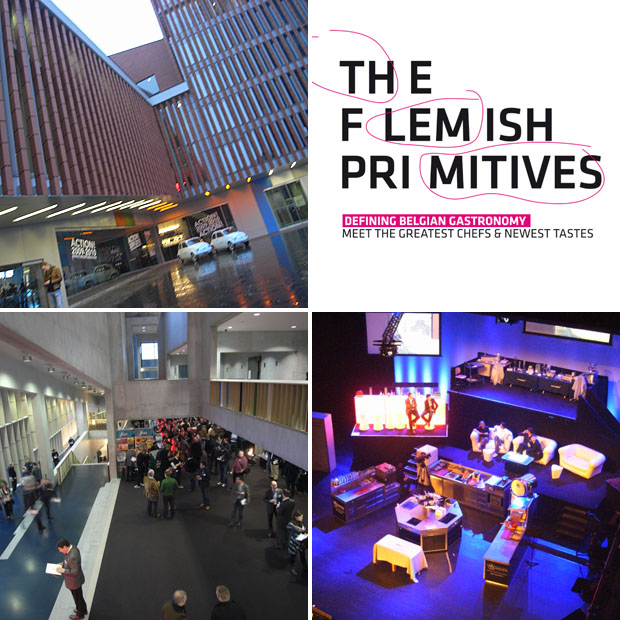
Again I was lukcy that all the practical details worked out so I could attend this year’s Flemish Primitives in Brugge. For some one who’s not attended, it’s not so easy to grasp the concept and ideas behind The Flemish Primitives (TFP). And I admit, even though I’ve been there twice it’s not so easy to convey it in a short way. First of all the name is rather cryptic (unless you’re into art) as it refers to early Netherlandish painting. The link to food is described as follows by the organizers of the event (my highlights):

In the 15th and 16th century, ’The Flemish Primitives’ were masters in combining their talent with new techniques. Techniques they developed by interacting with other disciplines like manuscripting, sculpting, etc. This way of working changed the painting techniques in all of Western Europe forever. The event ‘The Flemish Primitives’ wants to continue in the same spirit. Respect for food products and beverages, the knowledge of the classic cooking techniques combined with a stimulation of new techniques and creativity. By promoting interaction between scientists, the world’s most famous chefs and artists, the event wants to deliver a creative boost for the food industry and gastronomy in Belgium and the world.

Considering last year’s sucess it was no big surprise that this year’s event was sold out (and the foyer of the Concertgebouw was equally full in the coffee breaks). And with the memories from last year I arrived in Brugge with great expectations. One main difference from previous years was that the scientific parts were much better integrated throughout the day. Scientists were on stage alongside the chefs, explaining their work. Also, contrary to last year’s back stage kitchen, they had now moved the kitchen onto the stage, flanked by a bar, some sofas and laboratory mezzanine. A good decision!
(more…)

The Experimental Cuisine Collective

Friday, April 27th, 2007

The Scientist in an interview with Hervé This reports that:

Recently, New York University Assistant Professor of Chemistry Kent Kirshenbaum teamed up with chef Will Goldfarb to bring experts together to discuss the intersection of science, cooking and eating. Often they are talking about the same thing, but with different vocabulary, says Kirshenbaum, who specializes in the architecture of polymer chains. “I think of these as reagents. He thinks of them as ingredients.”

The initiative of Kent Kirshenbaum and Will Goldfarb resulted in The Experimental Cuisine Collective which was officially launched on April 11th with a workshop entitled “Experimental Cuisine: Science, Society, and Food”.

experimental-cuisine-collective.jpg

Their mission statement is an elaboration and expansion of Hervé This’ original and revised definitions of molecular gastronomy (ie. not excluding the technological and political aspects of molecular gastronomy, and including the social context):

  • Provide a venue for scientists, food academics, culinary and pastry professionals, journalists, and the dining public to gather and exchange knowledge.
  • Contribute to a rigorous scientific understanding of the physical basis for cooking processes.
  • Enhance understanding of the social contexts for cooking and the societal ramifications of new food technologies.
  • Accelerate the discovery of scientific and experiment-based approaches to innovative culinary practices, unorthodox flavors, and new dining traditions.
  • Provide technical expertise for chefs.
  • Advocate for a balance between modern cuisine while maintaining a healthful and sustainable approach to food preparation.
  • Disseminate knowledge about human diet and health; inform the public regarding the molecular basis of nutrition and the chemical constituents of food; and foster research that will improve people’s ability to obtain and choose healthful foods on a local and global level.
  • Introduce curricula on food and cooking as an approach for generating enthusiasm among school children for studying the physical sciences.
  • Celebrate taste.
  • Their mission statement sums up many of my interests related to molecular gastronomy and popular food science and I look forward to their contributions! And I really hope they will publish their results and findings on the web.