I believe most chemists are familiar with the “periodic videos” from the University of Nottingham, covering all the known chemical elements. The series features professor Martyn Poliakoff who’s grey hair is really worthy of a professor! They have now covered the complete periodic table of elements, and have even started to update some of their previously posted videos. There are also thematic videos as well as videos covering specific molecules appearing now. As a chemist I think the videos are great fun to watch since they show a number of exotic experiments I’ve never seen before combined with plenty of nice-to-know facts. I certainly recommend all these videos (for an overview, check out their website), but the reason I chose to blog about this is that I was delighted to find a number of more or less food related videos! These are definitely not going to make you a better cook. But some of them are quite amusing to watch, and you may even learn some chemistry as you go. But most of the food related videos are really just for fun
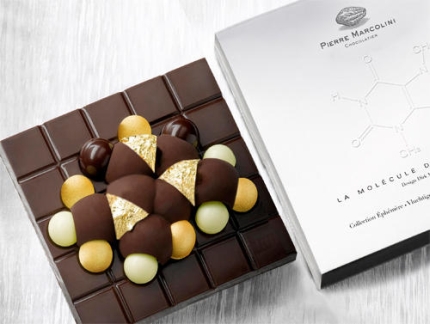
Here at Khymos I aim to cover things related to food and chemistry, and as I stumbled over a periodic table of cupcakes (with clickable “elements” linked to recipes) I couldn’t resist to dig a little deeper. And look what I found! The periodic table of elements is iconic, but the periodic table has also become an organizing metaphor for all sorts of things, including food. The Internet database of periodic tables holds more periodic tables than you could ever dream of, but it’s not complete – at least not with regards to food. Here are the food related periodic tables that I’ve been able to find. Fun? Yes! Useful? No, not really At the end of the post I’ve also included examples of how the real periodic table of elements can be illustrated in a more or less edible fashion. All images are linked to the page where I found them. Are you aware of other periodic tables of food? Please let me know and I’ll include them in this post. (more…)
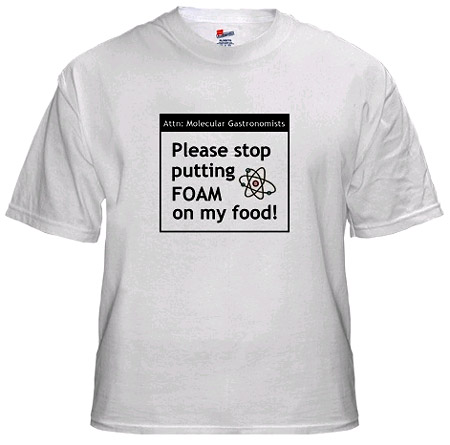
When many people hear molecular gastronomy, they think of culinary foams, originally introduced by Ferran Adria at El Bulli. In case you’re fed up with the foams, here’s a T-shirt to express your feelings:
Personally, I can’t even say I’ve taste any of these foams yet… Guess I’ll wait a little with the T-shirt then
An object does not need to be superconducting to levitate. Normal things, even humans, can do it as well, if placed in a strong magnetic field. Although the majority of ordinary materials, such as wood or plastic, seem to be non-magnetic, they, too, expel a very small portion (0.00001) of an applied magnetic field, i.e. exhibit very weak diamagnetism. The molecular magnetism is very weak (millions times weaker than ferromagnetism) and usually remains unnoticed in everyday life, thereby producing the wrong impression that materials around us are mainly nonmagnetic. But they are all magnetic. It is just that magnetic fields required to levitate all these “nonmagnetic” materials have to be approximately 100 times larger than for the case of, say, superconductors. This experiment was conducted at the Nijmegen High Field Magnet Laboratory.
This is slightly off-topic, but take a look at these two videos on mechanical gastronomy. First one is a lego-machine that opens a bottle of beer. The second one is a Rube Goldberg (homepage, Wikipedia) machine that pours a beer (jump to 2:10 if you want to skip the intro and just watch the action). Rube Goldberg described his cartoons as “symbols of man’s capacity for exerting maximum effort to accomplish minimal results”, but has since given name to complicated machines that perform simple tasks!
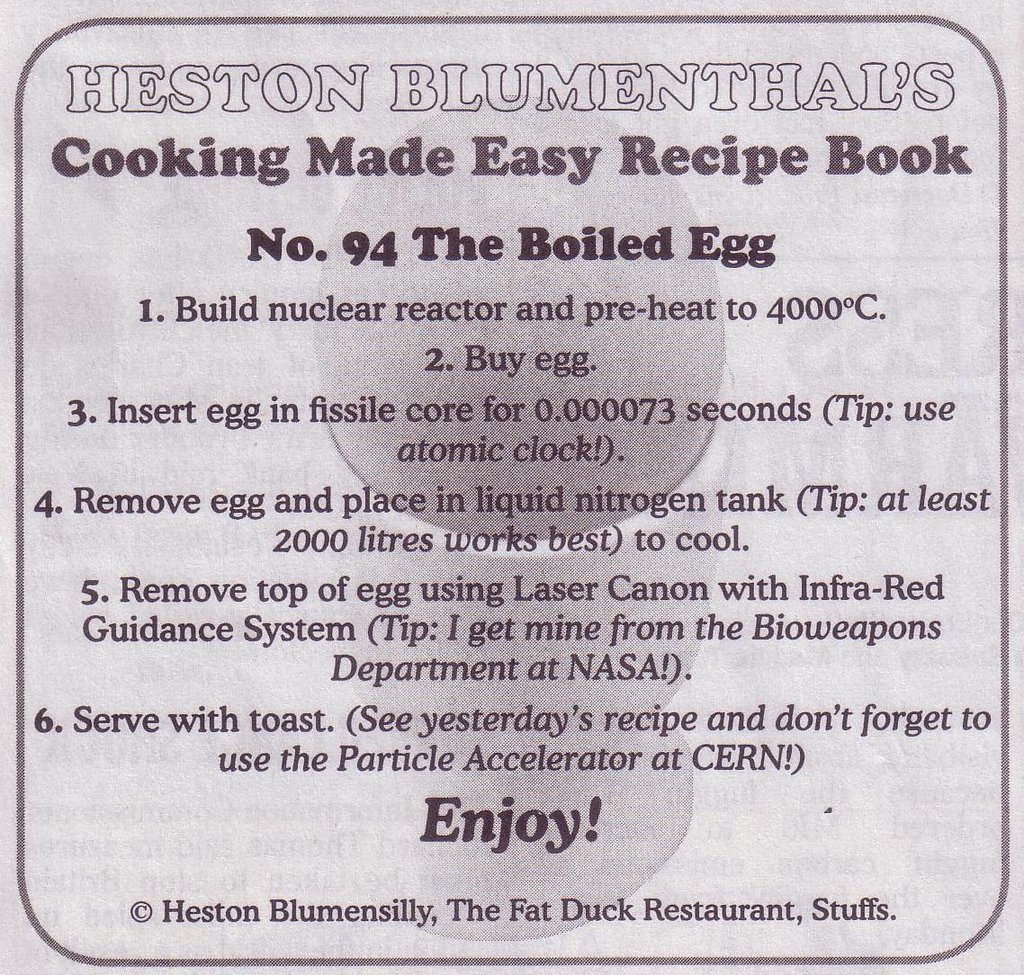
Heston Blumenthal was recently featured in “Private Eye”, a british satire magazine (found via Aidan Brooks). They included the following recipe for boiled eggs:
A further discussion of boiled eggs from the perspective of molecular gastronomy is found here.
Did you read about how I make my own mineral water at home in Wired's November issue? Then you might be interested in Mineral waters à la carte (where you find the latest version of the mineral water calculator) as well as my original post on DIY mineral water.
I'm back. Sorry for the long break :) 4 months ago
RT @Herve_This: Molecular cuisine and the same with other names (modernist, etc.) is for grand fathers. Let's move to Note by Note Cuisine ! 7 months ago