Posts Tagged ‘the flemish primitives’

TFP2010: Gadgets (part 5)

Saturday, March 13th, 2010


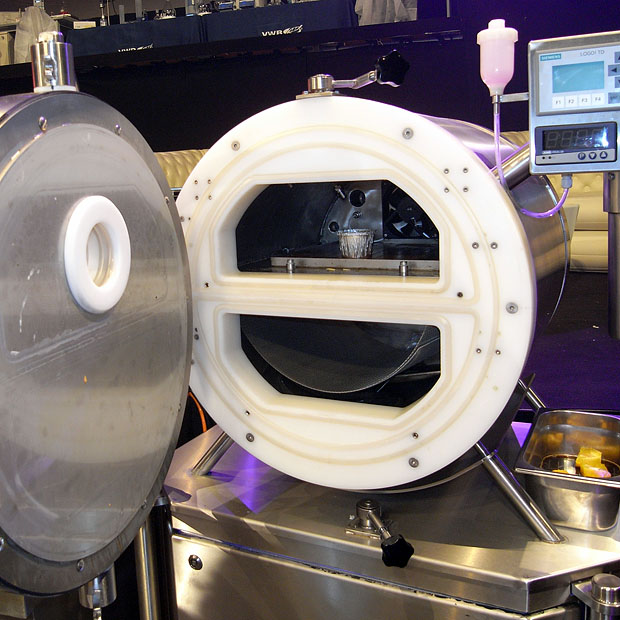
Crycotuv – a combined vacuum chamber and super fast freezer with internal spray nozzle.

If I were to name a topic for this year’s Flemish Primitives event I guess gadgets would be it. I’ve already covered the high pressure processing in a previous post. Regrettably we were only shown pictures and movies of this machine (it is to large/complex to be brought on stage) but there was much more that would qualify for a post focusing on some of the gadgets presented.

Crycotuv
The most obscure machine in my opinion was the Crycotuv – a vacuum chamber which could be cooled to any desired temperature between -150 and 0 °C in seconds/minutes. (more…)

TFP 2010: Interview with Bernard Lahousse (part 4)

Sunday, March 7th, 2010


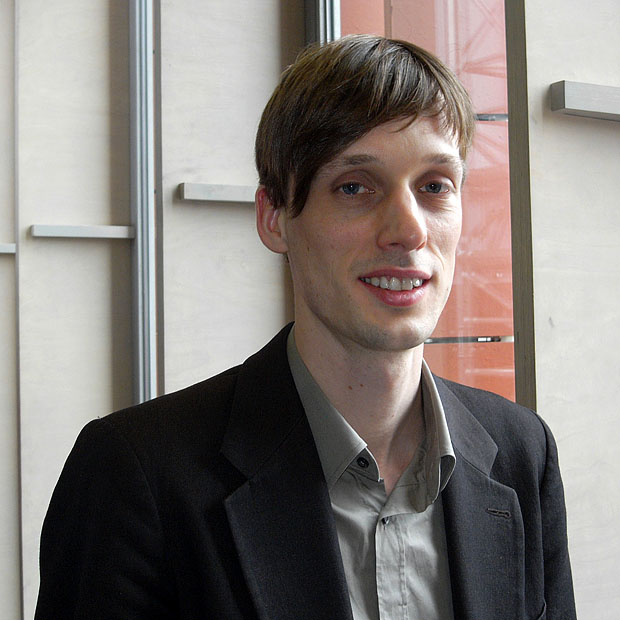
Bernard Lahousse, project manager of The Flemish Primitives.

I’ve written a couple of posts about The Flemish Primitives 2010 event (and there are more to come), but I also wanted to do an interview with Bernard Lahousse, the project manager of the event. Bernard first contacted me back in 2006 and we met at the EuroFoodChem conference in Paris in 2007. Those who’ve followed Khymos for a while may remember pointers to the “Food for design” blog and the foodpairing website which Bernard has set up.

ML: It seems you have always had an interest for things in the cross section of science and art? When we first came in contact you were writing the “Food for design” blog which covered gastronomy, science and design – what happend to it?

BL: Indeed, I’ve always been interested in the cross-section between different disciplines. Not only science-art or science-gastronomy, but many more. My belief is that the interesting stuff is happening where people with different background meet. As I lack time (and also Lieven), we made a choice to put Food for design on hold and concentrate on other topics. For me that’s foodpairing and my company. For Lieven it is his PhD.

ML: Could you briefly describe your educational background and how you ended up as a project manager for The Flemish Primitives?
(more…)

TFP2010: More inspiration from Asia (part 3)

Wednesday, February 24th, 2010


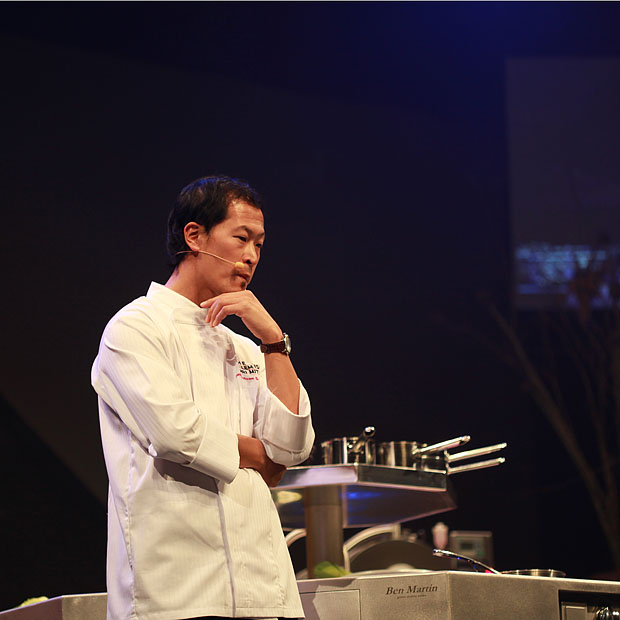
Sang Hoon Degeimbre (chef at L’Air du Temps) on stage at TFP2010. Photo by Piet De Kersgieter.

As mentioned in my previous post on The Flemish Primitives 2010 (TFP2010) two chefs had taken their inspiration from Asia. Peter Goossens had come across high pressure processing during a study trip to Japan, and had developed this further in cooperation with Stefan Töpfl. Korean born Sang Hoon Degeimbre (of L’Air du Temps) on the other hand had returned to his roots to study kimchi, the ubiquitious Korean staple food. It is a pickled dish made of vegetables with various seasonings, and it is a very common side dish in Korea. In fact, it’s so common that Koreans say “kimchi” when being photographed, just like we say “cheese” in English.
(more…)

TFP 2010: Inspiration from Asia (part 2)

Friday, February 19th, 2010


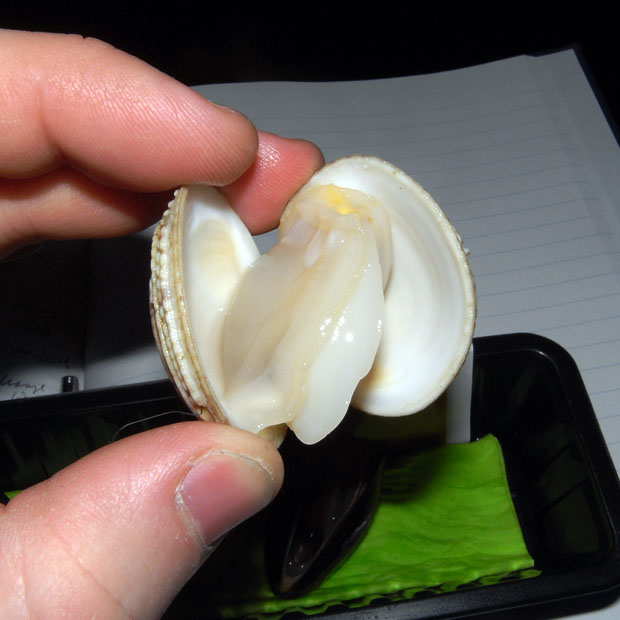
Shellfish after treatment for 2 min @ 6000 bar. Fresh, juicy and tasty!

The available litterature in English (including blogs) on popular food science focuses mainly on Western cooking, although the academic litterature on Asian foods is catching up quickly. Although widespread and apparently “well known”, Asian cooking is still largely being referred to in broad categories such as Chinese, Indian etc. Having spent 10 years of my childhood in Asia I’ve always had the feeling that this wasn’t quite right, and I do indeed look forward to learn more about the science aspects of Asian food in the years and decades to come. In one of the breakout sessions (more about those in a separate post) Alok Nandi made a point that Indian cuisine is as diverse as the European cuisine. With this background it is interesting to note that two of the chefs presenting at The Flemish Primitives 2010 had taken their inspiration from Asia.
(more…)

The Flemish Primitives 2010 (part 1)

Tuesday, February 9th, 2010

Again I was lukcy that all the practical details worked out so I could attend this year’s Flemish Primitives in Brugge. For some one who’s not attended, it’s not so easy to grasp the concept and ideas behind The Flemish Primitives (TFP). And I admit, even though I’ve been there twice it’s not so easy to convey it in a short way. First of all the name is rather cryptic (unless you’re into art) as it refers to early Netherlandish painting. The link to food is described as follows by the organizers of the event (my highlights):

In the 15th and 16th century, ’The Flemish Primitives’ were masters in combining their talent with new techniques. Techniques they developed by interacting with other disciplines like manuscripting, sculpting, etc. This way of working changed the painting techniques in all of Western Europe forever. The event ‘The Flemish Primitives’ wants to continue in the same spirit. Respect for food products and beverages, the knowledge of the classic cooking techniques combined with a stimulation of new techniques and creativity. By promoting interaction between scientists, the world’s most famous chefs and artists, the event wants to deliver a creative boost for the food industry and gastronomy in Belgium and the world.

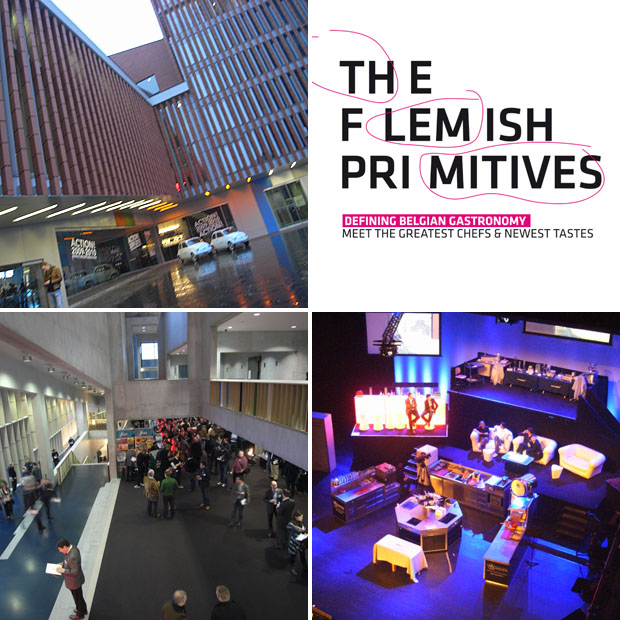
Considering last year’s sucess it was no big surprise that this year’s event was sold out (and the foyer of the Concertgebouw was equally full in the coffee breaks). And with the memories from last year I arrived in Brugge with great expectations. One main difference from previous years was that the scientific parts were much better integrated throughout the day. Scientists were on stage alongside the chefs, explaining their work. Also, contrary to last year’s back stage kitchen, they had now moved the kitchen onto the stage, flanked by a bar, some sofas and laboratory mezzanine. A good decision!
(more…)

The Flemish Primitives 2010

Sunday, January 10th, 2010

tfp-2010

If you’ve followed my blog more than a year you probably remember that I took part in The Flemish Primitives in Brugge in January 2009. The visit resulted in four blog posts (just in case you wonder what it’s all about): The Flemish Primitives: A travel report (part 1), Chocolate surprise (part 2), Heston Blumenthal (part 3) and Glowing lollipops (part 4). It was a day packed with experiences and interesting meetings. But let us not ponder more with 2009 – Bernard Lahousse has let me know that the next event is just around the corner. In fact it’s only a couple of weeks away. Like last year the venue is Concertgebouw Brugge and the date is February 8th, 2010 (Yes – you have to hurry up with your reservations!).

As for the program, I quote from the invitation folder (my highlights):
(more…)

The Flemish Primitives: Glowing lollipops (part 4)

Wednesday, February 11th, 2009

Bruce Bryan demonstrated a glowing cocktail drink (top left), and tempted us with fluorescent cake frosting (top right). The chocolate surprise boxes included a lollipop (bottom left) and I was quite busy sucking the lollipop, listening to the translation of the Belgian/French/Spanish contributions, taking notes and photographing at the same time (bottom right).

The chocolate surprise box was one of the highlights at The Flemish Primitives that I’ve blogged about three times already. As I promised you in the last post I’d come back to the lollipop that was included in the box. Between chocolates number 2 and 3 Bruce Bryan entered the stage. The lights went off, we were instructed to suck intensely on the lollipos and then – when I took the lollipop out of my mouth it was glowing! (more…)

The Flemish Primitives: Heston Blumenthal (part 3)

Friday, January 16th, 2009


Heston Blumenthal welcomed on stage by Gene Bervoets

To the music of Queen’s “We will rock you” Heston Blumenthal (HB) entered the stage, welcomed by Gene Bervoets (GB) and Bernard Lahousse (BL). Heston started of by telling about his childhood and how Britain in the 60’s was not the place to go for food. You could only get olive oil at the chemist’s because it was not used for consumption! Heston basically grew up without experiencing anything related to gastronomy. However this all changed at the age of 15 when he went to France for a holiday with his familiy. A visit to a Michelin restaurant was to become a decisive moment for Heston. He described it as if it were yeasterday – the sound of the waiters walking on gravels, the lavender smell, how they carved legs of lamb – the whole atmosphere. It was also the first time ever he tasted oysters. He felt a little like Alice in wonderland.
(more…)

Food pairing seminar update

Friday, November 7th, 2008


The food pairing seminar is named “The Flemish Primitives” after the 15th and 16th century artists who were combining talent with new techniques.

I’ve blogged about the upcoming food pairing seminar in Belgium on January 5th previously, but there are a couple of important additions to the programme: Albert Adrià (El Bulli, Spain) and Ben Roche (Moto, USA) will also participate. Given the extensive list of other chefs and notabilities within the realms of molecular gastronomy and science inspired cooking that will be present, this is definitely the place to be on January 5th. Registering is online, and the early bid registration fee is €245 (rises to €295 from November 16th). More information is available from the website (also in html format).

Food pairing seminar in Belgium

Tuesday, September 30th, 2008

Bernard Lahousse, director of CREAX foods, creator of the Foodpairing website (which I’ve blogged about previously) and blogger behind Food for design invites to an international food pairing seminar in Belgium on January 5th, 2009. The concept of the event is that participating companies (sponsors) each have chosen a food ingredient. The flavor profile of the foods is analyzed at the University of Leuven and based on this data a list of pairings is suggested based on the database underlying the Foodpairing website which currently includes 360 food products. These lists are then given to 11 invited chefs who are given the task of inventing new dishes based on the pairings. These dishes will be presented at the event, accompanied by a wine which will also be selected based on flavor analysis. Hoping for more than 1000 visiting food professionals this might be the largest molecular gastronomy inspired event so far in history :)

In addition to presentations of the new dishes there will be keynotes by Peter Barham (professor at the U. of Bristol, author of The Science of Cooking) and Heston Blumenthal (founder of The Fat Duck, author of The Big Fat Duck Cookbook). The program also includes masterclasses by Andrew Dornenburg and Karen Page (authors of Culinary Artistry, What to Drink with What You Eat and The Flavor Bible) on food pairing based on historical and contemporary recipes, and by Lorenzo Cerretani (professor at U. of Bologna) who will talk about food pairing and olive oil.

So if you have an interest in food pairing and can afford the trip and the registration fee of €245 (which includes a seminar book with all the recipes) this is certainly an event you wouldn’t want to miss! Luckily, for those who will not be able to participate, the recipes and food pairings from the event will be published on the Foodpairing website.

As a sidenote I should mention that the “They go really well together” (TGRWT) blogging event has let bloggers and foodies explore various food pairings in 10 rounds which has resulted in about 100 different dishes in total. Links to the round-ups can be found on the right sidebar on the front page of the Khymos blog. And – drumroll please – the next round of TGRWT will soon be announced, so stay tuned!

Those interested in the scientific considerations behind flavor pairings can find more info on this in previous posts. The topic however is controversial as the comments to this posts shows.