

After giving a presentation about molecular gastronomy I was asked if I had ever heard about a chocolate cake baked with sauerkraut. I admitted that this was new for me, but that I would be very interested in the recipe. Could it be that this is a new flavor/flavour pairing? Remember, the hypothesis is: if the major volatile molecules of two foods are the same, they might taste (and smell) nice when eaten together. Perhaps there’s some one out there with access to a headspace gas chromatographer that could check this out? Or perhaps someone who has access to the Volatile Compounds in Foods database could do a quick search? If you’re unfamilier with such flavor pairings, another nice pairing with chocolate is the one with caramelized cauliflower and chocolate jelly.
I did get the recipe and it turned out that it was from a cookbook called “Food that really schmecks” by Edna Staebler. The book is a collection of recipes from the Mennonite community in Ontario. Many Mennonites came from Germany, hence the word “schmecks” in the title which is German (zu schmecken = to taste). According to the cookbook, leftover sauerkraut makes the cake moist and delicious – which I can certainly confirm! And the strange things is you can’t really taste the sauerkraut. Here is the recipe (the way I made it):
Sauerkraut chocolate cake
170 g butter (ca. 3/4 cup)
300 g white sugar – less than the 1 1/2 cups in the original recipe
3 large eggs
1 teaspoon vanilla (either essence or vanilla flavored sugar)
2.5 dL water (= 1 cup)
6 dL flour (= 2 1/2 cup)
1.3 dL unsweetened cocoa (= 1/2 cup)
1 teaspoon baking powder
1 teaspoon soda (sauerkraut is sour, therefore the recipe calls for soda!)
1/2 teaspoon salt
330 g drained sauerkraut (1 1/2 cup) – more than in the original recipe
Mix butter and sugar. Add eggs, water and dry ingredients. Stir in the sauerkraut and pour batter into greased pan. Bake at 350 F/180 C for 30-50 minutes.
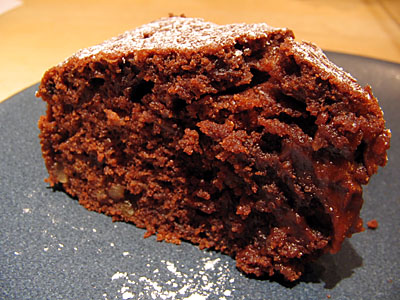
The cake was a little too moist in the center when I made it and could have needed a couple more minutes in the oven. Make sure you check if it’s all set by inserting a wooden match or a knitting pin in the center of the cake!
Interestingly, the cookbook “Food that really schmecks” was recently presented in the blog Cream Puffs in Venice, with the following statement attached: “There is no haute cuisine or molecular gastronomy to be found here”. But chocolate and sauerkraut might turn out to be another flavor pairing based on sound chemical reasoning.
Update: Read the followup on this post with more about chocolate and caraway (the main spice in sauerkraut)
Another nice pairing: chocolate chantilly (Hervé This) and smoked eel.
Did you use original German sauerkraut or plain Scandinavian pickled cabbage (surkål)? This receipe surely makes an alternative for a Sunday happening i near future.
I used the Scandinavian type (which is quite sweet), so I reduced the amount of sugar. But I’m convinced that the original German sauerkraut would be perfect too – probably even better.
This sounds like a great candidate for solid phase micro-extraction (SPME) and GC/MS. The SPME fiber gets exposed to the headspace above the kraut (or whatever) in a sealed vial for about 20 minutes. Desorption in the GC inlet at about 300°C and 20 minutes later… ding….a profile of any volatile organic emanating from the kraut.
It seems delicious!!!
Both Sauerkraut and chocolate are fermented products, so it is not surprising that they would have common flavour components (volatile fatty acids). So sausage,… should also fit?
Would volatile fatty acids also be the reason behind the classic combination of game and chocolate?
Andy – congratulations with your new blog! I have added your suggested flavor pairings to my list.
Chemgeek – do you have access to a SPME with a GC-MS attached? If so, let me know if you try to analyze chocolate and sauerkraut (or caraway).
food for design/Bernard – do you have any idea which volatile compounds are in common for fermented products? Are there are flavour pairings based on fermented products?
Note that Norwegian/scandinavian sauerkraut is in fact NOT fermented cabbage like the German kind, but pickled (and cooked/simmered and canned/preserved) using white vinegar, sugar and spice, i.e. caraway. So, the fermented flavor hypothesis should probably be tested with the German variety. Comparing two cakes made with the different sauerkrauts would also be interesting.
We tried the cake on Sunday (with the Norwegian sauerkraut variety) and it was good. The caraway was noticeable, so was the cabbage/pickled taste for the bites that contained cabbage, but neither caraway or cabbage were dominating in any way.
Another point is the large amounts of cocoa in this recipe. Other chocolate cakes I’ve made don’t ask for more than four tablespoons, without seeming bland in comparison (I think). May there be a threshold where adding more cocoa is not noticed that much? Or is there a taste synergistic/canceling effect in terms of cocoa concentration and other ingredients?
Did the exercice to compare both ingredients. From the 30 molecules I found in Sauerkraut, 16 are in common with cocoa;
3-methyl-1-butanol
1-pentanol
1-hexanol
benzaldehyde
acetophenone
0.1 propanoic acid
0.1 butanoic acid
1.4 hexanoic acid
10.9 heptanoic acid
10 octanoic acid
isopentyl acetate
ethyl 2-hydroxypropanoate
dimethyl sulfide
dimethyl trisulfide
1,1-diethoxyethane
furfural
I’m starting to do some research on food pairing. Any one who can provide me with some more info is welcome.
For pairing caraway and cocoa, it is much more difficult. The only similar molecule I see is camphor.
[…] As a followup to the previous posts on chocolate pairings (chocolate sauerkraut cake and chocolate + caraway and other pairings), here’s a picture of an exotic chocolate I got for Christmas. It’s from Schloss Bückeburg in Germany, but a label on the back says it’s made in Austria (possibly by Johannes Bachhalm, one of Austria’s most famous chocolatiers). […]
Good stuff. Check out other sauerkraut recipes at http://www.krrrrispkraut.com and http://www.sauerkrautnews.com.
This Sauerkraut Chocolate Cake recipe calls for 170g of butter (ca. 2/3 cup)(don’t know what ca. means?) According to the conversion table I have, 170g of butter or margarine is 3/4 cup.
ca = cirka/circa (about)
You are right that 2/3 cup is very approximate. 3/4 cup is much closer to the truth. Thanks for the correction!
BTW, a good online converter can be found here:
http://www.convert-me.com/en/convert/cooking
I’m totally making this for Valentine’s Day. I blogged two years ago about the discovery of highly acidic foods combatting the effects of the SARS virus……especially sauerkraut.
One recipe I found that I will NOT be trying is Sauerkraut Jell-O. :puke:
[…] you can’t figure out what to make, try the chocolate sauerkraut cake I blogged about last year. It was quite successful and I figured out that one possible reason for […]
[…] einem Blogeintrag von khymos.org bin ich auf das Rezept eines Sauerkraut-Schokoladenkuchens gestoíŸen und habe erst mal den Kopf […]