Download full text pdf file (5.7 MB):
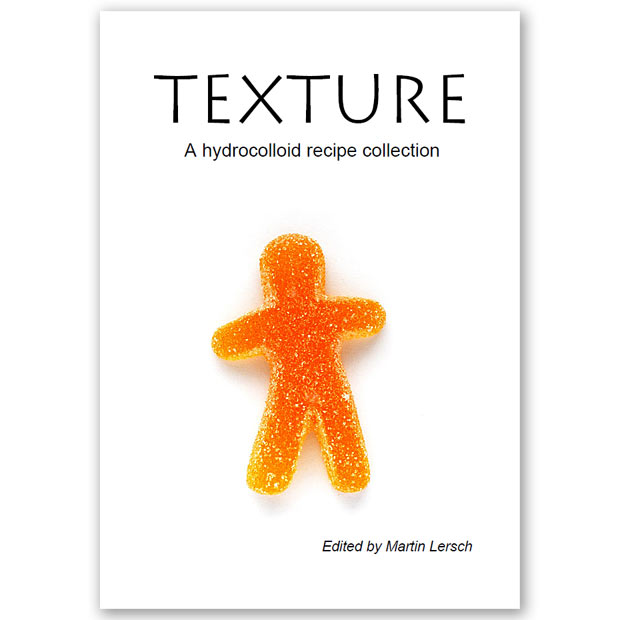
Texture – A hydrocolloid recipe collection (v.3.0, February 2014)
Foreword
A hydrocolloid can simply be defined as a substance that forms a gel in contact with water. Such substances include both polysaccharides and proteins which are capable of one or more of the following: thickening and gelling aqueous solutions, stabilizing foams, emulsions and dispersions and preventing crystallization in frozen products.
In the recent years there has been a tremendous interest in molecular gastronomy, molecular cooking and modernist cuisine. Part of this interest has been directed towards the “new” hydrocolloids. The term “new” includes hydrocolloids such as gellan and xanthan which are a result of relatively recent research, but also hydrocolloids such as agar which has been unknown in western cooking, but used in Asia for decades. One fortunate consequence of the increased interest in molecular gastronomy and hydrocolloids is that hydrocolloids that were previously only available to the food industry have become available in small quantities at a reasonable price. A less fortunate consequence however is that many have come to regard molecular gastronomy as synonymous with the use of hydrocolloids to prepare foams and spheres. I should therefore emphasize that molecular gastronomy is not limited to the use of hydrocolloids and that it is not the intention of this collection of recipes to define molecular gastronomy.
Along with the increased interest in hydrocolloids for texture modification there is a growing skepticism to using “chemicals” in the kitchen. Many have come to view hydrocolloids as unnatural and even unhealthy ingredients. It should therefore be stressed that the hydrocolloids described in this collection are all of biological origin. All have been purified, some have been processed, but nevertheless the raw material used is of either marine, plant, animal or microbial origin. Furthermore hydrocolloids can contribute significantly to the public health as they allow the reduction of fat and/or sugar content without losing the desired mouth feel. The hydrocolloids themselves have a low calorific value and are generally used at very low concentrations. It is indeed surprising that the health benefits of hydrocolloids receive so little attention.
One major challenge (at least for an amateur cook) is to find recipes and directions to utilize the “new” hydrocolloids. When purchasing hydrocolloids, typically only a few recipes are included. Personally I like to browse several recipes to get an idea of the different possibilities when cooking. Therefore I have collected a number of recipes which utilize hydrocolloids ranging from agar to xanthan. In addition to these some recipes with lecithin (not technically a hydrocolloid) have been included. Recipes for foams and gels that do not call for addition of hydrocolloids have also been included for completeness. Some cornstarch recipes have been included to illustrate its properties at different concentrations. However, recipes with other starches have been omitted. Similarly, recipes where flour is the only thickener do not fall within the scope of this collection as these are sufficiently covered by other cook books.
All recipes have been changed to metric units which are the ones preferred by the scientific community (and hopefully soon by the cooks as well). In doing so there is always uncertainty related to the conversion of volume to weight, especially powders. To give an example: the amount of flour in a cup depends on whether the flour is sifted, spooned or scooped into the cup. Conversions up until v. 2.3 were done at http://www.convert-me.com/en/convert/cooking. Starting with v.3.0 all new recipes have been converted from US customary volumetric units with mye volume-to-weight Excel spreadsheet calculator. Hydrocolloid densities are found in the appendix. As far as possible, brand names have been replaced by generic names. Almost all recipes have been edited and some have been shortened significantly. To allow easy comparison of recipes the amount of hydrocolloid used is also shown as mass percentages and the recipes are ranked in an ascending order within each chapter.
When collecting and editing the recipes, obvious mistakes have been corrected. But unfortunately the recipes have not been tested, so there is no guarantee that they actually work as intended and that the directions are complete, accurate and correct. An exception to this are all the recipes which now feature pictures. One motivation for including pictures of the actual recipes was that these may serve as a “proof” that the recipe actually works. Furthermore, in the cases where the source of a recipe is a specific website, this may also be taken as a good indication that the recipes in fact has been tested and works. It appears as if some of the recipes are not optimized with regard to proper dispersion and hydration of the hydrocolloids which again will influence the amount of hydrocolloid used. It is therefore advisable to always consult other similar recipes or the table with the hydrocolloid properties. The recipes have been collected from various printed and electronic sources and every attempt has been made to give the source of the recipes. But there is no guarantee that the source given is the original source of the recipe.
Given the many recent books about molecular gastronomy and modernist cuisine I have certainly asked myself: Is there a need for a revision of Texture? Since you read this I obviously landed on a “yes”. As a toolbox for chefs and amateur cooks I still believe that this collection is unique for several reasons: the ranking of recipes according to the amount of hydrocolloid used, the texture index and the total number of recipes. To the best of my knowledge no other cook books have taken the same approach to collect and systemize recipes this way. And judging by the feedback I have received many chefs and food enthusiasts around the world have found Texture to be a useful resource in the kitchen (to which the 80.000 downloads from Khymos alone also testify). I do not regard Texture as a competitor to the numerous books available, but rather as a supplement. Inspiration for cooking is best sought elsewhere, but if Texture can inspire to experimentation with the texture of foods I believe it has fulfilled its mission.
Since recipes can neither be patented nor copyrighted, every reader should feel free to download, print, use, modify, and further develop the recipes contained in this compilation. Texture is published under a Creative Commons Attribution-Noncommercial-Share Alike license. As long as you include an attribution, don’t charge any money for it and share it under the same conditions – you are more or less free to do whatever you like with the collection (see more details on p. 2 in Texture).
The latest version will be available for download from https://khymos.org/recipe-collection and updates will be announced on Khymos (https://khymos.org) and on twitter (@tastymolecules). Lastly I would like to thank readers for giving me feedback and suggestions on how to improve the collection. Feedback, comments, corrections and new recipes are always welcome at webmaster@khymos.org or by using the contact form.
Martin Lersch, Ph.D.,
Chemist and food enthusiast
Fredrikstad (Norway), February 2014
it is a good information. to be ownest i am not a cooker but i like to read this article and beginning to me to be interested on cooking or brewing. thanks for the articles.
Thank this is i looking for along time
[…] hyytelöintiaineita voi hyvin kokeilla esimerkiksi Khymos.org:n sivuilta löytyviin hydrokolloidiresepteihin. Sinne on eri otsikoiden alle koottu muun muassa agarilla, karrageenilla, maissitärkkelyksellä, […]
[…] baker named ‘tastyTrifles‘ pointed us all at a recipe from a really cool book called Texture: a hydrocolloid recipe collection. That recipe replaced the gelatin with xanthan gum. While it still contained egg whites and […]
hey, stupid question but how do i get the new hydrocollide recipes to print or even up on screen?
I went to a lunch today at Bistro 31 of the international Culinary School that featured Molecular Gastronomy dishes. One of the things they served was a yogurt “egg”. I was give this web site as a place to get recipes. I looked at the recipe collection but did not fian an actual recipe for these wonderful “eggs”. I am completely new to this kind of cooking and need specific directions. Help Please.
[…] is a common ingredient in Japanese confections. I got the idea to use agar in lemon curd from an online cookbook edited by Norwegian gastro-food blogger Martin Lersch. Thank […]
Dear Colleagues Did someone knows the e-mail adress of WD 50 restaurant or his chef owner Wylie Dufresne?
Thank you and a good weekend to all Enrico
Enrico: check out the yoghurt spheres and mozarella beads on p. 53 (in version 2.2) – are they what you are looking for?
Hi Martin,
Thanks so much for sharing this. I can’t seem to be able to open the file to read or print it. Any suggestions? Any help would be much appreciated. Thanks again.
Cheers,
Ed
Wow. This is incredible. Thanks, man! Awesome data source. Loving it.
[…] recipes that Martin Lersch maintains on his Khymos blog. The full collection is available here as downloadable PDFs. The radish jell-o? Also not an original idea but one borne out of necessity, […]
[…] Peep made from her recipe! While reading her post, I clicked on a link for a free PDF download of Texture: A hydocolloid recipe collection, available on Khymos.org. This is a very cool recipe collection that has some rather unusual […]
Thanks Mr. Lersch thanks for this wonderful recopilation of recipes, very useful for all the cooks, your efforts for ressearch and get us closer to the science…
[…] I know how to use all of these, and Martin Lersch maintains *the* hydrocolloid recipe collection on Khymos if I ever suffer from a memory lapse. Now just the question of which items in the […]
Textures is a revelation.
Sincere thanks for such a wealth of information, ardently compiled, and for offering it as part of the Open Source approach to the Web.
I will forward any small successes that I might have, in merging stevia, essential oils and nonfat liquids into the recipes.
Thank you for valuable informations.
[…] I followed all of the instructions, first as outlined in Martin Lersch’s Textures e-book and a second time following Chef Jose Andres’ instructions. I got the exact same result both […]
hi there martin and all awe struck foodies, chippin away at the list and looking good, jus quick question, would u ever think of using dough enchancer (leicten) in any sourdough aspect? Also i have jus made my own birch syrup after a lengthy yet amazing process, only problem is i have no reference flavor and and or recipes that really seem deserved, have u ever dealt with this product at all? little all over the show soz
cheers, love it all
lee, arhus, dk
ps just finshed reading the gastro food report from cope/bristol uni, little hard to grapple but the info was awsome and vry interesting, yet at times seemed to cut short? could of been 500 pages and i’d still be reading, is there a fuller report?
[…] What I consider to be the definitive hydrocolloid recipe collection has now been updated and is free for download in Pdf. format! When i first discovered in interest in using hydrocolloids in the kitchen this was a big first step for me. I plan on showcasing some of the techniques in this collection in the forthcoming months in my new kitchen, once it’s set up and operational 🙂 While some of the compounds and ingredients in these recipes are not readily available I got my methocel and gelatin from Terra Spice Company. Please feel free to share any of your personal experiences with me, because most of mine have ended in failure. You can download it here. […]
[…] class to use. By the way, if you are interested in trying this stuff, the best reference by far is Texture’s. It is a free recipe collection and can be found by click on the link above. It is really pretty […]
[…] con el primero, Texture v2.3. Martin Lersch de Khymos’ Blog ha actualizado su libro “Texture – A hydrocolloid recipe collection”, un manuscrito, del que ya os he hablado en el blog alguna vez, que viene repleto de recetas y […]
[…] You can find out alot more (where i got most of this info) via this great primer of hydrocolloids on Khymos.org. […]
thanks!! i just got what i want!! thanks again for sharing this!!
[…] – probably the best blog on molecular cuisine. Also publishes an open hydrocolloid recipe collection with enough recipes to get you […]
I am very happy that I found such fanthastic blog!
Before two years I began my own experiments with thickeners/gelling agents and I didn’t knew nothing about MG.
And this blog – exactly what I need for my searhing and experiments.
[…] Free dowload PDF of hydrocolloid recipes Khymos […]
Great resource! Informative and inspiring. I will try to submit some photos. Hours of happy experimentation await.
[…] I used this recipe for Turkish delight which I originally found on the Hydrocolloid Recipe Collection. It uses agar as the gelling agent and appears relatively easy to prepare (that’s why I tried […]
I’ve seen that you’ve written on http://blog.rewirpower.de/index.php/2007/08/19/molekularkuche-rezeptsammlung-hydrokolloide-zum-download/ in German. could you maybe translate the recipe collections into German? that would be really great! 🙂
Yes – I do speak German. But no, I’m sorry to inform you that there are no plans for a German translation. Unless some volunteers to do it. The collection is published with a Creative Commons Attribution-NonCommercial-ShareAlike license, so anyone is free to translate 🙂
[…] the fabulous Texture – A Hydrocolloid Recipe Collection which is put together by Martin Lersch at his Kymos blog, which has amongst it’s extremely […]
[…] different sizes so that each sheet will gel to the same degree, regardless of bloom strength.) The hydrocolloid recipe collection at Khymos has a great overview of bloom strength, and is worth reading for more information on […]
Hi,
I want to make edible flavoured bubbles, like what kids use ( water, detergent soap) do you have any ideas, i want a bubble machine to be able to blow them out, this is just a mad idea i had , need to research it some more, it you can help it would be most appreciated it
[…] only the most basic understanding of their differences. Arbitrarily, I grabbed LM pectin, which the Texture handbook tells me gels in the presence of calcium. I have some Calcium Ascorbate (buffered […]
[…] chocolate, I tried to salvage the ganache by adding 0.5% xanthan gum, the lowest percentage Khymos recommends for thickening. With stirring, it started congealing, but unlike a creamy starch-thickened […]
Found a grammar mistake on page 70, under Cream cheese noodles.
“Mixture should be consistency of heavy cream, if to thick, thin out with a little more water.”
It should be if “too thick,” with two ‘o’.
No mention of Tara Gum in your list… or I missed it..
[…] the beginning food hacker there are few resources better than Khymos’ blog and PDF hydrocolloid recipe book. Ingredients can be bought from Willpowder or Le Sanctuaire, among others. Don’t fall into […]
New to website. amazing info right!!! Kind of off the subject, but I Looking for molecular minded professional in San Francisco area to collaborate with.
Hi, thanks for the information.
Excellent document full of useful information.
Just one request. Could you include a simple table of suitability for each product and recipe type for us ‘non food professionals’. I would like to use some of these products as a substitute for starch based products but know nothing about which are most suited to each type of recipes, e.g. Ice cream, Cold puddings, Cold puddings containing alcohol, Hot sauces such as tomatoes based, Hot sauces containing cream, etc…
SandyM: My best suggestion is to use the index where you see a list of the different possibilities with each hydrocolloid.
[…] möglichst viele verschiedene Arten zu deklinieren. Das Rezept hier beruht auf der Version aus der Hydrokolloid-Rezeptesammlung von Martin […]
Thank you so, so much for making this available to everyone!
[…] For an absolute wealth of information on molecular gastronomy, including a free, downloadable pdf packed with recipes and how-to’s, visit Khymos.org. […]
Is not there any spanish translation?
No – unfortunately not 🙂
[…] Recipe collection […]
Hi
First of all, thank you for such a marvellous resource – fascinating and I have had plenty of success with a number of the recipes.
But I struggled completely with the Olive Oil Sponge – mine came out smelling like an omelette and was a sunken & rather sad sponge with no shape!! Looked very good going into the iSi siphon – any ideas where it might have gone wrong??
Best regards, Daniel
[…] http://blog.khymos.org/recipe-collection/ […]
Nice set of recipes. Surprised not to see potato starch in there, given that corn starch was. Potato starch is quite popular in Russian cooking and has a lot less flavor than corn starch. Kissel could be a reference item.
[…] recipes, THE definitive collection of molecular gastronomy recipes at the moment is available from Khymos. Best of all, it’s […]