

I blogged about carbonated strawberries some while ago. Those were made using dry ice which unfortunately is not always easy to get hold of. Last week however I bought a iSi Gourmet Whipper – one of those Ferran Adria uses to make foams/espumas. I plan to experiment with that as well, but the first thing I decided to prepare was carbonated fruit. In fact this is a safe way (the only?) to make carbonated fruit at home using a pressurized container.
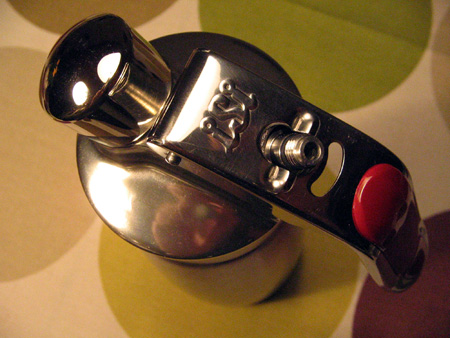
The instruction booklet which comes with the iSi Gourmet Whipper only mentions cream chargers (filled with N2O, dinitrogen oxide), whereas soda chargers (filled with CO2, carbon dioxide) are not mentioned (I guess the opposite is true for the iSi Siphons?). This is quite amazing actually! Luckily however the cream and soda chargers are exactly the same size and both hold 8 g of gas. So it should be possible to make carbonated fruit with any of the iSi whippers (cream, easy, gourmet, dessert, thermo) or siphons available.
Here’s how you proceed:
- Fill you iSi whipper (or siphon) with fruit, preferably fruit which has a cut, wet surface to allow the carbon dioxide to dissolve in the water/juice.
- Screw on top securly
- Charge with one soda charger (two if you have the 1 L whipper)
- Leave in fridge over night
- Release pressure with valve (Important!)
- Unscrew top and serve immediately!
- Enjoy!
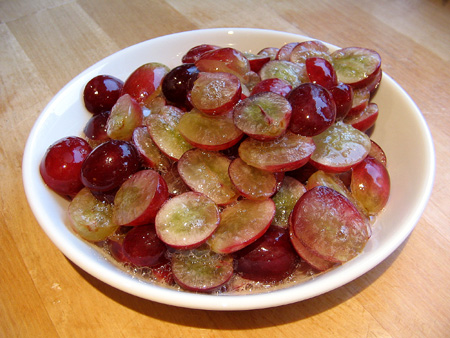
This is what carbonated grapes look like. As you see, I decided to cut the grapes in to halves.
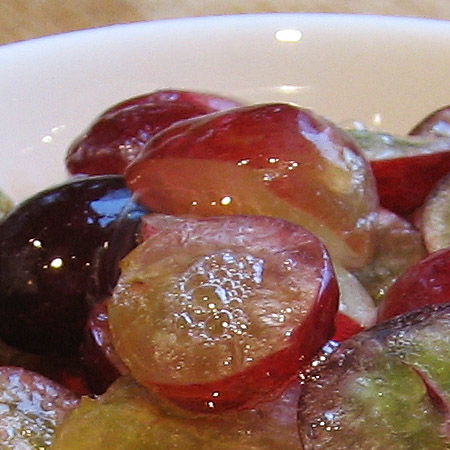
Notice how they sizzle!
A quick recap of the chemistry: cold water dissolves more CO2 than tempered water, that’s why we leave it in the fridge. Also, remember that it takes some time for the carbon dioxide to dissolve in water, therefore it’s better not to be in a hurry. A quick calculation of the pressures gives the following: Both gases have molecular weights of 44 g/mol, so 8 g of gas corresponds to 0.1818 moles or 4.1 L at 25 °C and 1 atm pressure. The volume of the chargers is 0.01 L which gives an initial pressure in the chargers of impressive 445 atm! With an approximate volume of 0.7 L this gives a pressure (in an empty whipper) of nearly 6 atm – the same as in a bottle of champagne. However once you add water, the equilibriums will change and the pressure in the head space will drop. Anyone who remembers how to calculate the head space pressure at equilibrium if the container is filled with 0.5 L of water and cooled to 4 °C?
I’ve done some googling and there is also some mention of making carbonated fruit with an iSi whipper over at Ideas in food.
(The word play in the title works better for those with a mother tongue where iSi would be pronounced just like “easy”!)
hey martin, these look yummy and fun ! there is a company here in the u.s. called Fizzy Fruit which sells carbonated fruit. they have a patent on the process.
they told me that they’re not selling their product in new york … yet ….
how did your grapes taste ?
They taste very nice! The sparkling/prickling sensation is different from drinking a soda – more concentrated in a way. The dissolved carbon dioxide makes the grapes more tangy. You should try it!
Thanks for tipping me about Fizzy Fruit. I saw that Homaru Cantu has provided them with recipes using carbonated fruit. More on this in this blogpost.
Have you tried carbonating anything besides fruit (and berries)?
No, not yet! I’ve read about carbonation of alginate spheres at eGullet, so I’ll try that sometime. Any other suggestions?
I just tried in the in my brand-new 0,5 l iSSi Gourmet Whip carbonated quartered strawberries [250 gram] combined with Creme de Cassis [0,5 dl]: surprising. Thanks for the idea.
I tried carbonating a few slices of veal (carpaccio thin slices). Interesting, but not much more 🙂
Martin,
I’ve got a quick question I’m hoping either you or your readers could help me with.
I’m looking to get an isi whipper myself, though the local kitchen shop doesn’t sell the “gourmet” series, only the “dessert”. Do you (or anyone reading this) know what the differences between the two are?
Thanks.
Gourmet version can be heated in a bain marie up to 75 °C, even after you have charged it with two chargers, so it can takle somewhat higher pressures than the dessert whip which (I guess) should not be heated. The gourmet version is all-stainless-steel and dishwasher proof. I don’t own a dessert version, but I guess the bottle is made of aluminum, so it’s not suitable for dishwashers.
Thanks Martin,
I just received an email from ISI essentially saying the same thing:
The Dessert Whip is not the model you need. It does only cold whipped
cream applications and is not dishwasher safe.
You need either the Gourmet Whip or Thermo Whip. They both do hot and
cold applications as well as Espuma, light sauces and soups. They are
both dishwasher safe and stainless steel for more durability. The Thermo
Whip is also insulated so you do not need to refrigerate as often or
have warming in a water bath.
Keep up the great work,
-gb.
ive carbonated several fruits and i have found that more firm fruits work better… the pressure seems to crush softer fruit, leaving them mushy. also water content of the product should be considered, “dryer” fruit doesnt seem to have the same fizzle as the more moist ones… my favorite thing to carbonate has been gelle…. it appears as though nothing has changed, but when you press it against your pallate it feels amazing (carbonated peach nectar gelle “bellinis”). chef tetsuya @ minibar is carbonating reverse sfers of mojito.
my only concern or ? is the practicality of this technique in restaurant application. the fruit or gelle loses its zing rather quickly…. i dont like flat soda? any ideas? (cost effective ones) id rather not open my siphon for one order anf then waste a charge to keep it pressurised, when i might or might not get another order for them in 1 minute?
as far as the whippers go, its the seals that really differ. ive got a thermo, a profi and a gourmet… the thermo is by far my fave, and on ebay they go for
sorry…
very little difference in price as long as you keep your eyes on the auctiuons.
Out of curiosity Martin, would it be possible to make crackling sugar (space dust) using an iSi whipper. As the sugar is carbonated, i assume it could be done the same way as with the fruit.
From what i’ve seen, the sugar crystals are then coated in cocoa butter.
If crackling sugar is the same as pop rocks, no. It requries pressures around 40 bars. The maximum allowed pressure in a 0.5 L whipper is around 12 bars at room temperature (corresponds to two chargers). There was a question about pop rocks last year on the molecular gastronomy discussion list (which BTW has been nearly dead no for a while). Here’s a copy paste from my reply:
Short version: Hot sugar syrup mixed with carbon dioxide at high pressure. When the candy is cooled and the pressure is released, the candy shatters – but some bubbles of carbon dioxide are retained, giving a prickling sensation when eaten.
More extensive explanation (includes link to the patent):
http://home.howstuffworks.com/question114.htm
I brew beer at home and have a keg setup (Cornelius kegs which were once used for soda prior to the switch to syrups). I was thinking about filling up the keg with fruit and then pressurize it with CO2 to achieve the very same effect as what you guys have done with the iSi whip. The kegs hold 5 gallons, can be re-pressurized using a CO2 tanks, and are stainless steel. Any idea how many pounds of pressure are necessary to achieve the carbonated fruit?
Sounds to me like a better method for large scale consumption. Any thoughts?
You don’t need a high pressure to make carbonated fruit, but the amount of carbon dioxide that dissolves in the fruit will be proportional with the pressure you use. If you check out the first link in the blogpost you can read about strawberries that were carbonated at ambient pressure using dry ice. In other words, filling the keg with fruit and simply flushing it with carbon dioxide will bring you a long way.
The other day I tried to carbonate strawberries using the iSi whipper. This result was a complete mess, because the strawberries more or less exploded the moment I released the pressure, leaving a sticky mess. The situation was worsened by the fact that the valve got partly clogged by the strawberries, so at one point I simply had to unscrew the top very carefully while the container was still partly under pressure (be VERY carefull if you need to do this – read the instructions in the manual). The result was sticky strawberries shooting out!
The reason for this is that a larger amount of carbon dioxide had dissolved in the strawberries under the higher pressure. Once the pressure is released, the carbon dioxide inside the strawberries starts to expand. As is obvious from the blogpost, it seems that grapes can withstand a much higher internal pressure, so they are more or less intact. I should add that the strawberries I used were very ripe, so next time I try this with strawberries I’ll use less ripe onces. I might also release some of the pressure from the start so less carbon dioxide will dissolve in the strawberries. Perhaps I’ll also leave them pressurized for a shorter time. As you see there’s many options!
If you plan to make a large batch you should remember that once removed from the carbon dioxide atmosphere, the fruit won’t stay fizzy for very long. Keeping the fruit cold helps, but it should be consumed within 10 minutes or so.
I tried strwberries and raspberries in a isi whipper, Nothing happened with the strawberries, but the raspberries came out great.
This is absolutely fascinating! I think I’m going to try this with some nectarines and framboise liquor.
Your blog is lovely and inspiring!
[…] professional chef: a whipper which you can charge with either carbon dioxide (for instance to make carbonated fruit) or dinitrogen oxide (too make foams/espumas or simply whipped cream). For the Pros: The Sealer […]
Is there a point where you can have too much fruit inside where there won’t be enough co2 to go around?
When filling the whipper with liquid, there is a maximum limit. The 0.7 L whipper should not be filled with more than 0.5 L of liquid. However, if you fill it with fruit, there will always be some pockets of air in between, so this isn’t really a problem.
Actually, what is the relationship between Physics and the way to make carbonated fruit?
Can you answer me within this week, please?
Because I’m working on a project about your great method.
thank you for your help
Wayne,
You ask about the relationship between Physics and the way to make carbonated fruit. I’m not quite sure what you are after here, but making carbonated fruit can be used to illustrate a lot of interesting physics and chemistry.
For instance the solubility of gases in water and how this varies with temperature and the partial pressure of the gas. Furthermore we have a gas (CO2) which reacts with water forming carbonic acid. Chemists would say that dissolved CO2 is in equilibrium with H2CO3. One can discuss diffusion of CO2 into the grapes – this takes some time and one could do several parallel experiments to see how long the grapes should be pressurised to allow the CO2 to diffuse into all of the grape. When the grapes burst open when the pressure is released this is because the pressure inside the grapes is higher than the ambient pressure once the can is openend. The skin can only withstand a certain pressure, so if the internal pressure of the grapes is to high they will burst open. I’ve also done this with strawberries – and they completely disintegrated!
After you have loaded the CO2 and remove the CO2 cartridge you might notice that it’s quite cold. This is because the gas expands as the cartridge is emptied. The same principle applies both for a refridgerator and an aircondition.
So – it’s a simple experiment, but the grapes are fun to eat, but as you see – you can discuss a lot of science based on this experiment!
Does anyone know if the isi gourmet whipper can accept standard 12 gram co2 cartridges?
You should only use the iSi chargers. Both the CO2 and the N2O chargers hold 8 g of gas.
Has anyone ever tried harder fruits like apples? Maybe fresh pineapple? Im always looking for new ways to have fun with my customers and clients and the whole carbonated fruit idea intrigues me.
[…] are just some of the many elements that come into play when we eat. This idea was borrowed from Martin L. from Khymos. As far as I know, he invented the execution of the idea, but probably not the concept of fizzy […]
How about using dinitrogen N2O chargers. Will it give the same effect?
Quoting from the CE&N blog:
hi martin, really interesting to read ur piece of writing, do you have any idea how to prolonged the fizz in the fruit so maybe can be put in restaurant menu..thanks
Question for you all… have you all been using iSi Gourmet Whip with CO2 Chargers? Everything I have been reading is that this model should only be used with N2O chargers. This article suggests it should be possible to use it with CO2. Can anyone confirm that it does indeed work? Or are you all using soda siphons instead of cream siphons? If you have been using the Gourmet Whip with CO2, does this only work for this application or is it also possible to make other carbonated applications that are expelled from the siphon? Hope this all makes sense and that someone can give me some advice. Much appreciated.
dmdjd: N2O and CO2 chargers are exactly the same size and they hold the same pressure. You can use them interchangeably with any whipper or soda siphon from iSi.
You can use the CO2 chargers to make carbonated fruit with a whipper, and you can use N2O chargers to make a different kind of sparkling water in a soda siphon (or a whipper if you don’t have a siphon).
Be aware though that CO2 and N2O are quite different chemically speaking. CO2 is more water soluble, and also reacts with water to give carbonic acid which lovers the pH – that’s why it is not used for whipped cream.
Can i just say how much i have loved reading your blog! I teach high school juniors and seniors Culinary Arts in VA. We have been following your blog and doing some of the molecular gastronomy experiments. Carbonated Fruit is our next fun experiment. Thanks for bringing molecular gastronomy down to a level that we can all enjoy and understand!
I just bought a Profi whipper and I was wondering if you can put hot liquids in it. Would it crack or would it not hold the heat like the thermo and the gourmet? Thanks
This technique works great with cherry tomatoes as well.
@ Martin and other readers,
Dear all,
I’m until recently in the possession of a Isi Gourmet Whip 0.5 liter and I’m experimenting with this model a lot. And I would love to experiment with the fruits inside the syphon. But I spoke with ISI today, and they told me that it isn’t wise to do it since the syphon would turn black in the inside due to the reaction of the metal with the CO2 charger.
Does anyone have experience with this? And does this affect further use of the Isi syphon? I hope to hear soon from you since I would love to try it out?
Thanks
I just read an entry where it said that the Nitrous Oxide and CO2 were interchangeable.
True they are the same shape.
However unless things have changed since I first tried an experiment (ok it was a mistake) in the 90’s I charged an Isi with cream with a bulb from a Soda Syphon.
The Cream was whipped but it had a carbonation mouth feel. Very different to the whipped cream mouth feel of the normal Isi output.
As I said things may have changed.
Does anyone have an idea as to the actual pressure in an Isi (after discharging one or two capsules) and related to that any idea as to the pressure in a Soda Syphon?
Stefan: the cheaper siphons are aluminum, the more expensive ones are stainless steel. It’s true that fruit acids can change the color of the aluminum. If you’re concerned with this, get the stainless steel version (thermo or gourmet).
John: The cartridges are interchangeable when talking about size, but of course not with regards to function/chemistry. CO2 will always give carbonation and a lower pH which is not suiteable for whipping cream. NO2 on the other hand is more fat soluble, gives no carbonation and is well suited for whipping creams and foams.
The reason I point out that the chargers are the same size is that according to iSi, the CO2 chargers are used with the siphons and the NO2 chargers with the whippers. If you want to make carbonated fruit you’ll want to use the CO2 in a whipper.
Hey Martin,
Thanks for the tip. I had the gourmet version already and I tried some cherry tomatoes out with a balsamic vinegar. Great pleasure of eating it, especially with some good olive oil on top! Thanks for the great tip!
[…] lang tid siden læste jeg det her indlæg på khymos.org (http://blog.khymos.org/2007/04/09/carbonated-fruit-the-isi-way/ ) og siden har jeg gået og haft løst til at prøve noget lignende. Kulsyre i bær.og så bare […]
$150 on that ISI bad boy, huh? Ever play marbles. If you’re not approaching 60-yrs of age, you probably haven’t. I was never any good at marbles anyway. One thing I’ll never forget is the rough size of a marble. Most AirGas stores and other commercial/industrial gas supply stores have a big bin of co2 that’s frozen (Dry Ice® is a registered trademark name). Here’s a picture of some: http://upload.wikimedia.org/wikipedia/commons/thumb/3/36/Dry_Ice_Pellets_Subliming.jpg/200px-Dry_Ice_Pellets_Subliming.jpg The piece in the lower right hand corner is roughly a marble-sized piece. It will fit EASILY into a 2L or 3L soda bottle. Grapes and even medium sized strawberries fit nicely in 3L bottles. You can probably get a free 3L bottle. But if you must, go to any Food Lion grocery store and buy a 3L bottle of their store brand soda for a dollar. Go home. Since it’s bad for you, pour the soda in the toilet or kitchen sink (whichever is more sanitary). Rinse the bottle. Put in your fruit & toss in the co2 marble. Cap it & lay the bottle on it’s side on the kitchen counter. Keep in a cool place for 24-hrs. Uncap & enjoy immediately. There now. I just saved you $150. Go buy your wife, hubby or best friend a Fizz Giz.
[…] crazy meats, but his infusion technique has my mind bubbling . Now, you may be aware that you can carbonate fruit using an ISI foamer with CO2, as the estimable Martin Lersch pointed out a few years ago. But what Dave Arnold is doing is […]
I’m looking for teachersarah from VA. I would like to share some stuff with her. I am a Chef lecturer in the UK. i have done some MG work with my students and have designed a Molecular Cookery course that we will run in the new year.
Please get in contact.
Thanks
Danny